
Client
Issues
The bank’s management was concerned that it was losing ground in terms of innovation and customer satisfaction. Market research indicated that its digital banking services were not as user-friendly or feature-rich as those of competitors, leading to a slow erosion of younger, tech-savvy customers. Additionally, the bank’s cost-to-income ratio was higher than industry benchmarks, hinting at operational inefficiencies. The client lacked clear insight into competitor strategies: how other banks were achieving lower costs, higher loan growth, or better customer retention. Without concrete data and analysis, internal improvement efforts were proceeding in the dark, potentially focusing on the wrong areas. There was also a need to challenge internal complacency; by revealing gaps between the client and its top competitors, leadership hoped to galvanize the organization around change. However, obtaining reliable and detailed comparative information posed a challenge, given the sensitive nature of banking data and varying public disclosures.
Solution
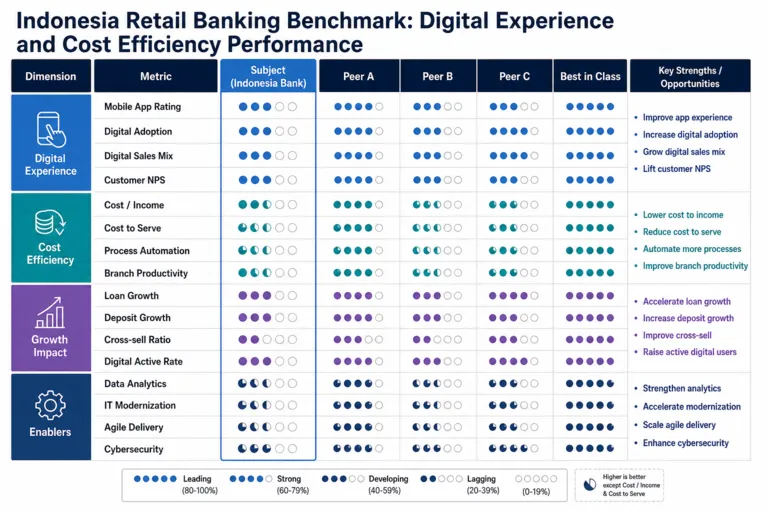
Eurogroup Consulting devised a structured competitive benchmarking project focusing on key dimensions of the bank’s performance: customer experience, digital capabilities, product portfolio, financial efficiency, and innovation. The solution involved gathering data on competitors through a mix of public sources, mystery shopping, and industry expert interviews. For customer experience, the consulting team conducted surveys and usability tests, comparing the client’s services (like mobile app and branch services) with those of leading banks and fintechs on ease of use, features, and customer satisfaction scores. In assessing digital capabilities and innovation, they benchmarked metrics such as online account opening time, availability of advanced features (e.g., AI chatbots, mobile payments), and rate of new product introduction. The product and pricing comparison covered interest rates, fees, and product terms across loans, deposits, and investment products. Operational efficiency was benchmarked using financial reports and analyst insights to compare cost ratios, revenue per employee, and asset yields. Eurogroup Consulting synthesized this data into a benchmarking report highlighting where the client led, met, or lagged behind peers. Importantly, for each gap identified, the team outlined strategic initiatives or best practices drawn from the top performers that the client could adopt – such as process automation for cost reduction, a revamped mobile app design for better user experience, or new partnership models to offer innovative services.
Approach
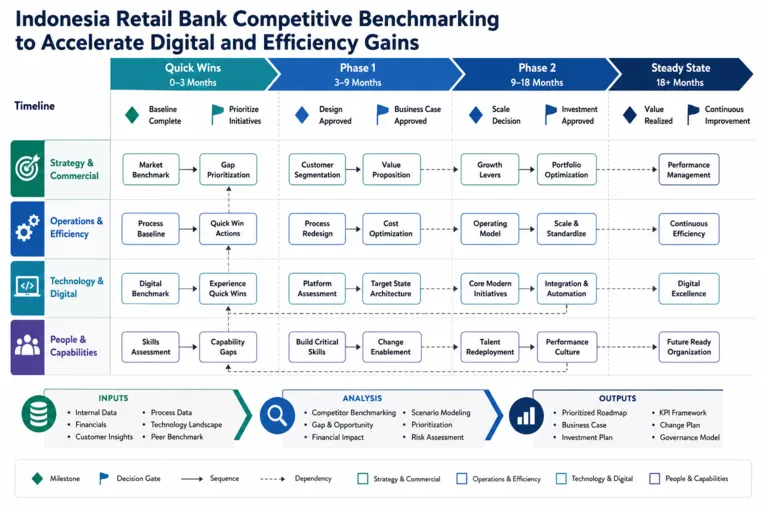
The benchmarking study was executed in phases over a few months. Initially, Eurogroup Consulting worked with the bank to identify a set of peer institutions and relevant fintech companies to include in the comparison, ensuring a mix of direct competitors and industry exemplars. The data collection phase followed, where consultants compiled financial and operational data from annual reports, regulatory filings, and market research databases. They also engaged a small team of mystery shoppers to evaluate in-branch and digital experiences of the client versus competitors, documenting aspects such as service speed, staff knowledge, and ease of use of digital tools. Interviews were conducted with industry analysts and former banking executives to gain qualitative insights into the practices behind the numbers – for example, understanding how a competitor achieved a particularly low cost base or high digital adoption among customers. The consulting team analyzed this information and created benchmarking dashboards that visualized the performance differences across key metrics. In the final phase, workshops were held with the client’s leadership and department heads to present the findings. Eurogroup Consulting facilitated discussions to delve into root causes of the gaps and brainstorm potential solutions. The outcome was a prioritized action plan aligned with the benchmarking insights, co-developed with the client’s input to ensure feasibility and buy-in.
Recommendations
Based on the competitive benchmarking results, Eurogroup Consulting made targeted recommendations to the bank. One major recommendation was a digital transformation initiative: investing in a new mobile and online banking platform with an improved user interface and adding features that competitors offered (such as personal financial management tools and seamless QR code payments) to win back tech-savvy customers. To address cost inefficiency, a recommendation was to implement process automation and consider outsourcing non-core back-office functions, inspired by competitors who had leaner operations. Enhancing data analytics capabilities was also advised, enabling more personalized product offers and risk management, matching industry leaders who successfully leveraged customer data. Eurogroup Consulting suggested a revamp of the bank’s product portfolio and pricing strategy – for instance, introducing flexible loan products or bundling services to increase customer loyalty, reflecting trends observed in competing banks. Additionally, the bank was encouraged to foster a culture of innovation internally, perhaps by setting up a small innovation lab or partnering with fintech startups, to stay ahead of emerging trends. Regular benchmarking was recommended as well: by institutionalizing an annual benchmarking review, the bank could continuously track its progress relative to the market and adjust its strategies proactively.
Engagement ROI
The competitive benchmarking project proved to be a catalyst for meaningful changes within the bank. Armed with a clear picture of where it lagged behind, the bank launched a series of improvement projects that delivered notable results. Within a year of implementing recommendations, the bank’s mobile app was relaunched with a significantly improved design and new features, leading to a sharp increase in user satisfaction ratings and a growth in digital transaction volumes. Operationally, the bank managed to reduce its cost-to-income ratio by a few percentage points through process optimizations and selective outsourcing, directly improving profitability. The introduction of new products and customer-centric services, such as a zero-fee digital savings account aimed at young adults, helped in attracting a wave of new customers and slowing the loss of market share. Moreover, the benchmarking exercise had an internal cultural impact: employees became more open to change and innovation when they saw concrete data on competitors outperforming them, creating a sense of urgency and collective purpose to strive for excellence. The bank’s leadership used the benchmarking insights as a baseline to set new performance targets and as a narrative to communicate the need for transformation. Overall, the engagement not only identified where and how the bank could improve but also set in motion a successful transformation journey, enhancing its competitiveness in the fast-evolving Indonesian banking sector.