
Client
Issues
The company’s growth was constrained by its limited distribution capabilities outside top-tier cities. Without direct presence or partnerships in many provinces, the client’s products were not readily available to a large segment of potential customers, ceding market share to competitors with wider distribution. The existing distribution partners the company did have were few and often lacked the incentive or capability to push the client’s products over other brands. Additionally, the client had limited insight into local market dynamics in smaller cities, resulting in a one-size-fits-all sales approach that did not account for regional differences in consumer behavior and retail structures. Managing logistics in remote areas was also a challenge, leading to higher costs and inconsistent product availability when attempts were made to serve those markets directly from central warehouses. These distribution gaps and inefficiencies hindered revenue growth and left the client vulnerable to aggressive competitors who could quickly fill the void in underserved areas.
Solution
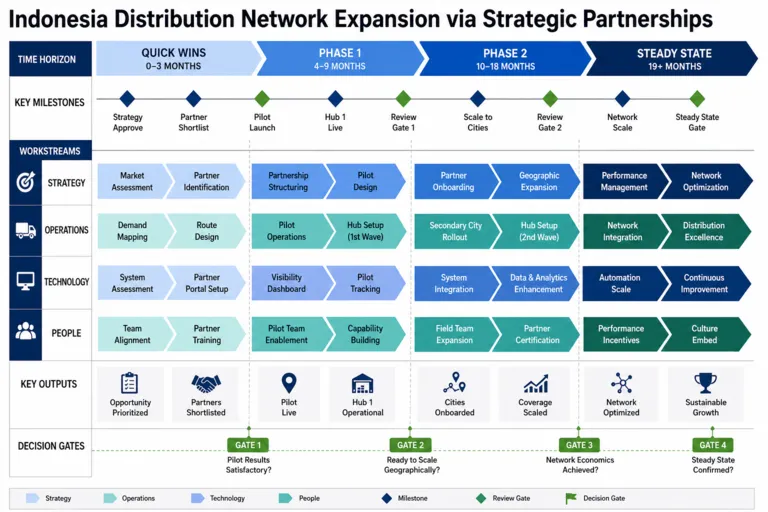
Eurogroup Consulting developed a distribution expansion strategy centered on identifying high-potential partners and structuring win-win partnership models. The engagement started with a market mapping exercise to pinpoint key regions and cities where demand for the client’s products was strong but current availability was weak. Within those target areas, the team identified potential distribution partners – including regional wholesalers, established local retail chains, and e-commerce platforms – that had the infrastructure and market know-how to effectively carry the client’s products. The consulting team then designed partnership frameworks tailored to each type of partner. For traditional distributors and retailers, this included developing incentive programs such as volume-based rebates, co-marketing funds, and exclusivity arrangements to motivate them to prioritize the client’s products. In parallel, Eurogroup Consulting helped the client create a value proposition for potential partners, highlighting how carrying the client’s innovative and reliable electronics could fill a gap in their product lineup and drive mutual growth. The strategy also entailed optimizing the logistics model: setting up regional hubs or using third-party logistics (3PL) services to ensure timely delivery of products to partners across Indonesia’s islands. To support execution, the consulting team created a dedicated partner management playbook, outlining processes for joint business planning with partners, performance monitoring, and providing technical training or after-sales support to partners as needed.
Approach
The project approach was collaborative and data-driven. Eurogroup Consulting began by analyzing sales data and market research to identify underpenetrated regions with high sales potential. They also conducted interviews with stakeholders in the distribution sector to understand the capabilities and reputation of various potential partners. Once promising partners were shortlisted, the consulting team reached out to initiate discussions, effectively acting as a mediator to gauge interest and gather feedback on what would make the partnership attractive. Using these insights, they helped the client craft compelling partnership proposals. A pilot phase was executed where a couple of new partnerships were formed in one region to test the approach. Eurogroup Consulting guided the client in negotiating terms and setting up operational processes with these initial partners, including integration of ordering systems and establishing inventory replenishment routines. The pilot’s performance (sales growth, partner engagement levels, logistics efficiency) was closely monitored and lessons were documented. The strategy was then refined and scaled up to other regions, with the consulting team supporting the client’s new distribution team in rolling out the partnerships systematically. Regular project meetings ensured that the client’s management stayed informed of progress and could provide input or resources when necessary. By the end of the engagement, the client had a clear framework and the internal capability to continue building and managing a broad distribution partner network.
Recommendations
To maximize the benefits of the expanded distribution network, Eurogroup Consulting made several recommendations to the client. It was recommended to institutionalize a dedicated distribution partnership manager role or team responsible for maintaining relationships, tracking partner performance, and providing ongoing support. The client was advised to continue tailoring its approach to different regions – for example, by allowing partners flexibility in marketing tactics or product mix to suit local preferences, as long as overall brand standards were maintained. Eurogroup Consulting also suggested implementing a joint performance review with major partners on a quarterly basis, using sales data and market feedback to address any issues and identify growth opportunities collaboratively. Investing in a robust distributor management system was another recommendation, to streamline order processing, inventory tracking, and communications with all partners in real time. Additionally, the client was encouraged to consider partnerships beyond traditional retail; exploring collaborations with online influencers for social commerce or bundling products with complementary goods through alliances with other local manufacturers could further boost market penetration. Finally, it was highlighted that nurturing trust and reliability is key – ensuring consistent product supply, prompt after-sales support, and honoring incentive commitments would solidify long-term partner loyalty and success.
Engagement ROI
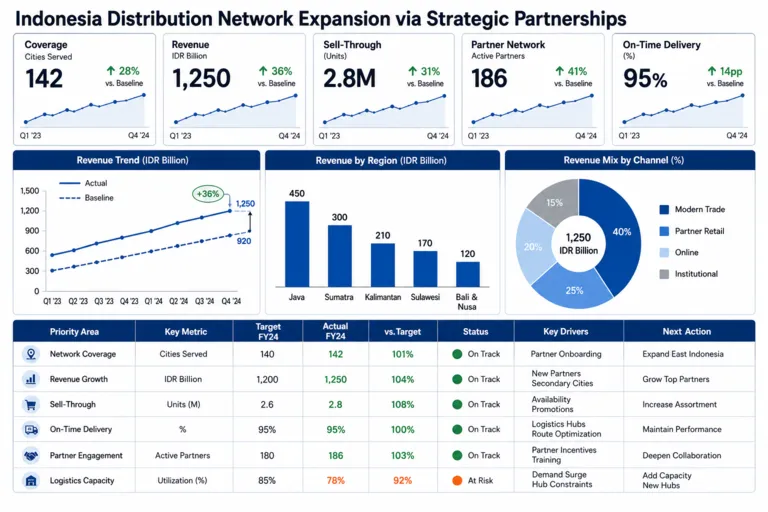
The distribution and partnership initiative significantly bolstered the client’s market coverage and sales growth. Within a year, the company expanded its presence to dozens of second-tier cities and even rural areas through a network of new distribution partners, doubling the number of outlets carrying its products. This expansion drove a considerable increase in sales, with some previously untapped regions contributing substantial new revenue streams. The strategic incentive programs put in place resulted in engaged partners; many distributors actively promoted the client’s products, leading to improved shelf placement and local marketing efforts that raised brand visibility. Logistics became more efficient as regional hubs and 3PL partnerships cut delivery times and costs, ensuring that even far-flung retailers received products in a timely manner. The client also benefited from local market intelligence flowing in from partners, enabling it to refine product offerings (such as introducing region-specific product bundles) and marketing strategies to better suit local tastes. Internally, the company’s new focus on partnership management led to faster resolution of issues and more agile responses to market changes, as they were now closer to the end customers. Overall, the project delivered a strong return on investment by unlocking new markets and accelerating sales, demonstrating the power of strategic partnerships in overcoming distribution challenges in Indonesia’s expansive archipelago.