
Client
Issues
The healthcare provider was struggling with uneven service quality and operational bottlenecks across its facilities. Patients frequently experienced long wait times for consultations and treatments due to inefficient appointment systems and resource allocation. The lack of an integrated hospital information system resulted in fragmented patient records and duplication of tests, hindering continuity of care. Additionally, administrative processes were largely manual and error-prone, consuming staff time that could be devoted to patient care. These challenges were intensified by limited staff training in modern healthcare management practices, leading to inconsistent patient experiences and lower satisfaction scores.
Solution
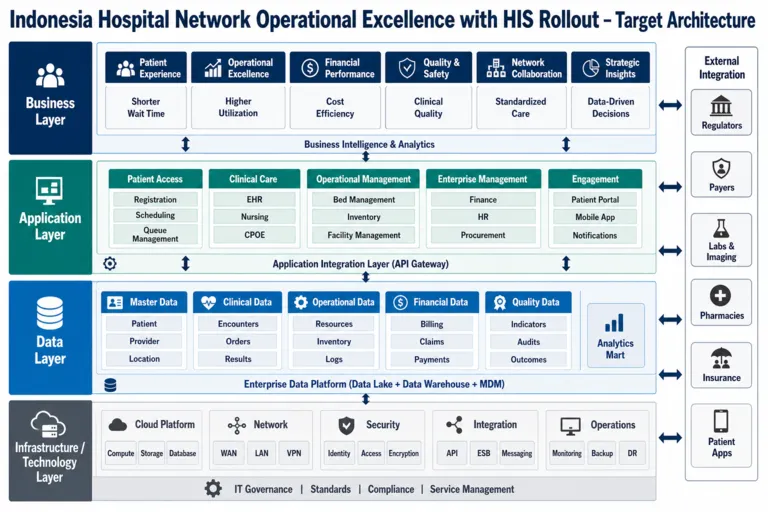
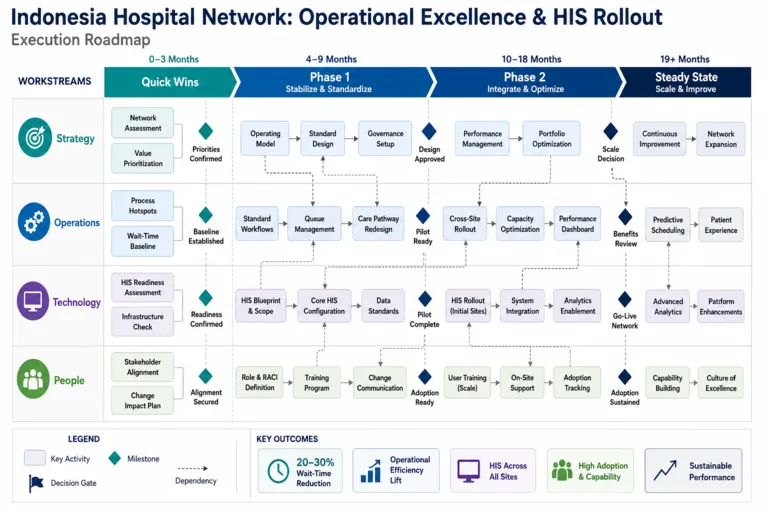
Eurogroup Consulting formulated a hospital operational excellence program built on process re-engineering, digital integration, and staff empowerment. The solution began with the deployment of a unified Hospital Information System (HIS) connecting all facilities, enabling real-time access to patient records and smoother referrals. Process improvements were introduced in patient flow management – including a revamped appointment scheduling system and triage protocols – to shorten waiting times and optimize use of medical staff. The consulting team also implemented lean management techniques in administrative and billing processes to eliminate redundancies and reduce errors. To support these changes, comprehensive training sessions were provided for doctors, nurses, and administrative staff focusing on patient-centered care, use of the new digital tools, and continuous improvement methodologies.
Approach
The project kicked off with a detailed assessment of hospital operations, collecting data on patient wait times, resource utilization, and workflow inefficiencies. Eurogroup Consulting worked closely with hospital leadership and frontline staff to map out existing processes and identify pain points. A multidisciplinary task force was established to champion the changes, ensuring buy-in at all levels. The consulting team then rolled out the new HIS in phases, starting with a pilot hospital to test and refine the system. Concurrently, process re-engineering initiatives such as streamlined admission and discharge procedures were piloted, with iterative adjustments based on feedback. Regular training workshops and coaching were held on-site to help staff adapt to new technologies and workflows. Over the course of the implementation, performance metrics (like wait times and patient feedback) were continuously monitored, guiding further refinements and ensuring the improvements translated effectively to better patient care.
Recommendations
To sustain the gains from the operational overhaul, Eurogroup Consulting recommended that the hospital network establish an internal Continuous Improvement Unit. This unit would be responsible for ongoing monitoring of key performance indicators, facilitating regular staff training, and driving further innovations in care delivery. Investing in advanced analytics was also suggested, so the network can leverage patient data to predict demand and allocate resources proactively. Additionally, it was advised that the client continue fostering a culture of patient-centric care through regular feedback collection and community engagement programs. By remaining agile and responsive to patient needs, the hospital group could maintain high satisfaction levels and service quality across all its facilities.
Engagement ROI
The hospital network saw remarkable improvements following the engagement. Patient wait times in pilot facilities dropped by nearly 40%, directly boosting patient satisfaction scores and trust in the hospital services. The unified HIS virtually eliminated duplicate tests and missing records, leading to faster diagnoses and more coordinated patient care between departments and locations. Administrative cost savings were realized through leaner processes, redirecting more resources to patient services. Staff reported higher morale and efficiency as repetitive paperwork burdens eased and they could focus more on care. Overall, the transformation not only standardized and elevated the quality of healthcare delivery across the network but also positioned the client as a forward-thinking leader in Indonesia’s healthcare sector.