
Client
Issues
The company’s supply chain was under strain due to Indonesia’s complex geography of thousands of islands and underdeveloped transport infrastructure in certain regions. Inefficient route planning and a lack of real-time tracking led to frequent delivery delays and increased fuel and operational costs. Inventory management was inconsistent, resulting in stockouts of popular products in some areas and overstock in others. Additionally, the client relied on a patchwork of third-party logistics providers without a centralized system, causing visibility issues and coordination challenges. These problems not only eroded profit margins but also risked customer dissatisfaction due to unreliable product availability and delivery performance.
Solution
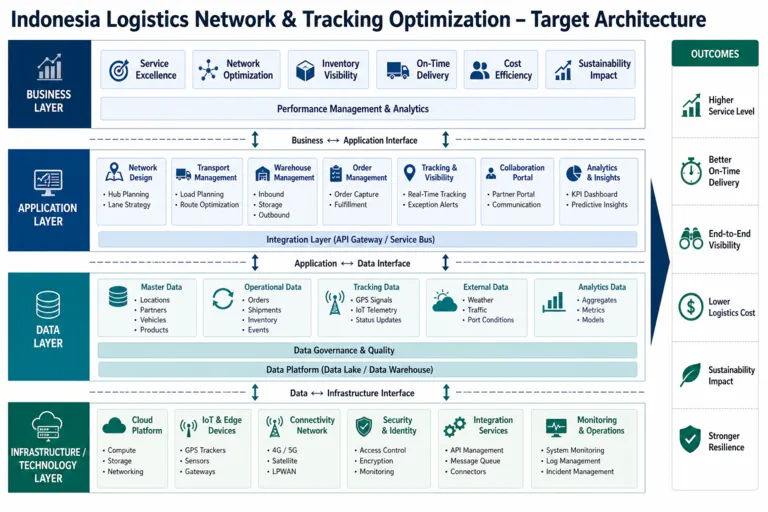
Eurogroup Consulting proposed a comprehensive logistics optimization program that tackled network design, technology integration, and process improvement. The solution started with redesigning the distribution network – consolidating warehouses and strategically locating new distribution centers closer to key markets to reduce transit times. Advanced route optimization software and GPS tracking systems were introduced to plan more efficient delivery routes and provide end-to-end visibility of shipments. The consulting team also implemented a centralized supply chain management platform to integrate data from all warehouses and logistics partners, enabling dynamic inventory management and demand forecasting. Process improvements such as standardized loading procedures, better coordination with third-party carriers, and contingency plans for disruptions (like port delays or weather events) were established. Eurogroup Consulting worked on upskilling the client’s logistics team to utilize these new tools and to adopt data-driven decision-making for continual efficiency gains.
Approach
The project initiated with a thorough analysis of the client’s logistics data, including delivery times, transportation costs, and inventory levels across regions. Eurogroup Consulting conducted on-ground studies to map transport routes and identify bottlenecks such as congested ports or unreliable regional carriers. Collaborating with the client’s supply chain managers, the team redesigned the logistics network by selecting optimal warehouse locations and rationalizing the number of distribution points. Next, suitable technology solutions were evaluated and implemented in phases, starting with a pilot of the route optimization and tracking system on a busy delivery corridor. Training sessions were organized for staff and partner providers to ensure smooth adoption of the new systems. As improvements rolled out, the consulting team closely monitored key metrics like on-time delivery rate, logistics cost per unit, and inventory turnover. Regular review meetings with stakeholders were held to resolve any operational teething issues and to adjust strategies in response to real-time data insights.
Recommendations
To maintain and build on the improvements achieved, Eurogroup Consulting recommended that the client continue investing in supply chain technology, such as IoT sensors for real-time inventory monitoring and blockchain for transparent tracking. It was advised to establish a dedicated Supply Chain Analytics team to continuously analyze data for further optimizations and to proactively identify potential disruptions. Strengthening relationships with logistics partners was also suggested, including establishing service-level agreements to ensure consistent performance. Eurogroup Consulting further recommended periodic network re-evaluation as the market grows or shifts, so that the distribution setup remains aligned with demand patterns. By institutionalizing a culture of continuous improvement in logistics, the company could keep its competitive edge in delivering goods swiftly and cost-effectively across Indonesia.
Engagement ROI
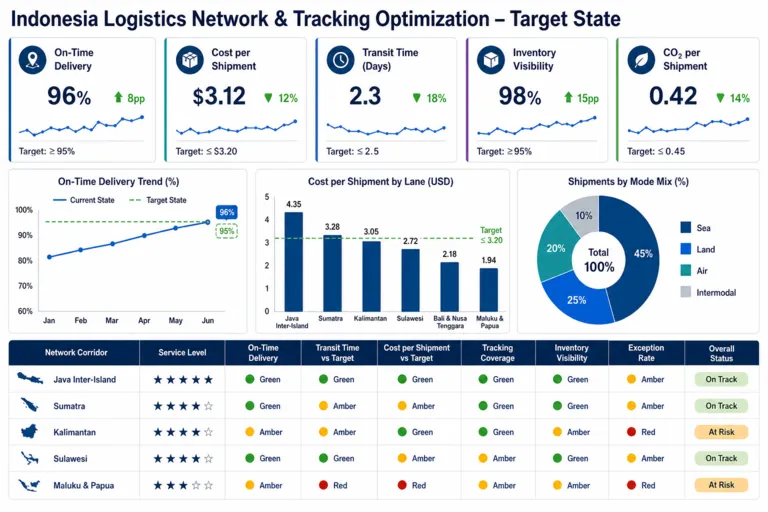
The logistics optimization program led to marked improvements in the company’s supply chain performance. Average delivery times to stores and customers were cut significantly, in some routes by up to 25%, ensuring fresher products and higher customer satisfaction. Logistics costs as a percentage of sales dropped substantially, improving the company’s profit margins. The enhanced inventory management system reduced stockouts by ensuring popular products were replenished in time, while lowering excess stock in slow-moving locations, leading to more balanced inventory turnover. With real-time tracking and better coordination, the company experienced fewer lost or delayed shipments, boosting reliability and trust with retail partners and consumers. Ultimately, the engagement enabled the client to distribute products more efficiently despite Indonesia’s challenging geography, solidifying its reputation for dependable service in the competitive consumer goods market.