
Client
Issues
Entering the Indonesian market presented several uncertainties and challenges for the client. Indonesia’s consumer landscape is diverse, with regional differences in tastes, cultural norms, and purchasing power that the brand needed to understand to position its products correctly. The client was unfamiliar with Indonesia’s regulatory environment, including foreign investment restrictions, import duties, and licensing requirements, which could significantly affect its entry timeline and costs. Fierce competition from established domestic retailers and other international brands in Indonesia meant the client needed a clear differentiation strategy. Additionally, choosing the right locations for initial stores was critical – the brand had to identify cities and sites where their target demographic was concentrated and where retail infrastructure could support their outlet format. The complexity of Indonesia’s logistics (given the geography) also raised concerns about supply chain and distribution for the new stores. Without a tailored entry plan, the client risked operational hiccups, brand misalignment with local consumers, or even regulatory roadblocks that could derail its expansion.
Solution
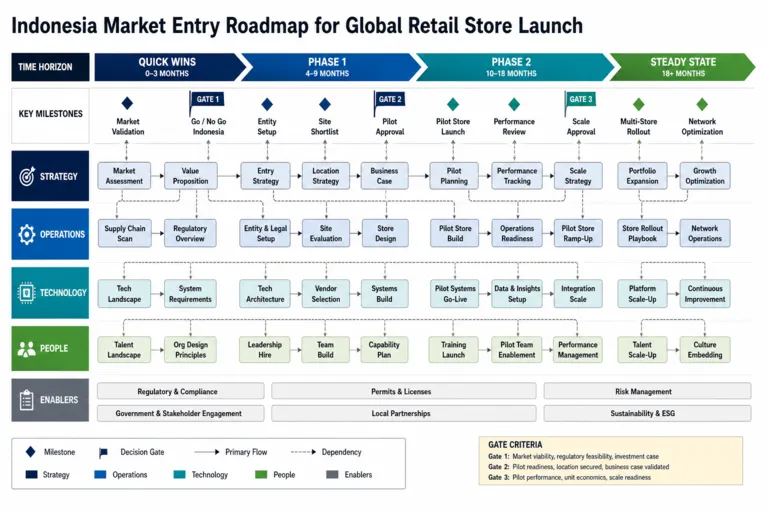
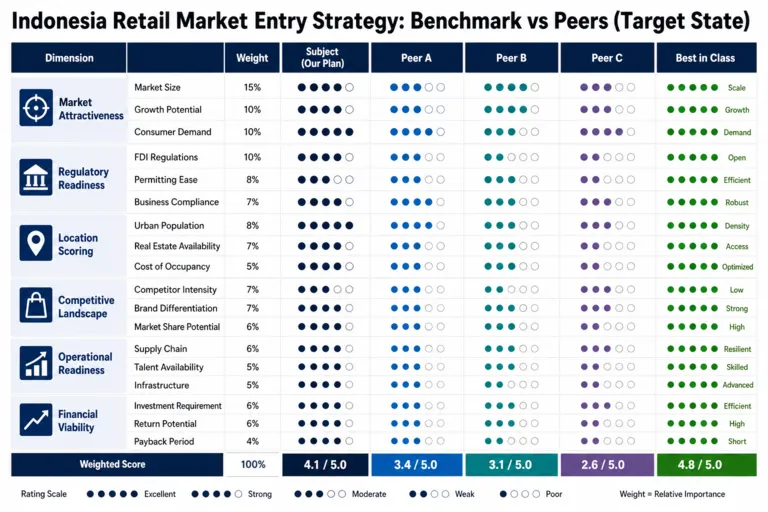
Eurogroup Consulting developed a detailed market entry strategy that covered market analysis, regulatory planning, localization of the brand experience, and operational setup. The strategy began with thorough market research to identify the client’s target consumer segments in Indonesia, including demographic and psychographic profiling to understand preferences and price sensitivity. Concurrently, a competitive analysis was performed to spot gaps in the market that the client’s brand could fill, and to benchmark local competitors’ offerings and store formats. On the regulatory side, the consulting team outlined the steps needed to establish a presence in Indonesia, such as the best legal entity structure, compliance with foreign ownership laws, and engaging with local authorities for necessary permits. The entry strategy also emphasized localization: adjusting the product mix and in-store experience to resonate with Indonesian shoppers – for example, incorporating local language signage, adapting product offerings to local size or taste preferences, and planning marketing campaigns with Indonesian cultural festivities in mind. Eurogroup Consulting recommended an initial rollout plan focusing on a few major urban centers known for trend-conscious consumers and higher spending power. This included selecting prime retail locations (with assistance from local real estate partners) and planning a supply chain model, such as a central warehouse in Indonesia to support store replenishment. The solution also detailed a phased expansion timeline, risk mitigation plans, and an estimated investment budget for the entry.
Approach
The creation of the market entry strategy was a collaborative and iterative process. Eurogroup Consulting’s team collected data on consumer demographics, spending habits, and retail trends through surveys and existing market reports. They also met with industry experts and potential local partners to gain on-the-ground perspectives. Mapping regulatory requirements involved consulting with legal experts and government liaisons to ensure all compliance aspects were covered. The consulting team facilitated strategy sessions with the client to clarify the brand’s value proposition for Indonesia and to incorporate the client’s global experience and priorities into the local plan. Location analysis was carried out using geographic information system (GIS) tools and field visits to assess shopping districts in Jakarta, Surabaya, and Bandung, among other cities. During the strategy development, Eurogroup Consulting presented interim findings and options to the client’s executives, allowing them to make informed decisions on key points like whether to form a joint venture with a local firm or go it alone. After aligning on the strategy components, the consulting team compiled a comprehensive entry roadmap document. This included a timeline with critical milestones (such as store opening dates, marketing launch, etc.), a responsibility matrix for tasks, and detailed guidelines for the local team that would implement the strategy. Before final handover, Eurogroup Consulting arranged knowledge transfer workshops, ensuring the client’s regional team understood the plan thoroughly and was prepared to execute it.
Recommendations
To increase the likelihood of a successful entry and growth in Indonesia, Eurogroup Consulting offered several recommendations alongside the strategy. Forming a strategic partnership or alliance with a well-connected local company was suggested to help navigate bureaucratic processes and cultural nuances; such a partner could be a retail conglomerate or a franchise operator with local expertise. It was also recommended that the client localize its supply chain by sourcing some products or materials within Indonesia, not only to reduce costs and import dependency but also to appeal to local preferences where possible. Eurogroup Consulting advised a strong initial marketing push coinciding with the store openings, including leveraging social media and possibly a pop-up or event strategy to generate buzz among target consumers. The plan highlighted the importance of hiring and training local staff extensively, to ensure they deliver the brand’s customer service standards while understanding Indonesian customer expectations. Lastly, a cautious scaling approach was recommended: use the performance and feedback from the first few stores to refine operations and offerings, then expand further into second-tier cities or additional locations, maintaining flexibility to adapt the rollout based on early results.
Engagement ROI
By following the carefully crafted market entry strategy, the client achieved a remarkably smooth and successful launch in Indonesia. The first stores opened on schedule and attracted large crowds, thanks in part to the localized marketing campaigns that created excitement around the brand. Initial sales figures exceeded projections, indicating that the product assortment and pricing strategy were well-tuned to the Indonesian market tastes and budget levels. The brand’s distinct positioning – refined with local cultural touches – allowed it to stand out in a competitive retail scene, and customer feedback was overwhelmingly positive regarding the shopping experience. Operationally, the groundwork on regulatory compliance paid off; the client navigated business licensing and import regulations without delays or penalties. The supply chain functioned efficiently, as early investment in a local warehouse and logistics planning prevented stock shortages even during peak opening demand. Importantly, the local team and partnership established provided strong execution support, and their deepening knowledge of the market continued to inform adjustments post-launch. Overall, the engagement enabled the global retailer to enter Indonesia not as an outsider fumbling through trial and error, but as a well-prepared market player making an immediate impact, laying a solid foundation for long-term expansion in the country.