
Client
Issues
The city was grappling with chronic traffic jams, resulting in long commute times, high pollution levels, and lost economic productivity. Public transportation systems were underutilized due to inconsistent service quality, limited coverage, and the inconvenience of disjointed ticketing systems for buses, trains, and other transit options. Road infrastructure and traffic management technologies were outdated, relying on static traffic signals and minimal data analytics, which made real-time traffic flow optimization nearly impossible. Additionally, the fast growth in vehicle ownership without corresponding improvements in infrastructure had strained the transport network. These issues impacted the quality of life and required an urgent comprehensive approach to improve mobility.
Solution
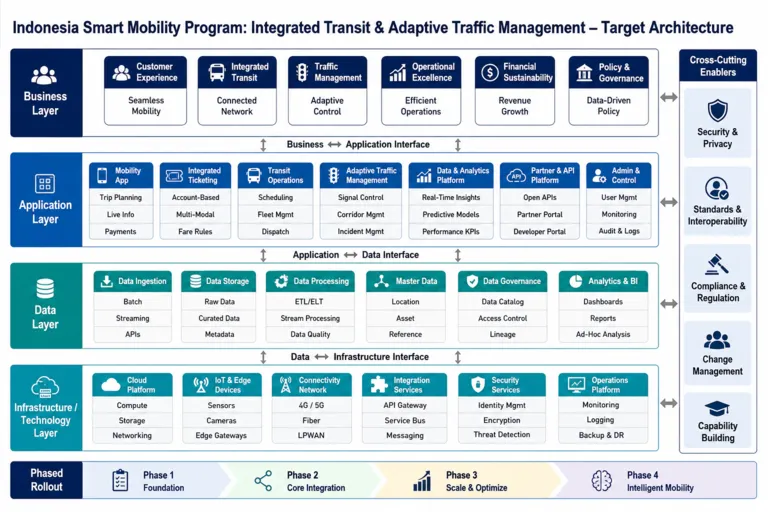
Eurogroup Consulting devised an integrated smart mobility strategy focusing on public transit enhancement, traffic management upgrades, and policy innovation. A key element was the development of an Integrated Transport System (ITS) – a platform consolidating all modes of public transport with a unified e-ticketing system and real-time scheduling information. To make public transit more attractive, the plan included expanding bus routes and optimizing schedules, as well as improving last-mile connectivity through feeder services. For road traffic management, the consulting team recommended deploying intelligent traffic signal systems using sensors and AI to adjust signal timings based on actual traffic conditions, thereby smoothing traffic flow. The strategy also encompassed the promotion of ridesharing and carpooling programs through mobile apps and designated lanes. Eurogroup Consulting worked with city officials to craft new policies, such as congestion pricing in the busiest areas and incentives for using public transport or electric vehicles, to encourage behavioral shifts towards sustainable mobility.
Approach
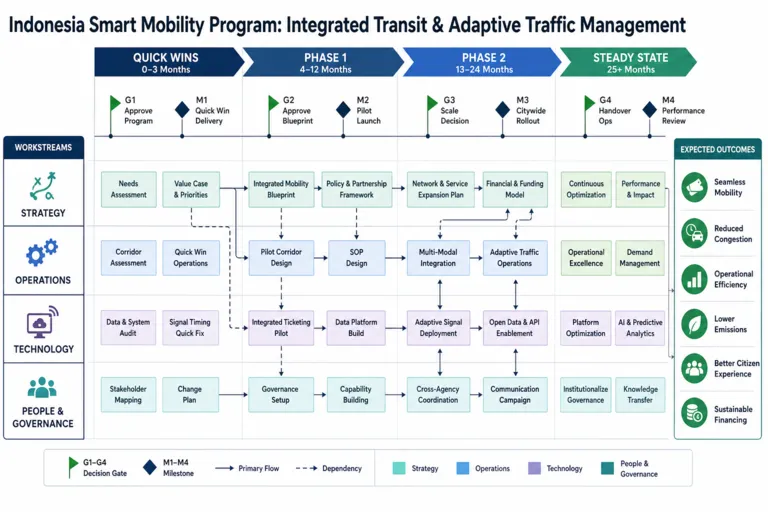
The project began with an extensive data-gathering phase, where Eurogroup Consulting analyzed traffic patterns, public transport usage statistics, and commuter behavior through surveys and sensors placed around the city. The team facilitated workshops with the transportation authority, city planners, and private sector stakeholders (like bus operators and tech firms) to develop a shared vision for the mobility improvements. A pilot of the integrated e-ticketing system was launched on a select group of bus and train lines to test user experience and interoperability, which was refined based on commuter feedback. Concurrently, a model corridor in the city was equipped with adaptive traffic lights and traffic cameras to trial the smart traffic management approach. Eurogroup Consulting also helped implement a public awareness campaign about the new mobility initiatives, highlighting the benefits of public transit and carpooling. Throughout the execution, the consulting team coordinated closely with the city’s technical teams and provided training on managing the new ITS and traffic systems. They also established a monitoring framework to track metrics such as average commute times, public transit ridership, and traffic speed improvements in order to gauge the impact and guide adjustments.
Recommendations
Upon completion of the initial phase, Eurogroup Consulting recommended scaling up the smart mobility solutions citywide in a phased manner. Expanding the integrated ticketing and information system to all transit modes and routes was advised to provide a seamless commuter experience. It was also suggested that the transportation authority continuously update the traffic management system by incorporating emerging technologies like predictive analytics and connected vehicle data as they become available. To lock in the gains, Eurogroup Consulting emphasized the importance of policy support, recommending that the city maintain incentives for public transport use and periodically review congestion pricing levels to manage demand. Furthermore, ongoing public engagement was advised: gathering commuter feedback and educating the public on the environmental and personal benefits of the new mobility options would help sustain higher adoption rates. Building a dedicated urban mobility innovation lab within the authority could ensure the city keeps innovating and adapting best practices from around the world.
Engagement ROI
The smart mobility initiative achieved significant positive outcomes for the city. In pilot areas, average travel times during peak hours dropped by roughly 20% thanks to synchronized traffic signals and better traffic flow, providing immediate relief to drivers. Public transit ridership saw a notable uptick, as the convenience of a unified ticketing system and improved service frequency attracted more commuters to buses and trains. The integration of real-time data into transit operations led to more punctual services and timely information for passengers, boosting their confidence in using public transport. These changes collectively contributed to lower vehicular emissions in the test zones, aligning with the city’s sustainability goals. The successful pilots built broad support for the mobility reforms and laid a robust foundation for citywide expansion. Overall, the engagement equipped the city with modern tools and strategies to manage urban transportation more effectively, enhancing both economic productivity and residents’ quality of life.