
Client
Issues
The company had been growing organically but lacked a formal strategy to navigate upcoming challenges and opportunities. Its leadership was concerned about increasing competition from both low-cost imports and innovative startups offering substitute products. Internally, decision-making was often reactive and short-term, with different departments pursuing conflicting priorities. The absence of a cohesive vision led to inefficient allocation of resources and missed opportunities for synergies between business units. Furthermore, the company had not fully explored diversification or expansion into new markets, partly due to uncertainty about where to focus and how to execute such moves. These issues put the company’s future growth at risk and created a sense of urgency to establish a unifying strategic direction.
Solution
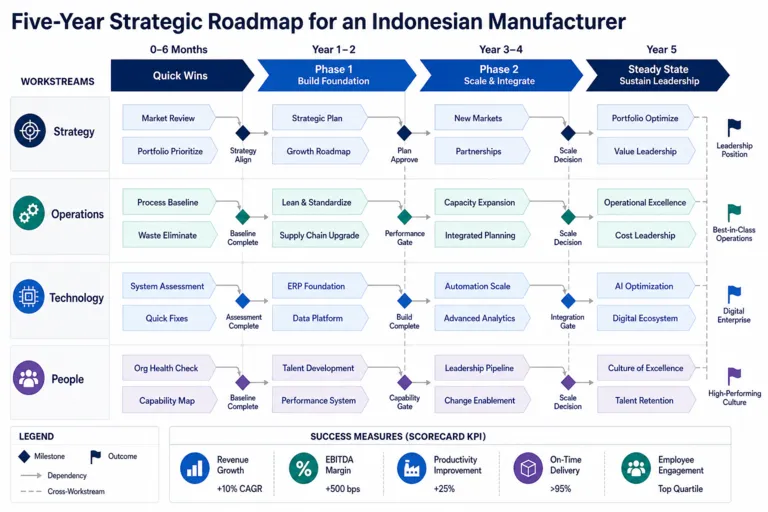
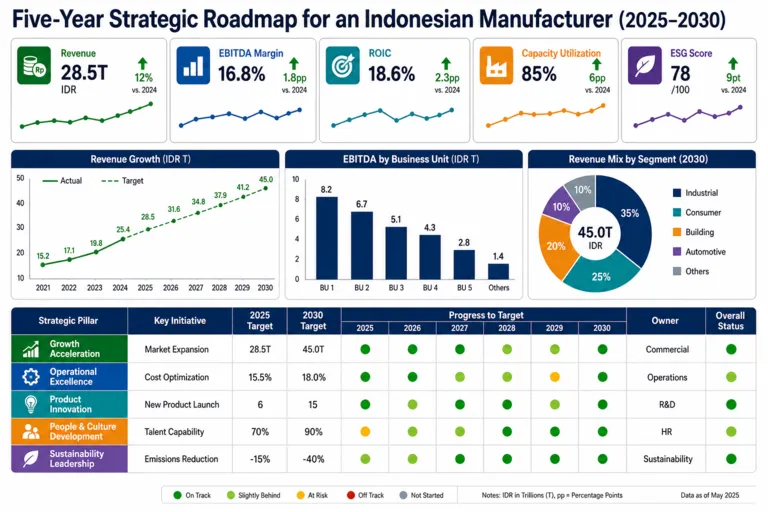
Eurogroup Consulting devised a comprehensive strategic planning process that engaged the client’s leadership and key stakeholders in creating a forward-looking roadmap. The solution involved several steps: firstly, a thorough external and internal analysis was conducted, including a SWOT analysis and market outlook assessment, to ground the strategy in reality. Using these insights, the consulting team facilitated strategy workshops with executives to clarify the company’s vision and mission in the context of current market trends. Together, they identified strategic pillars – for example, innovation in product development, expansion into select Southeast Asian markets, and operational efficiency improvements – as the foundation of the plan. For each strategic pillar, Eurogroup Consulting helped develop specific objectives and initiatives. This included outlining investment needs, key performance indicators (KPIs), and timelines. A balanced scorecard approach was employed to ensure the strategy addressed multiple dimensions of success (financial, customer, internal processes, and learning & growth). The final deliverable was a strategic roadmap document that clearly delineated short-term and long-term actions, ownership for initiatives, and a change management plan to align the organization with the new strategy.
Approach
The strategic planning engagement unfolded in a structured manner. Initially, Eurogroup Consulting’s team performed extensive data collection: reviewing the company’s financials, conducting interviews with management and staff, and researching industry trends and forecasts. This groundwork was synthesized into an insight report highlighting key challenges and opportunities. Next, a series of collaborative workshops and brainstorming sessions were held with the client’s executive team and heads of departments. These sessions allowed for open discussion of different strategic options and fostered consensus on the direction forward. The consulting team used scenario planning techniques to stress-test potential strategies against different future market conditions, ensuring robustness of the plan. Once the major strategic choices were agreed upon, Eurogroup Consulting worked closely with each department to outline how they would contribute to the corporate strategy – defining projects such as new product lines, market entry plans for neighboring countries, or cost reduction programs, complete with budgets and milestones. Regular check-ins with the CEO and board kept the process aligned with top-level expectations. After drafting the strategic roadmap, the consultants assisted in communicating the plan throughout the organization via town hall meetings and internal memos, aiming to secure buy-in from employees. They also established a schedule for quarterly strategy review meetings to help the client track progress and adapt the plan as needed.
Recommendations
To ensure successful execution of the strategic roadmap, Eurogroup Consulting made several key recommendations. It was advised that the client set up a Strategy Management Office (SMO) or designate a Chief Strategy Officer to oversee implementation and keep the organization focused on the strategic goals. The SMO would track the KPIs outlined in the balanced scorecard, coordinate across departments, and report progress to the leadership regularly. Eurogroup Consulting also emphasized the importance of communication: management should continuously communicate the vision and progress to all employees to maintain alignment and enthusiasm. Flexibility was another recommendation; the client should revisit and adjust elements of the strategy annually (or as market conditions change) rather than sticking rigidly to a five-year plan, to remain agile. Additionally, investing in leadership development and innovation programs was suggested to cultivate the internal capabilities needed to carry out the strategy, such as training future leaders and encouraging intrapreneurship for new ideas. By following these recommendations, the company would create a robust framework to turn its strategic plans into tangible results.
Engagement ROI
The strategic planning engagement brought clarity and direction that translated into measurable improvements for the client. With a unified strategy in place, the company saw enhanced coordination across its divisions, which led to more efficient project execution and resource utilization. Within a year of implementation, the company successfully launched a new product line identified in the strategy workshops, opening up a fresh revenue stream that contributed to overall sales growth. Efforts to improve operational efficiency, another pillar of the strategy, resulted in a reduction of production costs, boosting profit margins. The company also initiated steps to enter a neighboring market, supported by a detailed entry plan, marking its first foray beyond Indonesia and setting the stage for regional growth. Employees at all levels reported a better understanding of the company’s direction and their role in achieving it, improving morale and engagement. The process of building the strategic roadmap also strengthened the management team’s strategic thinking and collaboration, benefits that will endure beyond the plan’s timeline. In sum, the engagement equipped the company with a clear vision and actionable path forward, positioning it to navigate a dynamic market with confidence.