
Client
Issues
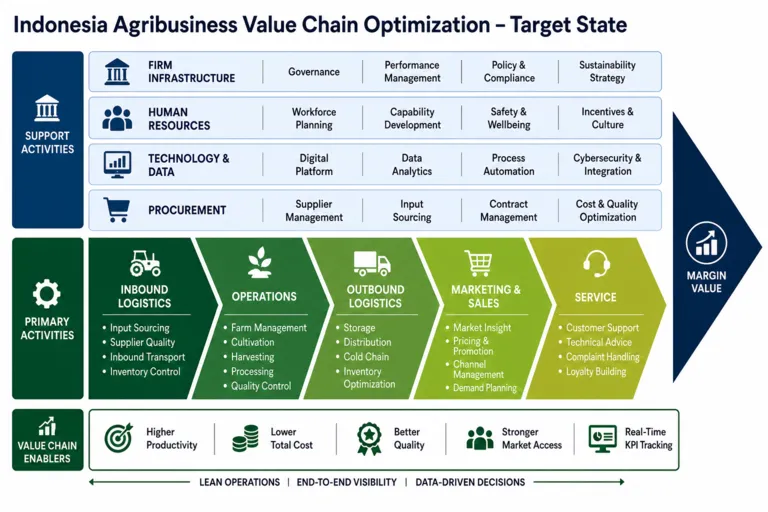
The agribusiness’s value chain was fragmented and laden with inefficiencies that were eroding profitability. Procurement of raw materials from farmers was inconsistent, with variable quality and middlemen driving up costs. The production facilities were not operating at full capacity due to scheduling mismatches and maintenance downtime, indicating suboptimal process coordination. There were also bottlenecks in distribution; the company struggled with delays in getting finished products to market, partly due to poorly synchronized logistics and inventory management. Additionally, limited visibility into each stage of the value chain made it difficult for leadership to pinpoint where losses and delays were occurring. These issues were further complicated by external pressures like volatile commodity prices and stringent quality regulations, which made cost control and efficiency even more critical for maintaining margins and market share.
Solution
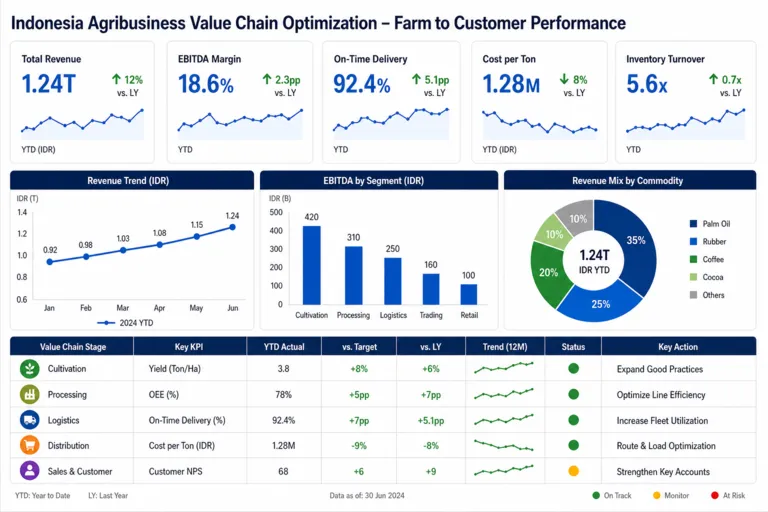
Eurogroup Consulting implemented a value chain optimization program targeting every stage from sourcing to distribution. The solution began with restructuring the procurement process: the team introduced a direct sourcing model by building stronger relationships with farmers and cooperatives, reducing reliance on intermediaries and securing better quality inputs at more stable prices. To improve processing efficiency, the consulting team applied lean manufacturing principles and better production planning tools to synchronize input supply with factory schedules, thereby increasing capacity utilization and reducing idle times. A robust maintenance management system was also put in place to minimize unexpected downtimes. For distribution, Eurogroup Consulting overhauled the logistics planning by integrating a new inventory management system that provided real-time stock levels at warehouses and predicted optimal shipment schedules based on demand forecasts. This enabled more timely deliveries and lower storage costs. The solution also involved the deployment of a digital dashboard that tracked key performance indicators across the value chain – from raw material costs and production yield to delivery times and quality compliance rates. Training was provided to managers and staff on using data analytics from this dashboard to make swift, informed decisions and to continuously identify improvement opportunities in the value chain.
Approach
The engagement followed a systematic approach to map and improve the value chain. Initially, Eurogroup Consulting conducted a thorough value stream mapping exercise, collaborating with cross-functional teams from procurement, production, and distribution to visualize the end-to-end process and identify waste. Data was collected on cycle times, costs, and throughput at each stage. The consultants then worked with the procurement department to implement a pilot direct sourcing program in one region, establishing agreements with local farmers and setting quality standards with incentive structures for compliance. Simultaneously, on the production side, a task force was formed within the client’s operations team to work alongside the consultants in adopting lean techniques – for example, reorganizing factory floor layouts and introducing just-in-time inventory for raw materials. For distribution improvements, a new software system was introduced in a controlled environment; key staff were trained and the system was tested in parallel with existing processes to fine-tune parameters like reorder points and lead times. Regular progress meetings enabled different departments to share insights and remain aligned on the project’s goals. As results from pilots became evident – such as cost savings from direct procurement and smoother production runs – the new practices were rolled out company-wide. Eurogroup Consulting maintained an advisory presence throughout to ensure knowledge transfer, adjust strategies in response to any issues, and help the company’s leadership embed a culture focused on efficiency and waste reduction.
Recommendations
To sustain the value chain gains, Eurogroup Consulting made several recommendations. It was recommended that the client establish a Value Chain Management team responsible for end-to-end oversight of the process. This team would use the new digital dashboard to continually monitor performance and flag issues early. Building on the success of direct sourcing, the client was advised to expand partnership programs with farmers, including offering technical support or financing options to farmers for improving crop yield and quality – which in turn would benefit the company’s input supply. Eurogroup Consulting also suggested periodic value chain audits – routine assessments of each stage to catch any drift from optimized processes or new inefficiencies creeping in. Embracing advanced analytics was another recommendation: the company could deploy predictive models to anticipate demand fluctuations or supply risks (like weather impacts on harvests) and adjust procurement and production plans proactively. Additionally, fostering a culture of continuous improvement was emphasized; the client should train employees in methodologies like Six Sigma or Kaizen, empowering frontline staff to suggest and implement small improvements regularly. By following these recommendations, the company would not only maintain the efficiency improvements achieved but likely uncover further opportunities to refine its value chain in the future.
Engagement ROI
The value chain optimization initiative delivered tangible and significant benefits for the agribusiness client. Procurement costs dropped as the new direct sourcing model cut out middleman fees and reduced price volatility, contributing to a healthier bottom line. Improved coordination between procurement and production meant factories faced fewer raw material shortages or surpluses, thereby increasing average production capacity utilization by around 15%. This efficiency gain led to a higher output without additional capital investment. Enhanced maintenance practices and lean operations reduced downtime and scrap rates, improving overall product yield and quality consistency. On the distribution end, faster and more reliable delivery schedules were achieved, which decreased the lead time to customers and improved customer satisfaction – especially important for perishable or time-sensitive products. Inventory levels were optimized, freeing up working capital that had been tied in excess stock. The digital KPI dashboard provided management with unprecedented visibility into operations, enabling quicker reaction to issues and more strategic planning. Overall, the project not only resulted in cost savings and efficiency improvements valued in the millions of dollars, but also equipped the company with the tools and mindset to drive continuous improvement, strengthening its competitiveness in Indonesia’s agribusiness sector.