
Brand health tracking in Indonesia is a structured, periodic measurement system that monitors how a brand sits in consumers’ minds across awareness, consideration, preference, and loyalty. In competitive categories such as FMCG, financial services, retail, and digital, it acts as an early warning system because perception can shift before sales data moves. Kantar BrandZ (2024) is cited as showing that brands running regular tracking are 2.4 times better at anticipating market share decline than brands relying only on sales performance data. The logic is that changes in consumer perception typically lead changes in purchasing behavior by 3–6 months, which is exactly why a KPI system should be designed around trend lines, not one-off snapshots.
A strong KPI system starts with a small set of complementary metrics that answer different questions. Top of Mind Awareness (TOM) captures the first brand named spontaneously in a category and is described as a strong predictor of market share that correlates directly with conversion rates and repeat purchase. Spontaneous awareness and aided awareness add diagnostic power; a wide gap signals that a brand is recognized when prompted but not remembered without stimulus, which can hurt purchase consideration. Consideration measures the percentage of consumers who include the brand in their evaluation set, while preference identifies the first choice among considered brands; the gap between them helps locate weakness at awareness, evaluation, or the final decision stage.
How to Keep KPIs Comparable Across Waves in Indonesia
Comparability is where many tracking programs break, especially in fragmented markets where teams are tempted to “improve” questionnaires every wave. The Indonesia-focused guidance is to keep methodology strictly consistent so movements reflect real brand health changes rather than survey artifacts. It highlights that small changes to question wording, question order, or respondent profile criteria can create false shifts. Three elements must remain identical across waves: the questionnaire (including question sequence), sampling criteria and respondent profile, and the overall approach to data collection across waves. For Indonesia specifically, sampling design should account for geographic and demographic diversity so results remain representative and usable for decision-making.
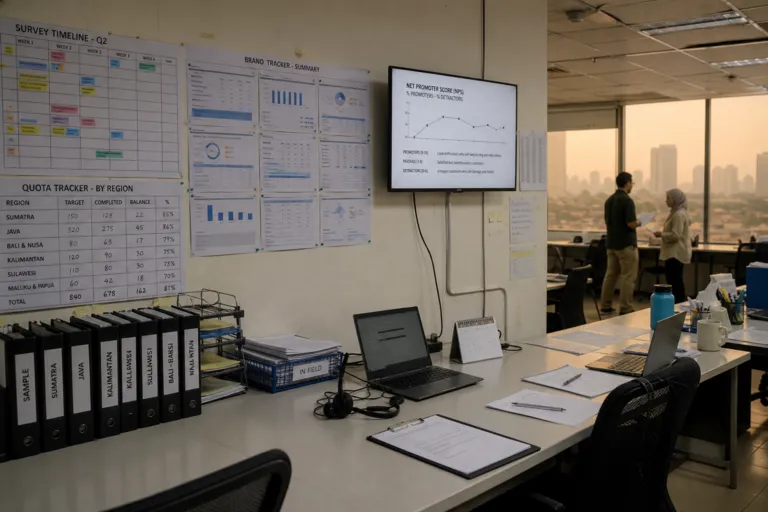
Loyalty and reputation KPIs should be built to flag risk early, not after revenue is hit. Net Promoter Score (NPS) is positioned as a single-question loyalty metric where a consistently declining NPS over two consecutive quarters is described as a reliable leading indicator of increasing churn, often visible before revenue impact. At the same time, NPS needs local interpretation because benchmarks vary significantly by category in Indonesia, so teams should compare against local sector references rather than global benchmarks. Brand association tracking also matters because it checks whether communicated positioning (for example, quality, innovation, affordability, trustworthiness, or lifestyle relevance) is actually received and retained by consumers.
To make brand health tracking Indonesia programs operational, reporting should map to the KPIs leadership already uses and should show movement over time. Best-practice guidance also suggests using custom dashboards to reduce noise by segmenting reporting by audience, campaign, or market, while still maintaining a consistent core framework. Program cadence can be set to match market dynamics; Harvard Business Review is cited as recommending routine audits either quarterly or annually depending on the industry. For fast-moving sectors like e-commerce and technology, quarterly surveys are suggested to keep insights fresh and enable responsive decisions. The goal is a KPI system that stays stable enough to trend, but practical enough to act on.
What is brand health tracking in Indonesia used for?
Which core KPIs should a brand dashboard track?
What does a two-quarter NPS decline signal?
How do you keep brand tracking results comparable over time?
How often should brand health tracking be run?