Indonesia layoffs 2026 have become a defining labour-market signal as the Ministry of Manpower reported 15,425 workers laid off between January and April 2026. The figures were released through the ministry’s Satu Data portal and are based on participants registered under the Job Loss Insurance (JKP) programme administered by BPJS Ketenagakerjaan. The ministry has not yet detailed which industries contributed most heavily, but the release has intensified attention on corporate restructuring and manufacturing competitiveness. The pattern also suggests an uneven recovery amid global uncertainty and domestic industrial adjustments.
The month-to-month trend in early 2026 shows a sharp shock followed by easing, but not a clean return to stability. February 2026 recorded the steepest wave of layoffs at 6,610 workers. That number later dropped to 2,863 in March and eased further in April, indicating layoffs started to slow after peaking in February. Analysts and economists cautioned that the downward trend does not necessarily indicate a full recovery, as companies continue to adopt cost-efficiency measures amid volatile energy prices, currency pressures, and weakening international trade conditions.
Where the Layoffs Are Concentrated—and Why It Matters
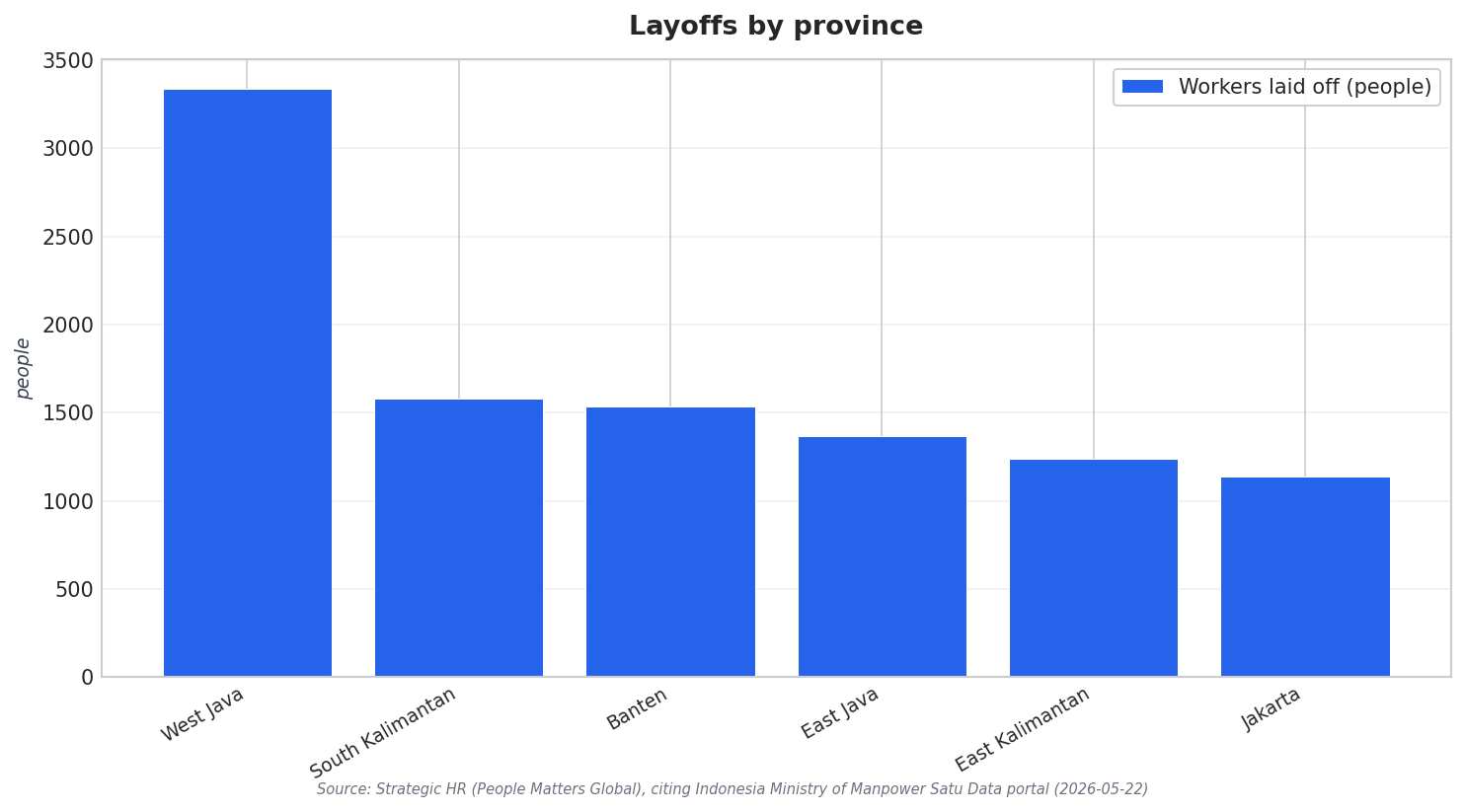
The 2026 layoffs are not evenly distributed across Indonesia, and the geographic concentration reveals where business stress is most acute. West Java was the hardest-hit province in January–April 2026, accounting for around 21.65% of reported layoffs nationwide, or 3,339 affected workers. Other provinces with significant layoffs included South Kalimantan (1,581), Banten (1,536), East Java (1,367), East Kalimantan (1,237), and Jakarta (1,140). In industrial provinces such as West Java and Banten, manufacturers are grappling with softer export activity and rising production expenses, while layoffs in resource-rich regions such as South and East Kalimantan may reflect fluctuations in commodity-linked industries, including mining and energy supply chains.
Looking back to 2025 adds context for the sectors under strain, even as official systems do not capture every worker. Government data showed layoffs surged 32.1% year-on-year in the first half of 2025, with 42,385 workers affected, up from 32,064 in H1 2024. The losses were heavily concentrated in manufacturing, wholesale and retail, and mining. Manufacturing alone accounted for 22,671 layoffs. Central Java recorded 10,995 job cuts, followed by West Java at 9,494 and Banten at 4,267. In June 2025, layoffs fell 65% month-on-month to 1,609 from 4,702 in May, but officials still cited unresolved layoff processes and ongoing volatility. The manufacturing PMI also dropped to 46.9 in June 2025, signalling contraction in output, hiring, and sentiment.
For businesses, the implications are practical and immediate: restructure without losing operational resilience, and defend competitiveness in labour-intensive supply chains. In West Java, labour-intensive sectors such as textiles, electronics, automotive supply chains, and export manufacturing were described as exposed to slowing global demand and rising operational costs during the January–April 2026 period. The government also introduced broader economic protection measures, including remote-work initiatives aimed at reducing fuel consumption during the global energy crisis linked to Middle East tensions and disruptions around the Strait of Hormuz. Meanwhile, The Jakarta Post reported that the ministry data can understate layoffs because it only covers the JKP programme, reinforcing that companies should pair official signals with internal workforce analytics before making irreversible staffing decisions.
How many workers were laid off in Indonesia in early 2026?
Which month saw the sharpest layoffs in early 2026?
Which provinces were hit hardest by layoffs in January–April 2026?
What sectors were most affected during the 2025 layoff surge?
What does the Indonesia layoffs 2026 trend mean for business planning?