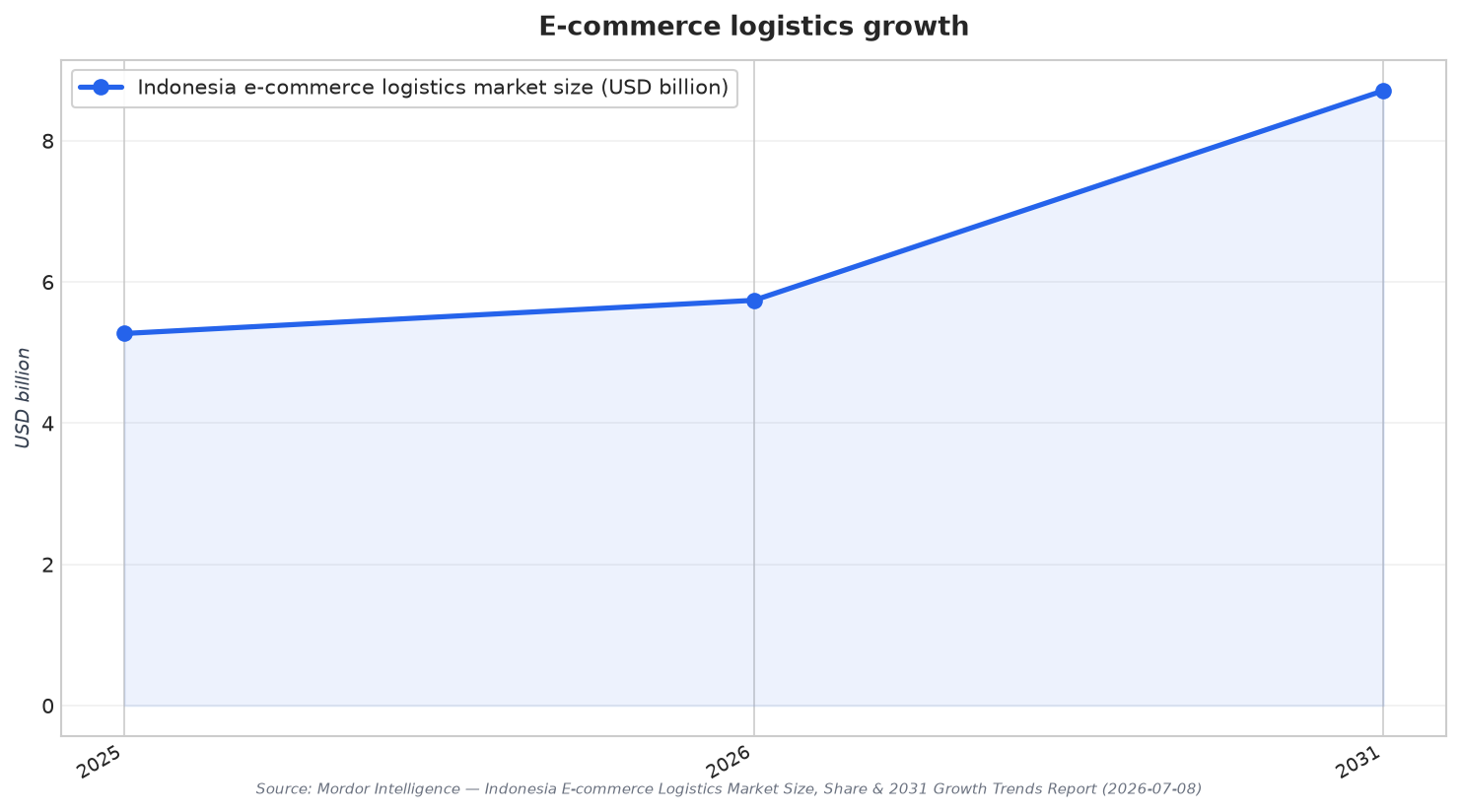
Warehousing demand in Indonesia is being pulled forward by fast-growing e-commerce logistics activity and the operational need for denser fulfillment networks. Mordor Intelligence estimates the Indonesia E-commerce Logistics Market will grow from USD 5.27 billion in 2025 to USD 5.74 billion in 2026, reaching USD 8.71 billion by 2031, at an 8.71% CAGR over 2026–2031. The same report highlights how live-streaming commerce increases parcel frequency through smaller, more frequent orders, which raises throughput pressure on storage and sorting nodes. It also notes that platform-owned fleets already handle nearly two-fifths of marketplace parcels, which supports integrated networks where real estate sits closer to delivery operations.
Market structure details also point to why warehouse space is central to logistics planning. Transportation held 72.78% of the Indonesia E-commerce Logistics Market share in 2025, while value-added services are forecast to expand at a 10.39% CAGR to 2031, indicating more activity beyond basic linehaul. B2C represented 75.23% of market size in 2025, with domestic shipments at 86.90% that year, which favors distribution facilities designed for national reach and frequent replenishment. Delivery expectations matter too. Standard services held 51.28% share in 2025, yet same-day delivery is projected to grow at a 9.12% CAGR, encouraging micro-fulfillment hubs and strategically placed warehouses that cut final-kilometer time and cost.
Where Demand Clusters: Java Corridors, Tier-2 Cities, and Cold Chain
Developers and occupiers are clustering along proven logistics corridors and expanding into fast-growing city tiers. In 2025, tier-1 cities accounted for 58.77% of overall activity, but tier-2 locations show the fastest outlook with an 11.45% CAGR. Regionally, West Java held an 18.20% share in 2025, while East Java is forecast for a 10.87% CAGR, with Surabaya positioned as a primary eastern consolidation hub. MarkWide Research links e-commerce fulfillment networks to compressed warehouse absorption timelines across Java’s logistics corridors, pushing developers toward earlier speculative construction. In Indonesian commercial property, logistics and office segments are described as leading transaction velocity, including areas such as the Bekasi–Cikarang industrial corridor.
Cold chain is becoming a decisive feature of new supply, not a niche add-on. Mordor Intelligence points to cold-chain build-outs reshaping competitive dynamics, while MarkWide Research highlights temperature-controlled fulfillment for fresh groceries and pharmaceuticals as underdeveloped, with specialized warehouse construction in Greater Jakarta addressing the gap. Product mix signals align with that shift. Grocery/FMCG logistics is projected to grow at a market-leading 10.49% CAGR, while fashion and lifestyle contributed 22.52% in 2025. These patterns support more multi-temperature, compliance-ready facilities in the industrial and logistics pipeline, especially where operators need to serve both high-frequency parcels and controlled-storage requirements.
Policy and compliance details are also influencing how Indonesia’s industrial real estate strategy evolves. MarkWide Research says the Omnibus Law on Job Creation, administered by the Ministry of Agrarian Affairs and Spatial Planning, accelerated land-use conversion permits for industrial zones, including projects in the Bekasi–Cikarang corridor. Building codes under BSI and spatial plans (RTRW) enforced by provincial governments shape density bonuses and green building thresholds, which can change feasibility between provinces. Meanwhile, Mordor Intelligence notes regulatory mandates for electronic proof of delivery (e-POD), plus carbon-credit incentives that accelerate EV adoption, while congestion and fuel-price volatility drive the use of micro-fulfillment and two-wheeler fleets. Together, these forces keep modern warehousing central to network resilience and near-term expansion.
What is driving warehousing demand behind Indonesia’s e-commerce boom?
Which locations are emerging as key warehouse and logistics hubs in Indonesia?
Why is cold-chain infrastructure becoming more important for logistics real estate?
How are regulations and policy affecting industrial property development timelines?
What should investors watch in Indonesia’s industrial real estate market as e-commerce grows?