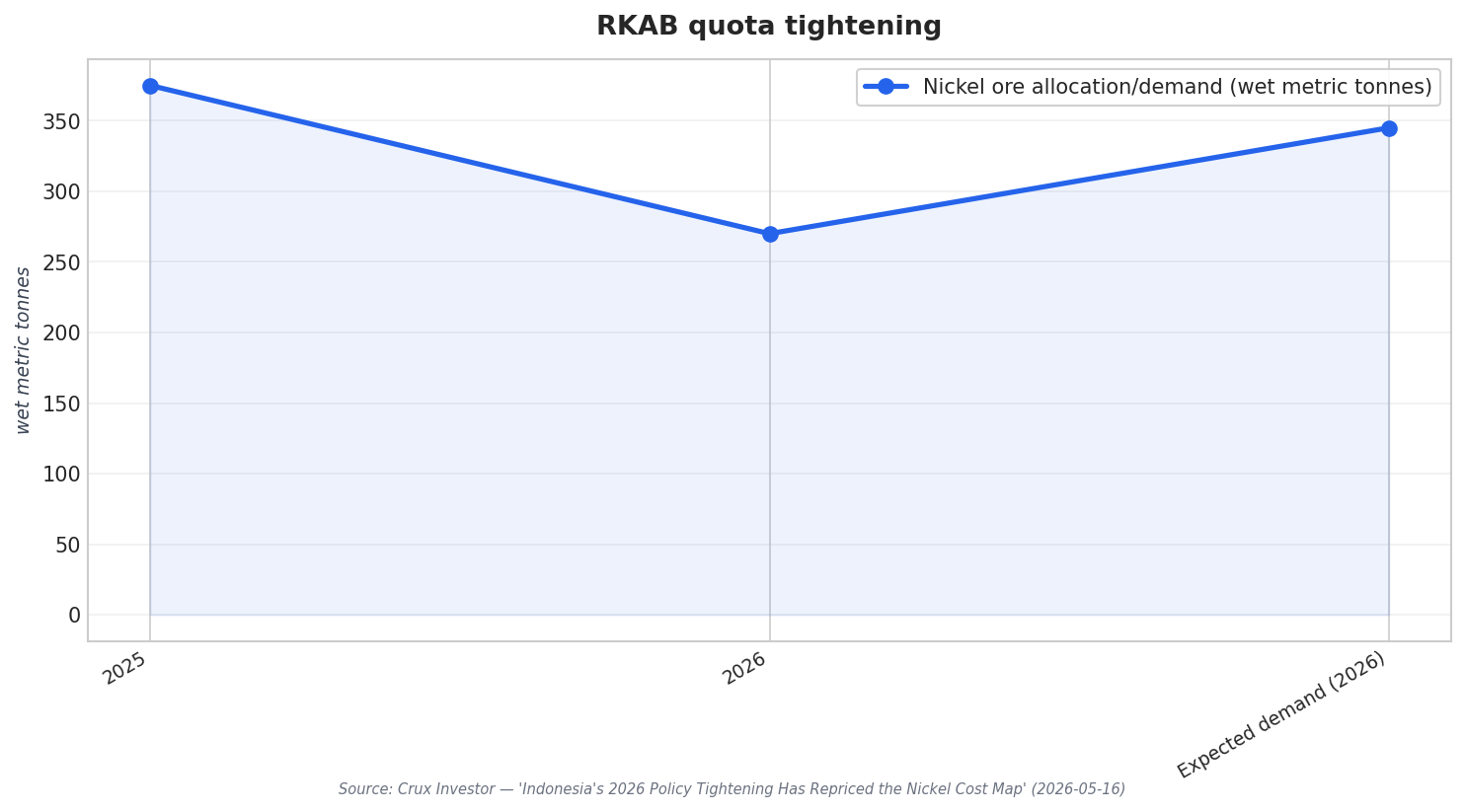
Indonesia’s nickel processing economics shifted in early 2026 because multiple cost drivers moved at the same time. The government approved a 2026 RKAB nickel ore mining quota allocation of 270 wet metric tonnes, down from 375 wet metric tonnes in 2025 and short of expected demand of 345 wet metric tonnes. Analysts described this as a repricing of the nickel cost map because constrained ore supply forces processors to compete for feedstock. At the same time, changes alongside tighter quotas included a revision to the HPM benchmark pricing mechanism and increases to tiered royalty rates, adding policy-linked pressure to operating margins.
For HPAL producers, the most destabilizing variable was reagent availability and price. The closure of the Strait of Hormuz and a Chinese sulphuric acid export ban drove high acid prices and the risk of market shortages. The problem is structural for Indonesia’s HPAL chain because some producers cannot source sulphuric acid domestically at scale, leaving them exposed to import logistics and shipping disruption. This is why the discussion around Indonesia nickel HPAL cost has increasingly focused on reagents, not only ore prices. When sulphur availability tightens simultaneously with ore quotas, the cost structure for refined battery-grade material escalates beyond what ore prices alone would suggest.
Ore Grade Decline Adds a Chemistry-Driven Cost Floor
Declining ore grades compound acid pressure because the HPAL process has a fixed chemical relationship between ore quality and acid consumption. Crux Investor noted that Indonesian ore grades falling below 1.5% increase acid consumption per unit of nickel recovered, creating cost pressure that operational efficiency cannot fully resolve. Separate market observations pointed to a commercial reality that material trading above 1.4% nickel is increasingly difficult to source in meaningful volumes, with the bulk of actively traded ore in the 1.3–1.4% range. That grade decline does not translate into a simple one-for-one cost move; analysis emphasized that a 10% grade decline does not produce a 10% cost increase, but a wider squeeze across mining, logistics, and processing.
Market signals in 2026 reflected that the cost reset was being taken seriously. The LME nickel price rallied 37% from late December 2025 to April 2026. The International Nickel Study Group also revised its 2026 balance from a 283,000-tonne surplus to a 32,000-tonne deficit, aligning price behavior with expectations of tighter supply rather than a brief disruption. Other analysis described a 22% year-on-year price gain alongside a 30%+ quota reduction, framing the move as grounded in genuine ore scarcity. At the same time, ING highlighted that Indonesia accounts for around 60% of global nickel output, which helps explain why shifts in Indonesia’s processing chain can transmit into broader pricing expectations.
Not all processing architectures carry the same exposure to reagent markets, and this is central to how the cost curve is being re-ranked. Crux Investor highlighted that sulphide-process assets with high native sulfur content can generate leaching acid internally, insulating them from reagent import costs that have raised Indonesia’s HPAL cost floor. As an example of that insulation, the Kabanga project advanced by Lifezone Metals contains approximately 30% sulfur in the ore. Inside Indonesia, the policy setting also intersects with scrutiny of HPAL’s intensive acid use, high waste volumes, and complex tailings storage, as noted by ING. Together, geology, chemistry, logistics, and regulation are now pushing in the same direction, making the repricing feel structural rather than temporary.
What changed in Indonesia’s ore quota settings for 2026?
Why did sulphuric acid become a major cost risk for HPAL in 2026?
How does ore grade decline affect HPAL processing costs in Indonesia?
What did market indicators suggest about nickel supply tightness in 2026?
How are analysts reframing the Indonesia nickel HPAL cost discussion?