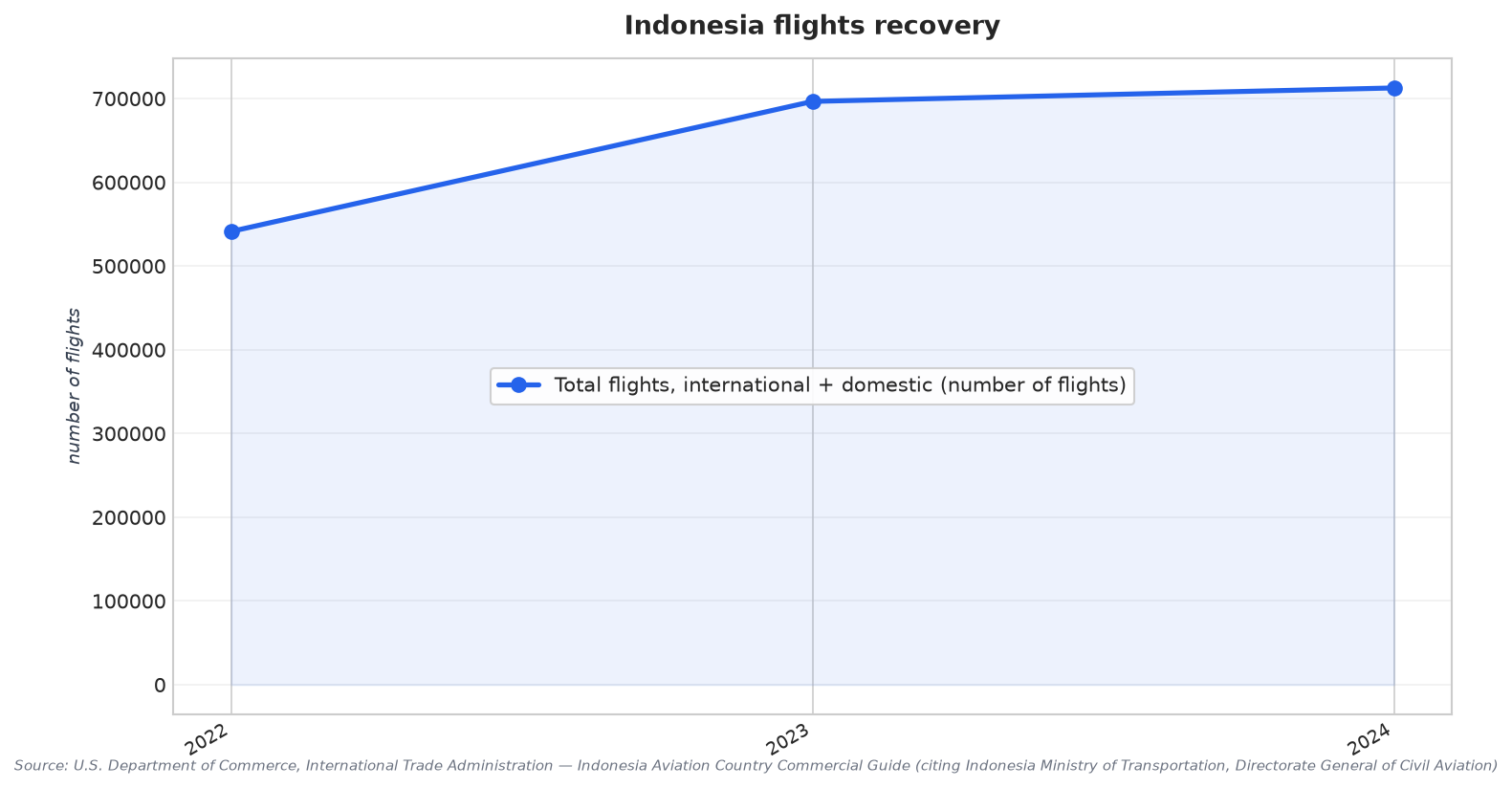
Any Indonesia aviation market outlook has to start with the post-pandemic rebuild in traffic and utilization. According to Indonesia’s Directorate General of Civil Aviation, the country recorded 712,676 international and domestic flights in 2024, up from 696,588 in 2023 and 541,320 in 2022. Load factors also improved to 82% in 2024 from 79% in 2023 and 78% in 2022. Passenger volumes grew as well: domestic passengers rose to 35,826,988 in 2024 from 29,189,842 in 2023, while international passengers increased to 67,128,566 in 2024 from 65,944,835 in 2023. For investors, these figures point to stronger aircraft utilization, which tends to lift maintenance demand and raise the value of reliable capacity.
Infrastructure scale supports long-run demand, but supply is not frictionless. Indonesia has 683 airports, with 35 commercial airports managed by InJourney Airports, established in September 2024 from the merger of PT Angkasa Pura I and PT Angkasa Pura II. The country also has 20 international airports, an increase of five from the previous year. On the demand-side fundamentals, the U.S. International Trade Administration notes the aviation market is projected to deliver a 6.5% CAGR from 2022 to 2028, while also describing Indonesia as Southeast Asia’s largest aviation market, with 41% of the region’s population. Yet short-term investability still depends on how quickly airlines can translate demand into seats, particularly when fleet availability and operating costs become binding constraints.
Fleet Shortages, Pricing Limits, and the Economics of Recovery
Recent commentary highlights why capacity and economics can diverge even when traffic indicators improve. Channel NewsAsia cites OAG data showing Southeast Asia seat capacity in 2025 was about 8% below 2019 levels, with Indonesia’s domestic market responsible for more than half of the gap, approximately 31 million of the 54 million seat reduction. It also notes that Indonesia’s domestic market was 19% below 2019 levels last year, and compared to 2018 it was down by 34% in 2025. The same commentary describes weakening consumer confidence in 2025, stating domestic airport passenger traffic declined 3% amid surging unemployment, while airline costs “skyrocketed” due to rupiah depreciation after the currency hit an all-time low against the U.S. dollar in January. For investors, these signals matter because constrained capacity and pressured affordability can reshape yields, route economics, and airline credit quality.
Fleet shortages are not theoretical. A Garuda Indonesia strategic outlook report states roughly 40% of the Group fleet was grounded by end-2025 due to deferred heavy maintenance, constraining the network despite a recovering market. The report adds that Garuda received approximately Rp8.7 trillion (US$524 million) for fleet recovery and is targeting at least 68 serviceable aircraft by year-end 2026, up from approximately 58 operational aircraft in late 2025. It also notes that approximately 63% of capital was redirected to Citilink, primarily to settle a three-year accumulated fuel debt owed to Pertamina. These details frame recovery economics as maintenance-led: getting aircraft back into service can be as important as demand growth, and the split of capital across group entities can materially affect capacity restoration timelines.
That maintenance focus pulls investors toward MRO as a parallel way to express the cycle. Ken Research estimates Indonesia’s aerospace and defense MRO market at US$1,653 million in 2025, projecting expansion to US$2,292 million by 2031 at a 5.6% forecast CAGR, with a historical CAGR of 5.2% during 2020–2025. It also reports GMF AeroAsia operates four hangars with approximately 29 simultaneous aircraft maintenance lines, and flags constraints including licensed engineer shortages and imported component lead times, as well as competition from Singapore and Malaysia. Grand View Research separately projects Indonesia’s aerospace and defense MRO market revenue could reach US$2,015.9 million by 2030, with a 4.6% CAGR expected from 2025 to 2030. For investors, the core takeaway is that as flight activity rises, recovery bottlenecks can shift value toward maintenance capacity, parts logistics, and workforce certification rather than pure airline growth narratives.
What is the latest Indonesia aviation market outlook for traffic and utilization?
How far is Indonesia’s domestic market from pre-pandemic levels?
What evidence is there of fleet shortages affecting Indonesian airlines?
What are the key MRO market projections investors track in Indonesia?
How big is Indonesia’s airport footprint, and why does it matter for aviation investment?