Indonesia has announced a new export regime that shifts key natural resource trade into state hands. President Prabowo Subianto told parliament that the government would issue a regulation designating cabinet-approved state-owned enterprises as the sole exporters for several commodities, starting with coal, palm oil, and ferroalloys. Reuters also reported that sovereign wealth fund Danantara will oversee a designated trading company that channels exports after a three-month transition. The stated goals include stronger export management, higher export revenues, and a tougher response to illegal export practices, with the president arguing the state should know precisely how natural resources are sold abroad.
The mechanics described across reports point to a single intermediary model. EBC Financial Group wrote that, from June 1, 2026, Indonesia began routing its three largest commodity exports—thermal coal, crude palm oil, and ferroalloys—through one state entity, PT Danantara Sumberdaya Indonesia (DSI). During a transition window, exporters can keep selling abroad but must report shipments to DSI via the customs CEISA 4.0 platform, before DSI becomes the sole counterparty to foreign buyers in a second phase. Lexology added that the regime is intended to cover export stages including pre-export clearance, such as the obtaining of necessary licences, and that traders may become suppliers to DSI rather than direct sellers.
Scale, Timelines, and Why Coal and Palm Oil Are First
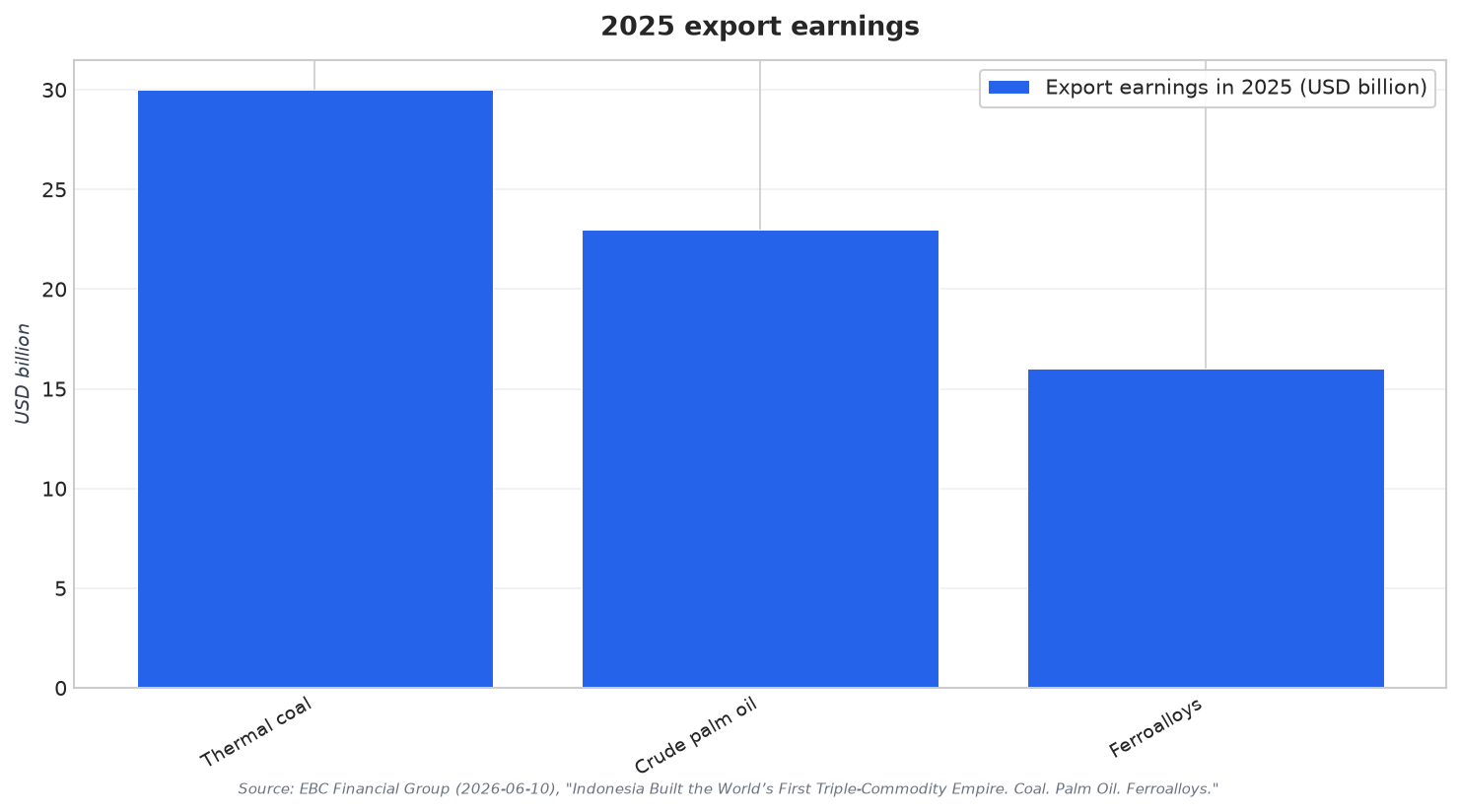
The plan targets commodities where Indonesia holds strong positions in global trade. HLC said Indonesia is the world’s largest exporter of coal, palm oil, and nickel, with combined exports exceeding US$65 billion in 2025. EBC reported 2025 earnings of $30 billion for thermal coal, $23 billion for crude palm oil, and $16 billion for ferroalloys, for a combined haul of over $65 billion. HLC also stated Indonesia accounts for more than 40% of global seaborne thermal coal trade and supplies around 50% of global palm oil trade. Lexology further noted that palm oil, coal, and ferroalloys accounted for around a quarter of Indonesia’s total exports in 2025, reinforcing why the initial list focuses on these channels.
The policy is justified by the government as a response to under-invoicing and pricing power. Reuters reported Prabowo’s claim that Indonesia lost as much as $908 billion in revenue over the last 34 years because commodities were sold “on the cheap,” and quoted him saying palm oil prices are decided in other countries. EBC similarly framed the move as an attempt to convert Indonesia’s physical weight in supply into more influence over price setting, while also reporting Prabowo’s claim that under-invoicing cost $908 billion in lost revenue between 1991 and 2024. Alongside export routing, EBC described a parallel rule effective the same day: exporters must place foreign earnings in state-owned banks, at 100% for 12 months for palm oil and ferroalloys, and 30% for three months for coal.
Execution risk is the central concern raised by analysts and legal observers. Reuters quoted S&P Global Energy’s Pritish Raj warning markets may price “transitional uncertainty” until there is clarity on execution, documentation processes, and trade flows, while Indonesia may add more commodities at three-month intervals. IndexBox reported Senior Economic Minister Airlangga Hartarto said the government will evaluate every three months which commodities to add, with a three-month transition period where exports can continue but will be strictly monitored. EBC described a negative market reaction soon after the change, with the rupiah breaking past 18,000 per dollar for the first time on June 4 and the Jakarta Composite Index down roughly 31% in 2026, while a materials sector subindex dropped more than 9% in a single session on June 3. Lexology cautioned that contract transfers and timing mismatches could delay shipments and disturb supply chains planned months in advance.
What is Indonesia changing with state-controlled commodity exports?
Which commodities are included in the first phase, and why do they matter?
How big is Indonesia’s role in global coal and palm oil trade?
What is the timeline for adding more commodities to the controlled export list?
How does the Indonesia commodity export state control plan affect exporter proceeds?