
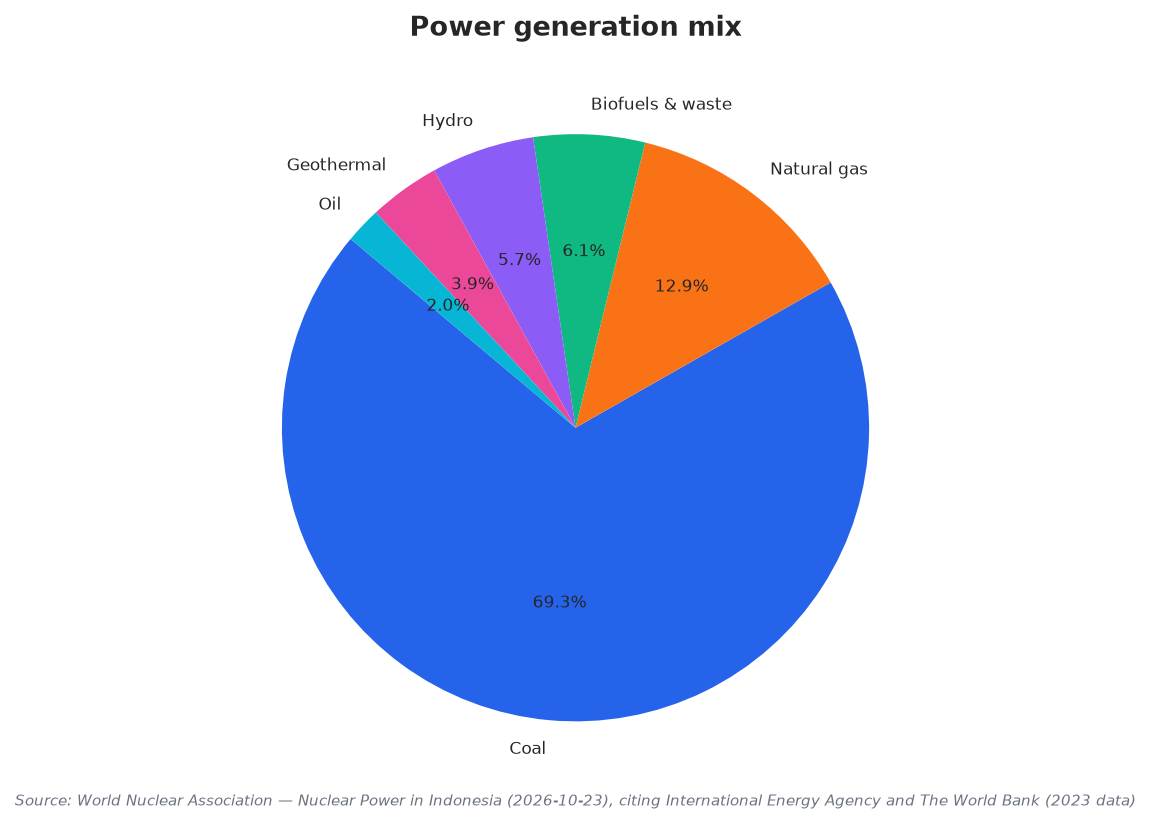
Indonesia still generates 0% of its electricity from nuclear power, and in the past five years it has produced no nuclear electricity. In 2023, total generation was 433 TWh, led by coal at 300 TWh (69%) and natural gas at 56.0 TWh (13%), with biofuels & waste at 26.5 TWh (6%), hydro at 24.6 TWh (6%), geothermal at 16.9 TWh (4%), and oil at 8.6 TWh (2%). Per capita electricity consumption was about 1500 kWh in 2023, up from about 550 kWh in 2000. Indonesia’s population of about 282 million was served by power generation capacity of about 101 GWe in 2024, while blackouts were still described as frequent.
Against that backdrop, the national discussion has shifted from “whether” to “how,” and the first-unit timeline is now part of public market signaling. The government is considering 500 MWe of nuclear capacity by 2034, and another industry-facing view frames a 500 MW first plant by 2032 within a wider target of 44 GW by 2060, including a dedicated 9 GW for hydrogen production. Separately, 2025 planning talk included proposals for 4–10 GW of nuclear capacity by the 2030s–2040s, but these were described as proposals rather than construction-ready projects. Site screening has been associated with Sumatra and Kalimantan, and a West Kalimantan project has been cited as a near-term prospect.
Regulatory Gaps: The Difference Between Policy Support and Bankable Projects
Multiple sources underline a similar risk: policy recognition is not the same as investment-grade certainty. BAPETEN is described as Indonesia’s independent regulator for nuclear and radiation safety, and it is updating its licensing framework for modern designs. Yet several “missing middle” components repeatedly surface as constraints: a standardized licensing pathway with clear and enforceable timelines, a credible offtake and tariff framework that makes revenue foreseeable over a 30-year horizon, and a well-defined, proportionate nuclear liability regime. One analysis also argues for a “governance before infrastructure” sequence that prioritizes legislation, licensing systems, liability frameworks, emergency preparedness, and long-term waste management strategy before project decisions rather than developing them in parallel.
Fuel-cycle strategy and long-horizon capacity aspirations add another layer of complexity. A simulation-based study describes an “ambitious 44 GWe nuclear roadmap” and quantifies material needs for a 44 GWe (99-reactors) fleet, including demands for 131,000 tonnes of uranium and management of nearly 15,000 tHM of spent fuel. It also identifies strategic gaps, including a “Fabrication Sovereignty Gap” with over 90% import reliance, plus a “Backend Reality Gap” that it frames as a mismatch between optimistic planning and geopolitical realities of waste management. Today, Indonesia’s nuclear system is oriented around research and supporting infrastructure: three research reactors (including RSG-GAS at 30 MW in Serpong) and centralized radioactive waste handling at PTLR in Serpong under BRIN for low- and intermediate-level waste and interim storage for used fuel from research reactors.
For suppliers, the openings sit where Indonesia is still evaluating designs and still building the rules around them. A five-year cooperation agreement with Japan was described as non-binding and extendable for an additional five years, giving Jakarta flexibility as it evaluates competing SMR designs from American, Japanese, Danish, Russian, and other suppliers. A trilateral Indonesia-Japan-US framework has been linked to discussions on SMR regulatory frameworks, workforce development, and stakeholder engagement, while Russia’s Rosatom has pitched a floating nuclear power plant for Indonesia. In East Kalimantan, four Danish companies signed an MOU with Pupuk Kalimantan Timur and Pertamina New & Renewable Energy for a potential $4 billion thorium SMR facility in Bontang targeting ammonia production for fertilizer. The picture that emerges for an Indonesia nuclear power plant program is a crowded pre-project arena, where credible licensing, procurement transparency, and financeable revenue structures may determine who converts MOUs and feasibility work into real builds.
Does Indonesia generate any electricity from nuclear power today?
What timelines are being discussed for Indonesia’s first nuclear power plant?
Who regulates nuclear safety in Indonesia?
What regulatory gaps are highlighted as barriers to investment?
Where are supplier openings emerging for the Indonesia nuclear power plant market?