
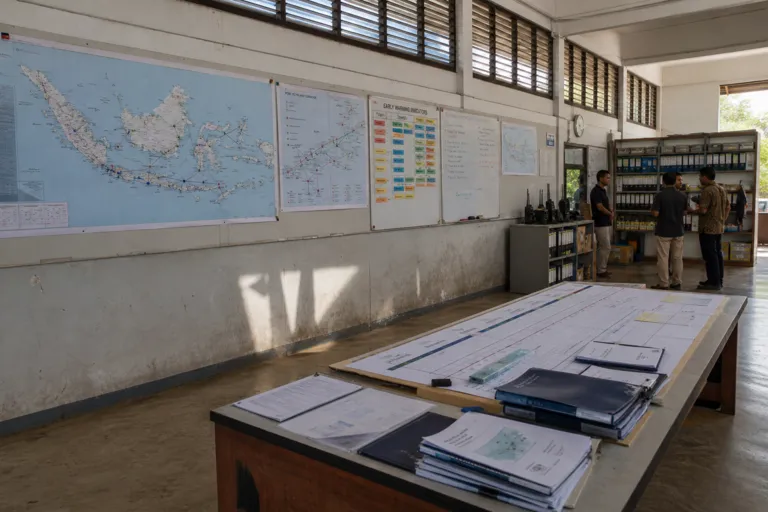
Indonesia’s operating context forces strategy teams to plan for variance, not averages. One source describes 285 million people across 17,000 islands and over 700 languages, with purchasing behavior varying by island, religion, generation, and income tier. It also warns that research scoped to Jakarta becomes “Jakarta data,” not national reality, even as Jakarta and Java account for 57% of GDP but only 40% of population. For scenario work, that implies every “national” plan needs explicit assumptions about geography, channels, and execution constraints. A separate business brief also highlights local currency planning by citing an exchange rate of approximately 1 USD = 17,592 IDR, reinforcing why budgeting and unit economics can flip under volatility. In 2025, GDP growth is cited as approximately 5.11% year-on-year, and Indonesia’s digital economy is framed with an estimated US$ 99 billion in gross merchandise value.
A practical way to structure Indonesia scenario planning for 2027 is to start with a four-quadrant logic built around two critical uncertainties. In Indonesia’s baby care industry, one scenario-planning study describes uncertainty drivers including economic volatility, rapid digital transformation, changing consumer preferences, demand for product safety, and intensifying competition. The research used semi-structured interviews to identify driving forces, prioritized them into two major critical uncertainties, and then developed four plausible futures: The Battle Arena, The Golden Age, The Dark Times, and The Old Guard, with early warning signals to anticipate changes in macroeconomic and industry conditions. The method matters for 2027 planning because it is built for ambiguity, then tied back to decisions via evaluating current strategy, identifying strategic gaps under each future, and translating implications into a TOWS matrix and a five-year implementation roadmap.
Four Macro Paths to Model for 2027 (and What to Watch)
Path 1: “Digital Acceleration, Concentrated Core.” Here, strategy assumes faster enterprise digitization, but execution concentrates where adoption is already densest. Mordor Intelligence estimates the Indonesia digital transformation market grows from USD 24.37 billion in 2025 to USD 29.03 billion in 2026, forecast to reach USD 69.57 billion by 2031 at a 19.11% CAGR (2026–2031). It also reports Java and Sumatra contributed 69.84% of market size in 2025. Path 2: “Digital Leap, Frontier Catch-up.” This path assumes Eastern Indonesia’s faster trajectory becomes strategically decisive; Mordor Intelligence cites a 24.86% CAGR to 2031 for Eastern Indonesia. For both paths, teams can set early-warning signals around where cloud-heavy programs land, since cloud solutions captured 52.41% share in 2025 and cloud and edge computing led with 28.07% by technology. These signals help teams avoid overfitting a single “Indonesia” assumption to very different regional realities.
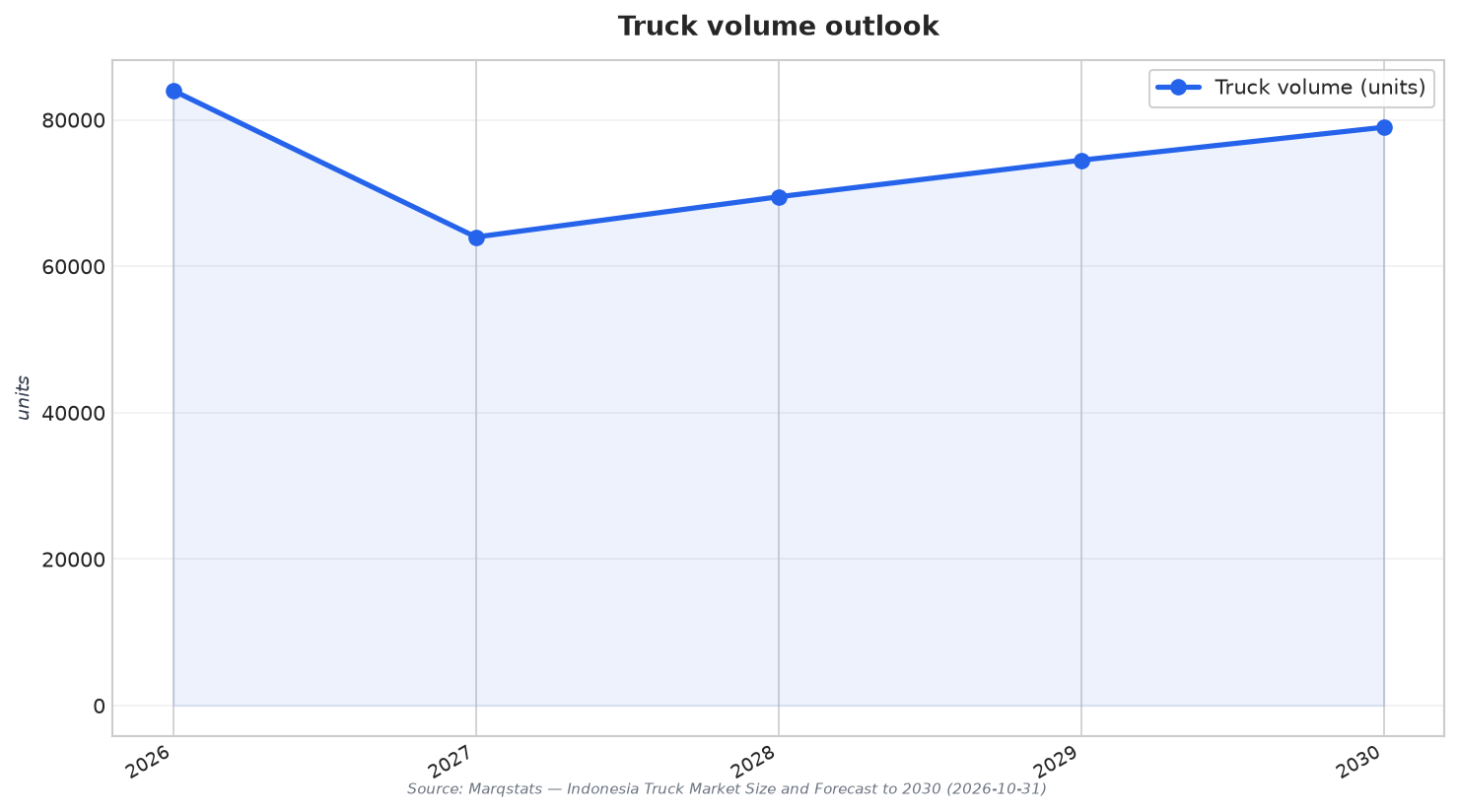
Path 3: “Channel Shake-up Under Pressure.” Scenario work should stress-test what happens if distribution channels evolve quickly while margins compress. A study of a family-owned FMCG distributor in Central Java identified two critical uncertainties: the pace of distribution-channel evolution and the severity and pace of tobacco regulatory tightening, then constructed four scenarios to 2030 and tested options in a robustness matrix. It found operational optimisation robust in every future, and preservation of the status quo unfavourable, while expansion, franchising, and exit were contingent bets keyed to particular scenarios. Path 4: “Regulatory-and-Capacity Whiplash.” In logistics-linked categories, 2027 can be distorted by capacity resets. Marqstats estimates 84,000 trucks in 2026 and 64,000 in 2027, describing a 23.81% fall from 2026 as 31,500 programme trucks stop, with 2026 Hino waiting times of four to five months cited as evidence regular customers were crowded out. It also notes Zero ODOL data integration reached 98% and the start stays at January 2027, creating a clear marker to monitor alongside weighbridge enforcement actions after January 2027.
To make these four macro paths usable, translate each into “decision tests” rather than narratives. The brand-building lens in one consumer-focused essay recommends evaluating consumer economics across four connected layers: SKU, channel, working capital, and company profitability, and it cautions that market growth does not automatically translate into an attractive company. Combine that with the scenario-planning studies’ emphasis on early warning signals and gap analysis: define what must be true in each path for your pricing, service levels, and cash conversion to hold. Finally, keep locale fidelity: treat Jakarta-centric evidence as partial by design, specify which islands and channels the plan assumes, and pre-commit thresholds for go/no-go gates such as willingness-to-pay validation, OSS licensing timelines, and whether a channel strategy ignores traditional trade outside major urban centers. This is how a 2027 plan stays adaptive without becoming vague.
How should teams structure Indonesia scenario planning for 2027?
What Indonesia-specific signals can anchor a 2027 scenario set?
Which digital transformation figures can strategy teams use in scenarios?
What 2027 logistics capacity shift is highlighted for Indonesia’s truck market?
What strategic options look robust across uncertain futures in Indonesia distribution?