
Indonesia’s hospitality real estate outlook is being defined by a transition from recovery to pipeline discipline. Mordor Intelligence expects the Indonesia hospitality real estate market to grow from USD 2.44 billion in 2025 to USD 2.7 billion in 2026, and forecasts USD 4.46 billion by 2031, at a 10.58% CAGR over 2026-2031. That trajectory is being supported by demand signals tied to long-run development, including government infrastructure spending of USD 25.5 billion in 2025 and the ongoing Nusantara Capital City program. In parallel, tourism’s USD 72.5 billion contribution to 2024 GDP is cited as a marker of post-pandemic resilience that investors can underwrite when assessing where the next hotel and resort corridors may form.
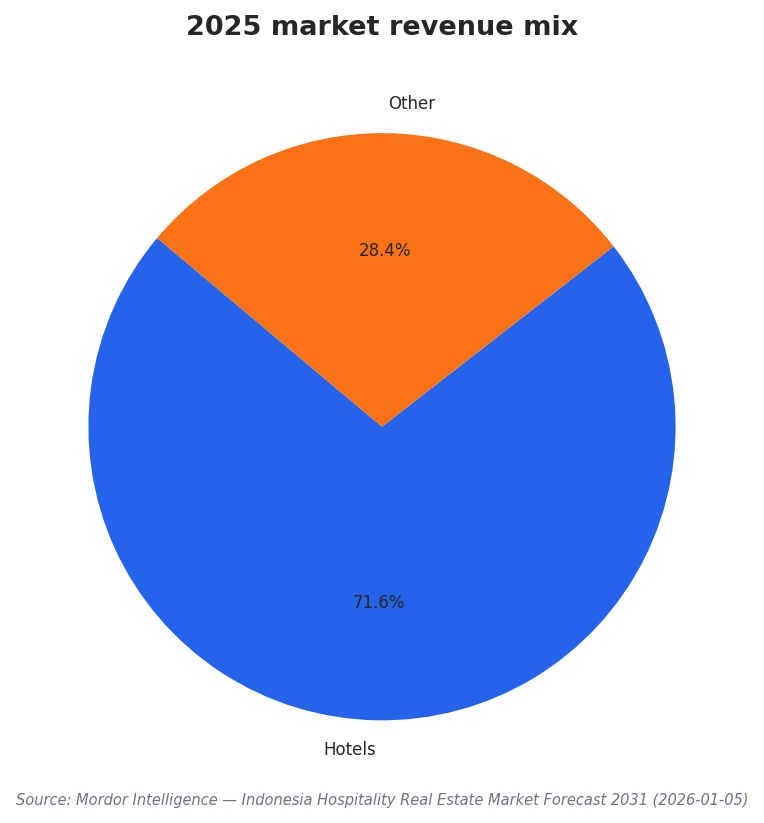
Understanding the Indonesia hotel investment pipeline also requires clarity on what is generating revenue today versus what is expected to grow tomorrow. In 2025, hotels led by property type with a 71.64% revenue share of Indonesia’s hospitality real estate market, according to Mordor Intelligence. Independents still held the larger share by type at 62.85% in 2025, while chain hotels are projected to expand at an 11.14% CAGR through 2031. Midscale assets represented a 41.78% share in 2025, yet luxury developments are forecast to grow at an 11.46% CAGR to 2031. This mix suggests a bifurcated pipeline: large existing independent and midscale bases, alongside faster growth expectations in branded and luxury-led formats.
Where the Next Corridors Are Forming: From Jakarta to “Rest of Indonesia”
Geography is another key filter for mapping investable opportunities. Mordor Intelligence notes Jakarta captured a 27.14% share in 2025, while the “Rest of Indonesia” category is set to log the fastest 11.74% CAGR through 2031. Several government-backed destination strategies reinforce why investors are scanning beyond the traditional cores. Mordor Intelligence highlights USD 3.7 billion in private hospitality commitments tied to the Nusantara Capital City program. It also cites North Sulawesi’s USD 50.0 million influx into hotels and restaurants as an example of capital moving toward less familiar islands. HVS frames the same expansion through the “10 New Balis” approach, with five Super Priority Destinations: Lake Toba, Borobudur, Mandalika, Labuan Bajo, and Likupang.
At the destination level, HVS provides a concrete case study in Labuan Bajo. Public and private investments of IDR 4-6 trillion helped transform infrastructure across transport, utilities, and tourism zones. Demand indicators show 2023 total visitors reached 424,000, with 2024 recording 411,000, and HVS notes both years doubled 2019 figures. The existing upscale set includes Labersa Hotel (152 keys), Hotel Niagara (170 keys), and Taman Resort (130 keys). Yet HVS also cautions that as of 2025 there were no notable pipeline projects under international brands announced there, which can matter for investors prioritizing global flag depth, financing familiarity, or brand-driven demand capture.
At the top end of the market, performance and adjacent real estate formats are shaping underwriting. STR, as cited by Hospitality Net and InClover Magazine, reports Indonesia’s luxury hotel occupancy for the 12 months ending March 2026 returned to pre-pandemic levels, while other hotel classes remained 5.5 percentage points below their previous highs. InClover also states Indonesia’s hotel rates have risen by more than 40% since 2019. ITX 2026 further spotlighted branded residences in Bali, with C9 Hotelworks research indicating Asia’s branded residences pipeline reached IDR 707 trillion (about USD 40 billion) across 50,025 units, representing 30.3% year-on-year growth. For pipeline mapping, that combination suggests luxury hotels and branded living products can move in tandem where international demand is strongest.
What signals are shaping Indonesia’s hotel investment pipeline beyond the rebound?
Which hotel segments lead today, and which are projected to grow faster?
How does the geography of growth look across Indonesia?
What does Labuan Bajo tell investors about destination-led growth?
What does the luxury recovery imply for future hotel development decisions?