Indonesia’s preparation phase for the Indonesia–European Union Comprehensive Economic Partnership Agreement (IEU-CEPA) is increasingly focused on what happens after signatures. Several public updates point to an end-of-October 2026 signing target, while the government has also voiced optimism that implementation could begin in early 2027, once both sides complete signing and ratification. This matters because tariff outcomes are central to export planning. The Jakarta Post reports that around 90% of tariff lines for Indonesian goods entering the EU market will gradually be eliminated to zero, while other reporting specifies the near-term shape of that transition once the agreement takes effect.
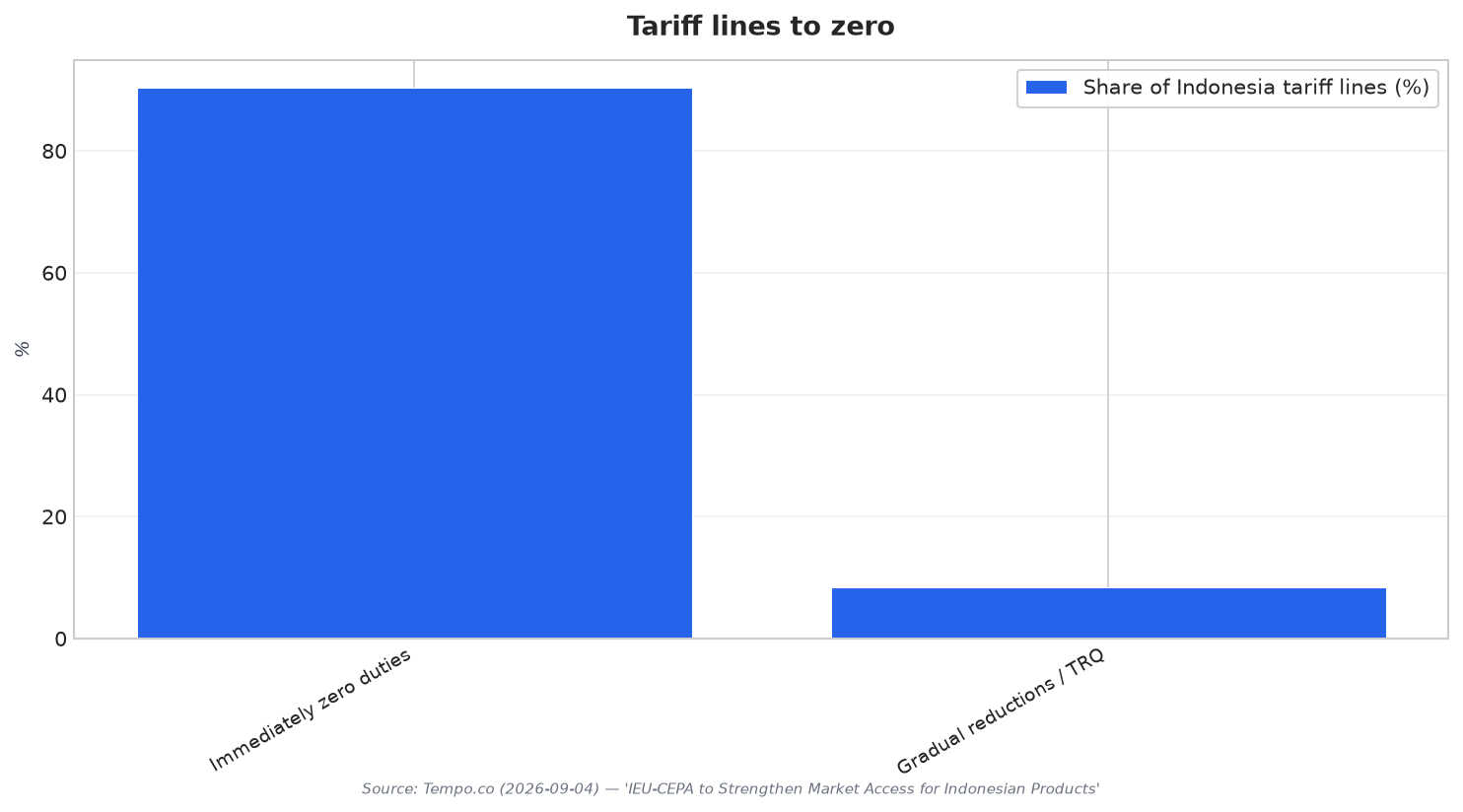
For exporters, the most actionable signal is how many products move to duty-free treatment and how quickly. Tempo and Europesays report agreed conditions in which 90.4% of Indonesia’s tariff lines would receive zero tariffs immediately once the agreement enters into force. They also state that another 8.37% would benefit from gradual tariff reductions and Tariff Rate Quota (TRQ) facilities. Separately, officials have highlighted administrative coordination with EU member states, noting the EU has 27 countries, which can affect sequencing and readiness work. Together, these details outline the core IEU-CEPA exporter benefits: broader, clearer pathways to lower landed costs in the EU, with some lines shifting instantly and others moving through staged reductions.
Sector-by-Sector Winners as EU Tariffs Move Toward Zero
Sector winners are likely to be those already identified as key Indonesian exports that stand to gain from tariff elimination and better market access. Palm Oil Magazine says the agreement is expected to eliminate tariffs on key Indonesian exports, including palm oil and derivatives, textiles, footwear, and rubber. That creates a direct planning agenda for each segment. For palm oil and its derivatives, the same source stresses that improved access and competitiveness depends on exporters meeting the EU’s increasingly stringent sustainability and regulatory requirements. For textiles, footwear, and rubber, the opportunity is similar: tariff relief is meaningful, but only if companies align product documentation, compliance processes, and buyer requirements to EU expectations during the run-up to implementation.
Preparation is not only about goods. Trade Minister Budi Santoso, as quoted by Palm Oil Magazine, emphasized that IEU-CEPA goes beyond tariff reductions for trade in goods and can help expand products in Europe, attract investment in strategic sectors, and strengthen Indonesia’s role in global supply chains. The Jakarta Post adds that the government expects the agreement to unlock greater European investment in Indonesia, and it lists target sectors: electricity and hydropower, batteries, renewable energy, digital industries, advanced manufacturing, critical mineral processing, water management, and sustainable infrastructure. While those are investment priorities rather than confirmed outcomes, they matter for exporters because investment can expand upstream supply capacity and downstream processing, which can support more stable EU-oriented production and compliance systems.
Exporters should also watch timelines and policy transitions. The Jakarta Post notes the IEU-CEPA only takes effect after being signed and ratified, and it highlights that Indonesia’s GSP facility for exports to EU countries is set to expire at the end of the year, with an aim to bridge any gap if IEU-CEPA is ratified soon. Other reporting adds a practical reference point on process speed: Europesays says Indonesian authorities anticipate the parliamentary approval process may take as little as 90 days, citing the EU–Mexico trade deal as an example. The best preparation is to map product tariff lines to the two buckets described above—immediate zero (90.4%) and staged/TRQ (8.37%)—and then build an EU-ready compliance plan so tariff relief is not lost to sustainability or regulatory friction.
When could IEU-CEPA be signed and start being implemented?
How many Indonesian tariff lines are expected to get zero duties in the EU under IEU-CEPA?
Which sectors are positioned as early winners from tariff elimination?
What should companies focus on to realize IEU-CEPA exporter benefits in the EU market?
What Indonesian sectors are being prioritized to attract European investment alongside the agreement?