Indonesia’s debate over an Indonesia regional tax increase is closely tied to what happens to central transfers. Ministry of Finance data cited by Kompas show transfers to regions at IDR 863.54 trillion in 2024, easing to IDR 849.04 trillion in 2025, then dropping sharply to IDR 696.9 trillion in 2026. Kompas describes that 2026 level as the lowest since 2016 and the deepest reduction across 25 years of fiscal decentralization. When that transfer pool falls, local governments face a narrower budget room, and the remaining options often point back to local revenue tools.
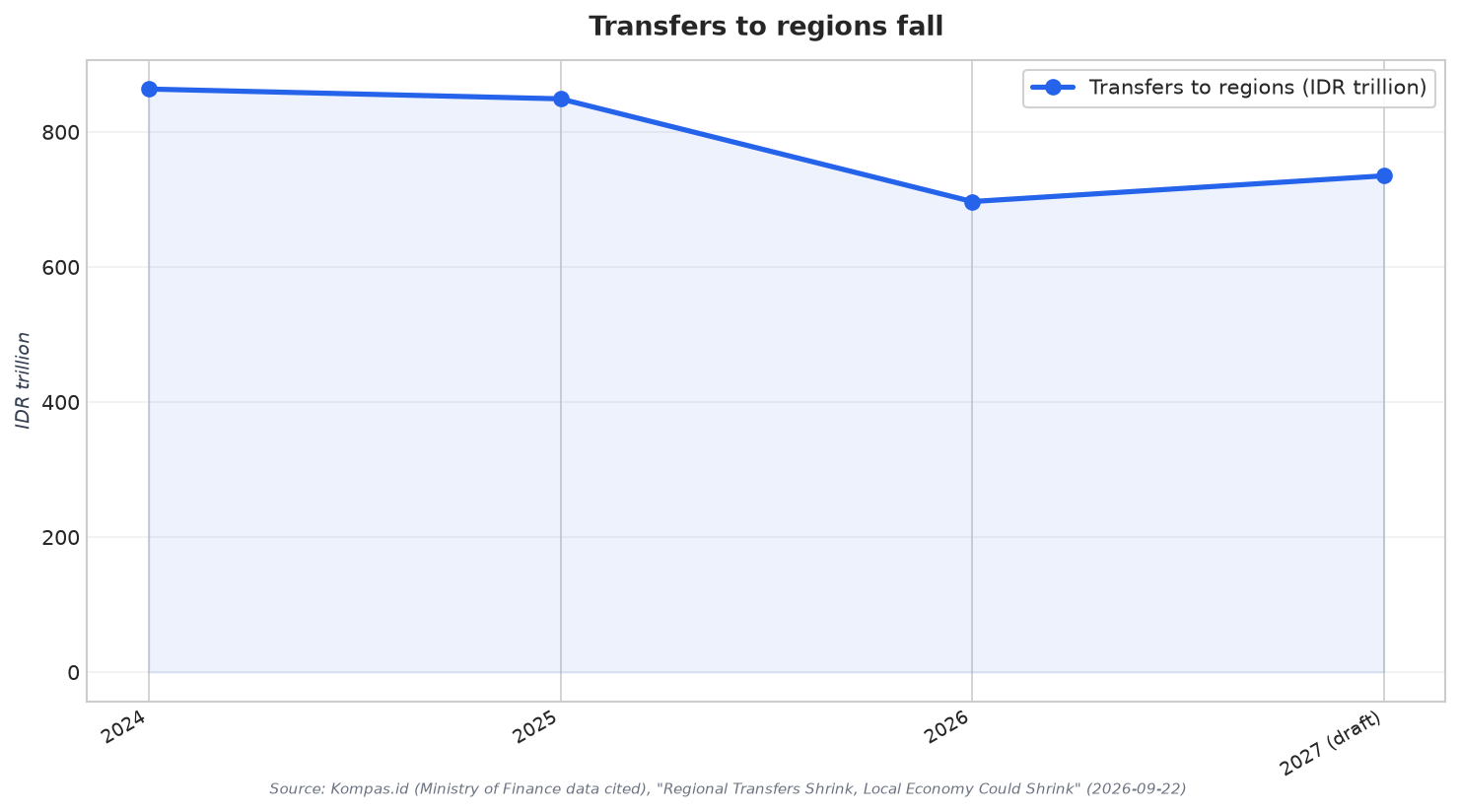
Kompas also reports that the share of transfers in total state spending has declined, from 28.24% in 2023 to a projected 17.94% in the 2027 Draft State Budget (RAPBN). For 2027, the RAPBN projects a regional development allocation of IDR 735 trillion, described as a 5.47% increase compared with the 2026 outlook, but still below a referenced 2025 TKD ceiling of Rp 919 trillion. The Regional Representative Council (DPD) subsequently proposed raising TKD from Rp 735 trillion to Rp 780.22 trillion. In this squeeze, regions may turn to measures that effectively raise the local burden on firms through taxes, retributions, and fees.
How Transfer Cuts Shift Fiscal Stress to Local Levies
President Prabowo Subianto, quoted by Kompas, linked the 2026 transfer reduction to funds that were transferred but not used and instead accumulated in banks, citing frictions such as conflicts between regents and local parliaments. Yet Kompas also warns that shrinking transfers can narrow fiscal space if it is not matched by stronger local revenue capacity or spending efficiency, which can reduce the ability to fund basic services and development programs. Research on provincial spending patterns supports a shift in emphasis: a 2021–2025 panel study across Indonesian provinces finds PAD and DAK have a significant positive effect on regional expenditure, while DAU and DBH are positive but not statistically significant in that sample. The implication is clear: when transfers feel less reliable, regions have incentives to intensify local revenue efforts.
This revenue push can be uneven across the country because not every region has the same tax base. An Indonesian Treasury Review discussion of fiscal inequality notes that regions with a dominant primary sector can face a narrow tax base, with businesses that are informal, small-scale, and scattered. It adds that local governments are not the authority collecting corporate income tax (PPh) from these businesses, so the taxes they can impose tend to be indirect or small levies. That structure can lead to higher dependence on fiscal transfers. When transfers are cut, these structural limits can make local governments more likely to lean on what they control, even if that means broader levy collection that businesses experience as higher local costs.
Administrative capacity also matters in how a local tax push plays out. A study of regional tax compliance across 34 provinces in Indonesia, using secondary data from 2020 to 2024, examines how factors such as socialization, inspections, collection costs, and provincial tax instruments—especially the motor vehicle tax (PKB) and vehicle ownership transfer tax (BBNKB)—relate to compliance. It situates this within fiscal federalism: decentralization gives provinces specific taxing powers over PKB and BBNKB, while major national taxes remain centralized. Put together with the transfer trends reported by Kompas, the direction is consistent: the path of least resistance for many regions is to strengthen what they can collect locally, which is why businesses watch local tax policy closely during periods of transfer tightening.
What transfer trend is raising concerns about local tax hikes in Indonesia?
Why can a transfer squeeze translate into higher local levies on businesses?
What did President Prabowo say about why transfers were reduced in 2026?
Why is the impact of an Indonesia regional tax increase risk not the same in every region?
Which local tax instruments are highlighted in research on provincial tax compliance?