Smart mobility in Southeast Asia is evolving as cities seek alternatives to growing congestion, high private-vehicle dependence, and fragmented public transport systems. Expanding mass transit, electric vehicles, shared mobility, and intelligent transport technologies could improve urban connectivity, although infrastructure financing and implementation remain major challenges.
The Future ASEAN Sustainable Cities whitepaper by Eurogroup Consulting, developed in cooperation with the French Foreign Trade Advisors (CCE), identifies sustainable urban mobility as a major priority for the region's rapidly expanding cities.
The challenge extends beyond introducing cleaner vehicles. Effective urban mobility requires coordinated transport planning, reliable infrastructure, accessible services, and systems capable of supporting future population growth.
Southeast Asia's Mobility Challenge: Private Vehicles Still Dominate
Private motorcycles remain particularly important in countries such as Indonesia, Vietnam, and Thailand, where two-wheelers offer relatively affordable and flexible transportation. However, widespread reliance on individual vehicles contributes to congestion, air pollution, and pressure on urban road networks.
The Eurogroup Consulting whitepaper presents a regional transport survey conducted in February 2022 and published by Statista. Among surveyed respondents, private motorcycles accounted for 45.9% of reported leading transport modes, compared with 22.1% for public transportation and 16% for private automobiles.
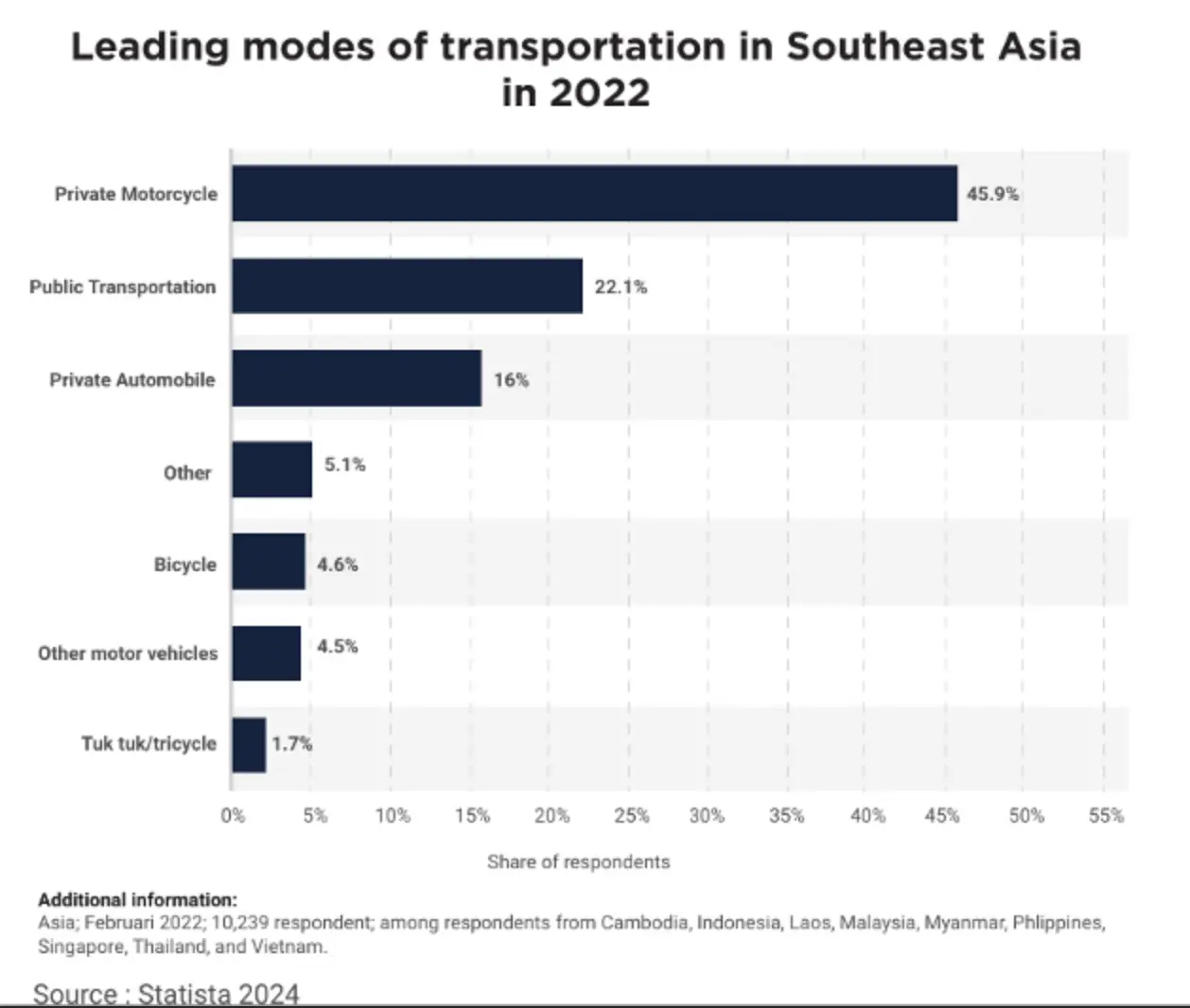
Leading Modes of Transportation in Southeast Asia in 2022. Source: Future ASEAN Sustainable Cities, Eurogroup Consulting (p. 31), based on Statista.
These figures describe survey responses rather than the total share of passenger trips or vehicles across ASEAN. They nevertheless illustrate the importance of private motorized transport within the region's mobility landscape.
The consequences of congestion extend beyond commuter inconvenience. Unreliable journey times can reduce workforce productivity, increase delivery costs, and complicate business operations. For companies operating in logistics, distribution, manufacturing, and urban services, transportation efficiency directly affects commercial performance.
How Is Public Transport Reshaping ASEAN Cities?
Mass rapid transit (MRT), light rail transit (LRT), and bus rapid transit (BRT) systems can provide alternatives to private vehicles, particularly in densely populated urban corridors. However, building individual transport lines is only part of the solution. The wider challenge involves creating connected networks that allow passengers to move efficiently between different modes.
Jakarta illustrates this approach. The whitepaper highlights the city's efforts to integrate BRT, MRT, and LRT services while developing unified electronic payment arrangements. Singapore offers another regional reference point through its established MRT network and intelligent transport planning, while Manila and Ho Chi Minh City are also developing urban rail infrastructure.
The effectiveness of these investments depends on several factors. Stations must be accessible, schedules should support reliable journeys, and connections with residential and employment areas need to be considered during project planning. Fare structures, maintenance capacity, service quality, and institutional coordination can influence whether infrastructure delivers the expected improvements.
For engineering companies, transport operators, and technology providers, integrated mobility projects create opportunities extending beyond physical construction into ticketing systems, passenger information, operations, and maintenance.
Electric Vehicles and Shared Mobility: A Changing Urban Ecosystem
The Eurogroup Consulting whitepaper reports that regional electric vehicle sales tripled in 2023, with Thailand recording growth of approximately 400% compared with 2022. These historical figures illustrate the pace of adoption during the report's research period rather than the current level of EV sales.
However, electrification alone does not resolve urban congestion. Replacing conventional cars with electric vehicles may reduce certain emissions, but cities still require effective traffic management and transport alternatives. Electric buses, shared vehicles, and micromobility solutions can complement mass transit by serving routes and journeys that fixed infrastructure cannot easily accommodate.
In Indonesia, services such as Gojek and Grab illustrate how digital platforms have become integrated into everyday urban transportation. These platforms can help address first- and last-mile travel needs, although their effects on overall traffic depend on operating patterns and local transport conditions.
The expansion of electric mobility introduces additional infrastructure requirements, including public charging networks, reliable electricity supply, parking arrangements, technical maintenance, and appropriate safety standards. Read more about these challenges in Can Indonesia's EV Infrastructure Meet the Moment?, which explores the relationship between EV adoption and charging infrastructure development.
From Jakarta to Singapore: Technology Is Changing the Commuter Experience
Traffic-management systems, electronic ticketing, real-time passenger information, and data analytics can help transport authorities improve how existing networks operate.
The whitepaper identifies Singapore's Smart Mobility 2030 initiative as an example of intelligent transport development, including traffic monitoring, predictive analytics, and emerging transportation technologies. Kuala Lumpur provides another example through its exploration of Autonomous Rapid Transit technologies. However, the whitepaper emphasizes that autonomous driving remains experimental in many applications.
As Henri Pottier, CEO Asia-Pacific at RATP Dev, explains in the report:
"One of the biggest challenges for ASEAN cities is to build infrastructure that is not only adapted to current needs, but also scalable and sustainable in the long term."
For technology companies, this creates opportunities in areas such as transport data management, integrated payments, predictive maintenance, and passenger information systems. Digital technology can improve mobility performance, but it cannot replace effective transport planning.
What Smart Mobility Means for Infrastructure Investment
The Asian Development Bank estimate cited in the whitepaper identifies US$8.4 trillion in regional transport infrastructure requirements across the 2016–2030 period. However, the most attractive opportunities will not necessarily be the largest projects. Smaller investments in network integration, service reliability, charging infrastructure, and intelligent systems may also deliver meaningful operational improvements.
For companies evaluating Southeast Asian markets, several considerations are important:
- Transport integration: How new services connect with existing road, rail, and bus networks.
- Commercial feasibility: Whether projected demand can support sustainable operations.
- Technology readiness: Whether proposed systems have demonstrated reliability in comparable environments.
- Local implementation: How regulations, procurement structures, and partnerships affect delivery.
Frequently Asked Questions
What is smart mobility in Southeast Asia?
Smart mobility refers to transport systems that combine efficient public transportation, digital technologies, electrification, and shared services to improve urban movement. In Southeast Asia, applications include integrated mass transit, intelligent traffic management, electronic ticketing, and electric vehicles.
What is the most commonly reported transport mode in Southeast Asia?
According to a February 2022 Statista survey cited in the Eurogroup Consulting whitepaper, private motorcycles represented 45.9% of respondents' reported leading transport modes. Public transportation accounted for 22.1%, while private automobiles represented 16%.
Why is public transport integration important?
Integrated transport systems make it easier for passengers to move between buses, rail networks, and other mobility services. Jakarta's efforts to connect BRT, MRT, and LRT networks illustrate the importance of planning transport as a connected system.
Explore the Future of Urban Mobility in ASEAN
Download the Full Future ASEAN Sustainable Cities Whitepaper
Explore Eurogroup Consulting's research, developed in cooperation with the French Foreign Trade Advisors (CCE), covering sustainable mobility, green infrastructure, smart technologies, investment requirements, and strategic opportunities across ASEAN.