
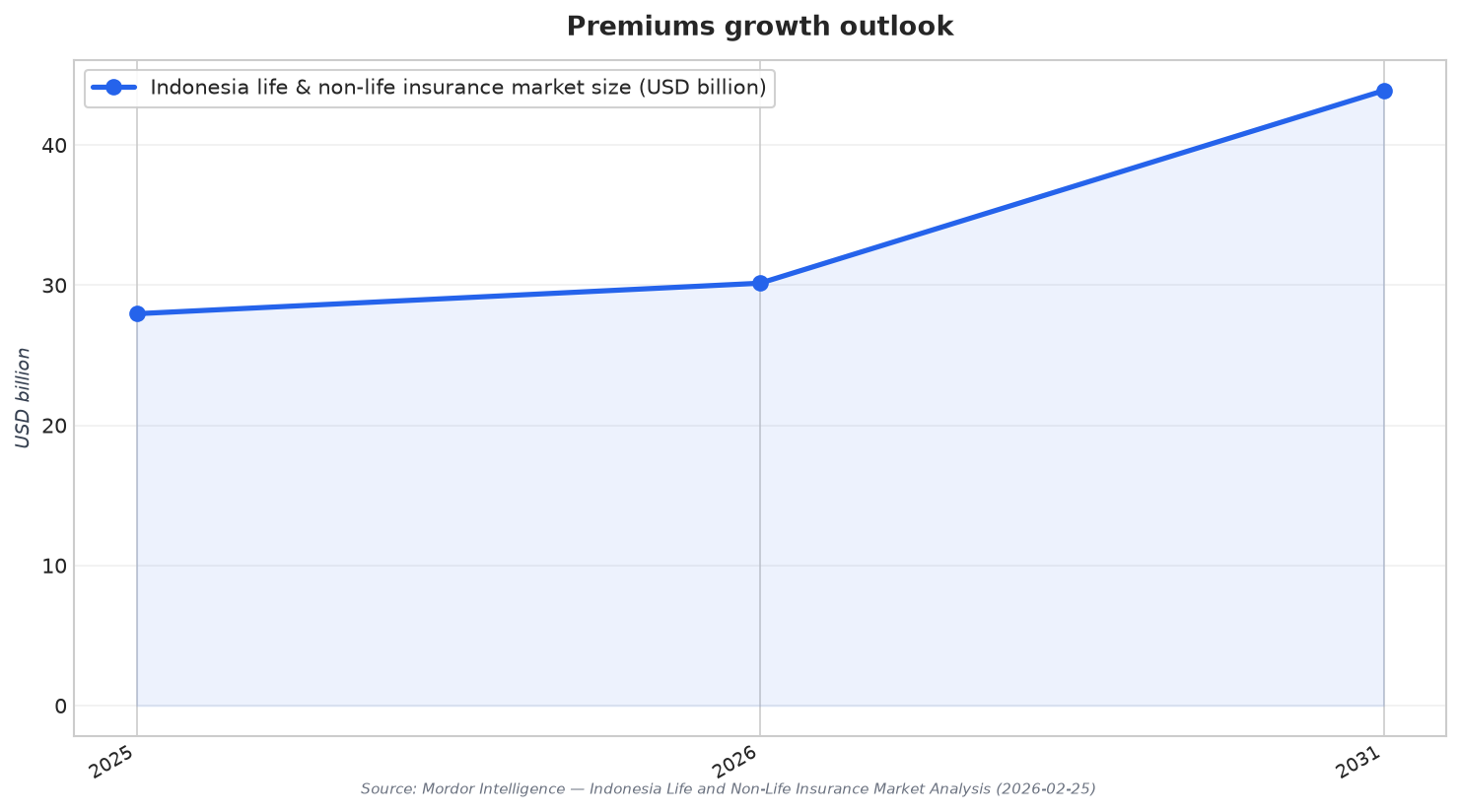
Indonesia’s life and non-life insurance market is expanding from a sizable base while still being described as structurally under-penetrated. Mordor Intelligence values the market, in premium terms, at USD 27.96 billion in 2025 and estimates it will rise from USD 30.14 billion in 2026 to USD 43.88 billion by 2031, implying a 7.80% CAGR for 2026–2031. This direction is supported by reforms that formalize digital distribution, strengthen prudential standards, and adopt IFRS 17 in 2022 to improve reporting quality and pricing discipline. OJK’s consumer-protection agenda also matters as the market scales beyond major urban centers.
Channel and product mix show where the next wave of demand can form, especially as more households seek first-time protection. Life insurance led with 70% of the Indonesian life and non-life insurance market in 2025, while non-life is projected to expand at an 11% CAGR from 2026 to 2031. Distribution is bank-led today, with banks capturing 33% share in 2025, but Mordor Intelligence also forecasts “other channels” growing at a 16% CAGR through 2031. Retail customers already account for 58% of the market and are projected to post a 9% CAGR between 2026 and 2031, aligning with a broadening middle-class footprint in financial services demand.
Digital Distribution, Trust, and the New Middle-Class Buyer
Indonesia’s regulators are pushing a modernization cycle that changes how people buy and manage policies. OJK’s modernization of distribution rules under POJK No. 38/2020 enabled product sales and servicing through electronic systems with registration and IT risk management requirements. Mordor Intelligence notes this helped catalyze a structural shift toward digital bancassurance in 2026, illustrated by Prudential’s long-term bancassurance agreement with Bank Syariah Indonesia in late 2024. Trust infrastructure is also getting stronger. In 2025, OJK deployed the Indonesia Insurance Agents Database and the Indonesia Insurance Policies Database to improve agent verification and policy-level transparency, with the stated goal of reducing mis-selling risk and supporting consumer confidence.
Health coverage reveals how baseline protection can create demand for upgrades. Mordor Intelligence values Indonesia’s health and medical insurance market at USD 1.63 billion in 2025, and estimates growth from USD 1.77 billion in 2026 to USD 2.54 billion by 2031, a 7.48% CAGR. Near-universal coverage under BPJS Kesehatan’s JKN is central to this dynamic: by October 2025, it had 283 million participants, equal to 99.34% of the population. The report says private demand concentrates on supplementary benefits, such as private hospital amenities and faster specialist visits, once consumers choose to upgrade beyond JKN entitlements under a coordination-of-benefits framework.
Specialty lines provide additional windows into how rising mobility and higher expectations translate into new premiums. NextMSC reports Indonesia’s travel insurance market reached USD 62.0 million in 2023 and is projected to grow to USD 143.7 million by 2030 at an 11.0% CAGR, driven by increasing outbound travel for leisure, business, education, and religious purposes like Hajj and Umrah. Across the broader Indonesia insurance market growth story, the recurring theme is distribution that meets customers where they are. In health, Financial Service Aggregators licensed by OJK reached 20 registered providers with 1,172 institutional partnerships and served 13.10 million users as of August 2025, pointing to a scalable path for simpler purchase journeys.
What is the projected outlook for Indonesia’s insurance premiums through 2031?
Which parts of the market are growing faster: life or non-life?
How is digital distribution changing Indonesia’s insurance buying process?
Why do people buy private health insurance if JKN coverage is near-universal?
What does Indonesia insurance market growth look like in travel coverage?