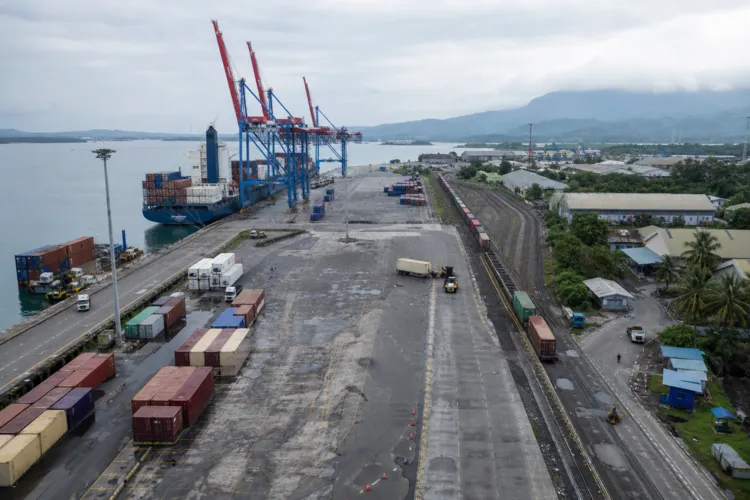
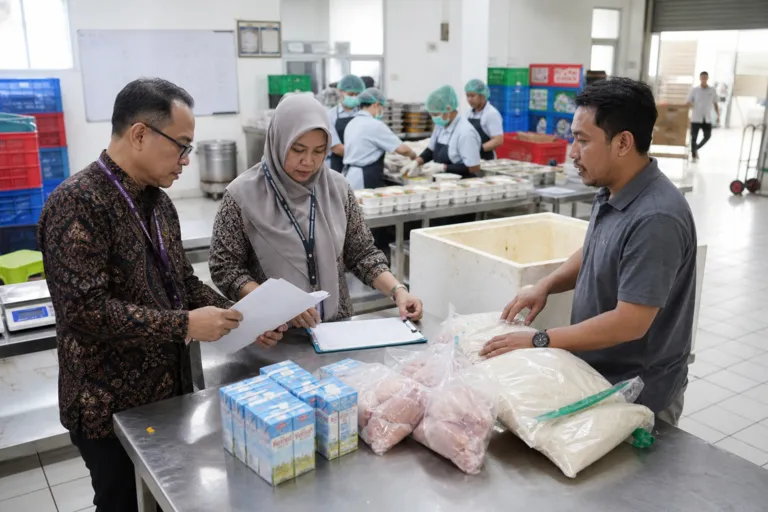
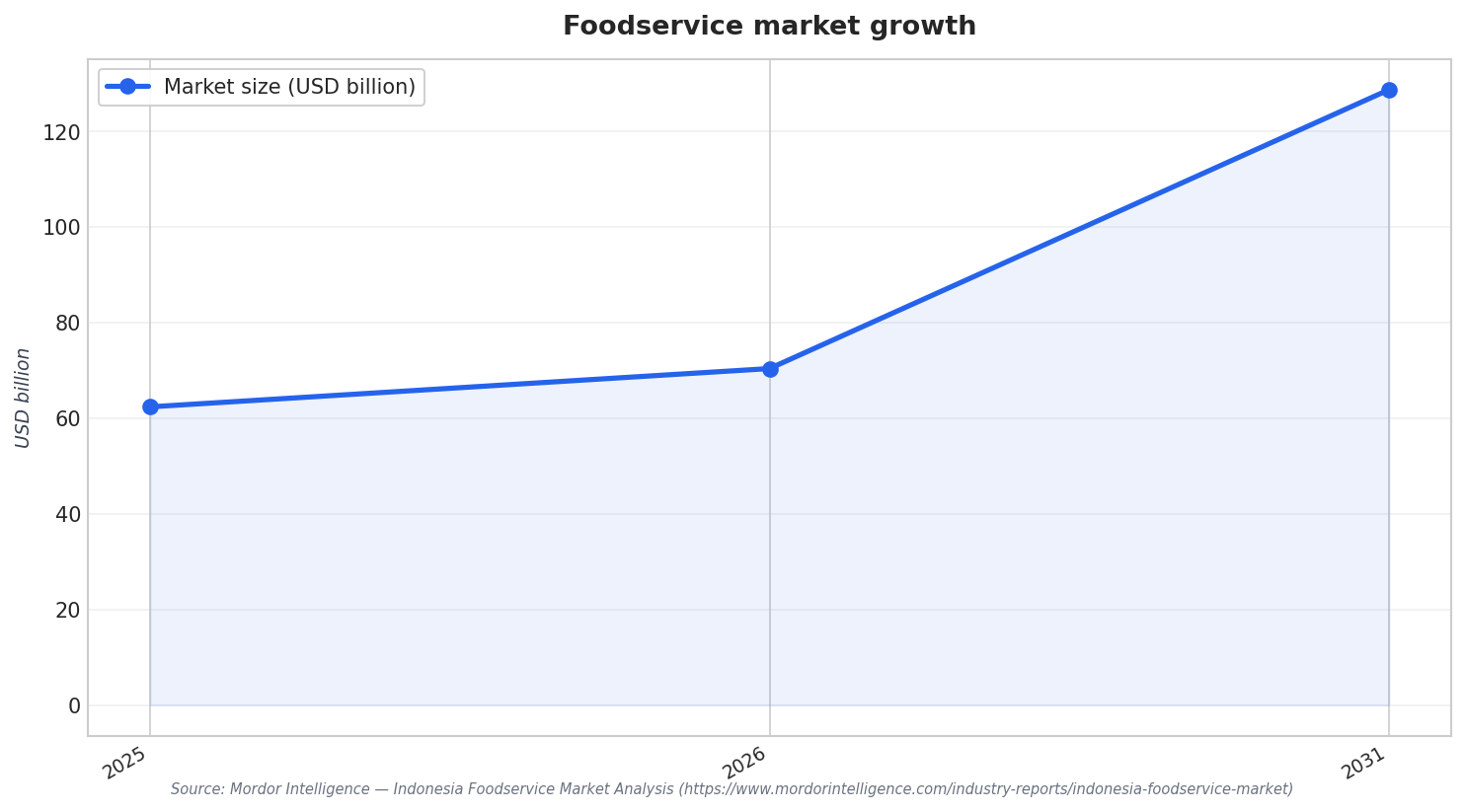
Winning supply contracts in Indonesia’s free meal program will not be only about price. It will be about dependable sourcing, scalable production, and distribution that works across diverse settings. That is why broader market signals matter when mapping where contract-ready capacity already exists. In foodservice alone, Mordor Intelligence estimates Indonesia’s market at USD 62.40 billion in 2025 and USD 70.41 billion in 2026, with projections reaching USD 128.76 billion by 2031 at a 12.84% CAGR (2026–2031). That expanding base suggests a growing ecosystem of kitchens, distributors, and standardized procurement routines that can be adapted for institutional meal delivery.
Procurement structure also hints at who can realistically execute at scale. In 2025, full-service restaurants held 52.67% of Indonesia’s foodservice market share, while independent operators accounted for 62.41% of market size. At the same time, chained formats are forecast to grow at a 13.76% CAGR through 2031. For a public meal effort, that split matters. Independents provide local reach, but chains and standardized operators can offer repeatable quality controls and centralized purchasing. Location and service patterns reinforce this: standalone venues held 77.68% share, dine-in was 47.96% in 2025, and takeaway is predicted to grow at a 12.98% CAGR to 2031, aligning with packaging and distribution requirements common in large meal programs.
Where the Biggest Supplier Openings May Concentrate
Imports and ingredient exposure shape the opportunity map for suppliers. Indonesia’s agricultural imports for fresh products and processed foods reached $29.6 billion in 2024, up from over $28 billion in 2022, according to Trade.gov. The most frequently imported commodities include soybeans, wheat, rice, beef, fresh fruits, and various feed ingredients. Ken Research adds that Indonesia’s foodservice industry relies heavily on imported ingredients, with over USD 20 billion worth of food imports annually, and notes that disruptions and rising import taxes have increased costs for restaurants. For program procurement, that environment can favor suppliers that can stabilize pricing, localize inputs where possible, or create blended sourcing strategies that reduce volatility.
Dairy and shelf-stable nutrition are another potential contract lane, especially when cold-chain constraints exist. IndexBox describes Indonesia’s non-perishable milk categories as UHT liquid milk, evaporated milk, sweetened condensed milk, and milk powder, and estimates total consumption to exceed 1.5 million metric tons per year in product-weight terms. It also estimates per-capita dairy consumption around 12–16 liters per year in liquid-equivalent terms, and notes that UHT has posted annual volume growth of 7–10% while milk powder grows 3–5%. IndexBox also states Indonesia remains a net importer of milk solids and estimates a national herd of 1.5–2 million dairy cattle. For suppliers, that mix points to opportunities in fortified UHT, powder-based formulations, and dependable import-to-processing pipelines that can meet volume targets.
Finally, the frozen and ready-meal ecosystem can support distribution-heavy feeding models. Mordor Intelligence reports that frozen ready meals lead Indonesia’s frozen food market, and cites Statistics Indonesia data showing 46.61% of urban expenditure in Indonesia was allocated to food in 2024. The same report highlights that off-trade and e-commerce growth requires integrated temperature control and effective last-mile delivery, and notes global suppliers are increasingly collaborating with local partners to align taste and texture with Indonesian preferences. For Indonesia free meal program suppliers, these signals point to a clear playbook: build partnerships that combine standardized production, compliant labeling and certification processes, and logistics strength—especially for shelf-stable and frozen formats that reduce daily delivery pressure.
What capabilities are most likely to win supply contracts for Indonesia’s free meal program?
How does Indonesia’s import dependence affect supplier opportunities?
Why might shelf-stable milk products matter for large meal distribution?
What does the foodservice market structure suggest about potential vendors?