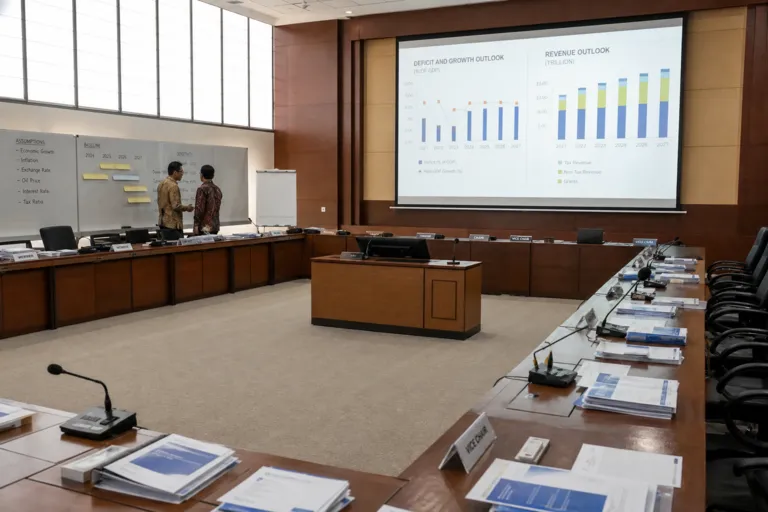
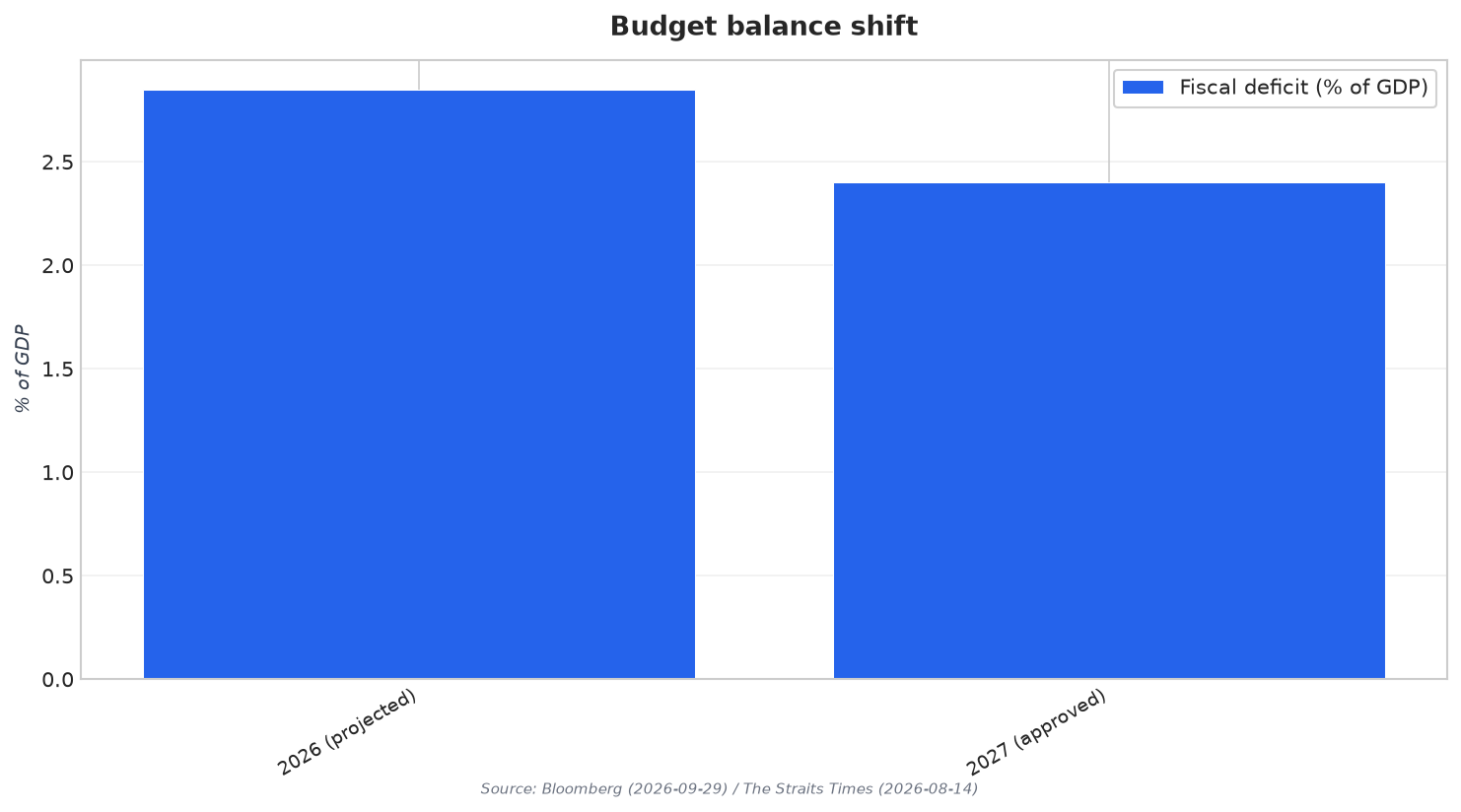
Indonesia has enacted a 2027 state budget that aims to combine faster expansion with tighter headline fiscal metrics. Bloomberg reported that parliament approved the budget at a plenary meeting, setting a deficit of 2.4% of GDP, or 671.2 trillion rupiah ($37.3 billion). The same report put planned state spending at 4,106.3 trillion rupiah against revenue of 3,435.1 trillion rupiah. The growth target attached to this package is 6%, which Bloomberg described as the fastest pace in more than a decade, and the deficit goal is designed to remain within the legal limit referenced as a statutory ceiling of 3% of GDP.
The deficit path matters because it is also a consolidation story versus the prior year’s baseline. Both Bloomberg and The Straits Times noted the 2.4% deficit target is lower than a shortfall projected at 2.85% of GDP in 2026. In his Aug 14 budget speech cited by The Straits Times, President Prabowo Subianto stressed that “fiscal discipline must be present in every rupiah that is spent,” arguing inefficiencies show up when ministries and local governments purchase the same goods separately at different prices. For markets, that discipline narrative landed alongside observable price signals in The Straits Times report, including a 10-year government bond yield noted at 7.18% after the remarks, and rupiah non-deliverable forwards extending gains by 0.4%.
Where the Numbers Look Conservative—and Where They Depend on Growth
Several sources framed the budget as restrained in structure, but fragile in its assumptions. BriefAsia said the draft plan projected 8.6% year-on-year revenue growth and 6.6% spending growth, with both hinging on achieving 6% GDP expansion. The same article said Indonesia’s GDP growth over the past 15 years has averaged around 5%, and that the economy has rarely breached 5.5% in recent years—context that makes the 6% forecast look more aspirational than empirical. CNBC similarly described the 6% target as an acceleration from a roughly 5% decade-long growth average, while still trying to keep the fiscal deficit below the 3% statutory ceiling.
The practical tension is that revenue is the key pressure point if growth undershoots. BriefAsia warned that tax collection accounts for the bulk of state income and is highly sensitive to economic activity; it added that missing the growth target could force spending cuts or widen the deficit. CNBC echoed the same balancing act, quoting DBS Bank’s Radhika Rao that the “scale of planned fiscal consolidation will require a sharp focus on revenue generation and debt management efforts.” CNBC also highlighted policy constraints: fiscal stimulus could lift growth, but the proposed budget points to little appetite for loosening, and Bank Indonesia operates independently of the government.
Execution and non-tax levers are therefore part of the credibility test for Indonesia’s 2027 state finances. The Straits Times reported Prabowo’s push for stricter spending controls and higher dividends from state-owned enterprises, including an expectation that SOEs remit 200 trillion rupiah in dividends to the state in 2026, a 40% jump from 142 trillion rupiah paid in 2025. Another implementation angle came from News Directory 3, which said fiscal management has shifted toward a more uniform distribution of spending through the year to avoid traditional year-end spikes, a change intended to improve discipline and help markets anticipate project outlays. Put together, the Indonesia 2027 state budget may stay within fiscal rules on paper, but its discipline will ultimately be judged by whether growth-linked revenue materializes and whether spending control becomes measurable in execution.
What deficit does Indonesia target in the 2027 budget?
How large are planned spending and revenue in the 2027 budget?
Why do analysts question the 6% growth assumption behind the plan?
What could happen if growth falls short of the target?
What is included in the Indonesia 2027 state budget debate about discipline?