
Rupiah swings in 2026 have turned routine currency risk into a business-model issue for companies that depend on imports. In Q1 2026, Indonesia’s GDP expanded 5.61%, yet market attention shifted to external funding support and dollar liquidity. EBC Financial Group noted USD/IDR pushing toward 18,000 as a $9.1 billion Q1 balance-of-payments deficit and a wider current-account deficit weighed on sentiment. The current-account deficit widened to $4.0 billion, or 1.1% of GDP, from $2.5 billion, or 0.7% of GDP, in Q4 2025. For import-heavy firms, these macro signals show why costs can rise even when domestic growth looks strong.
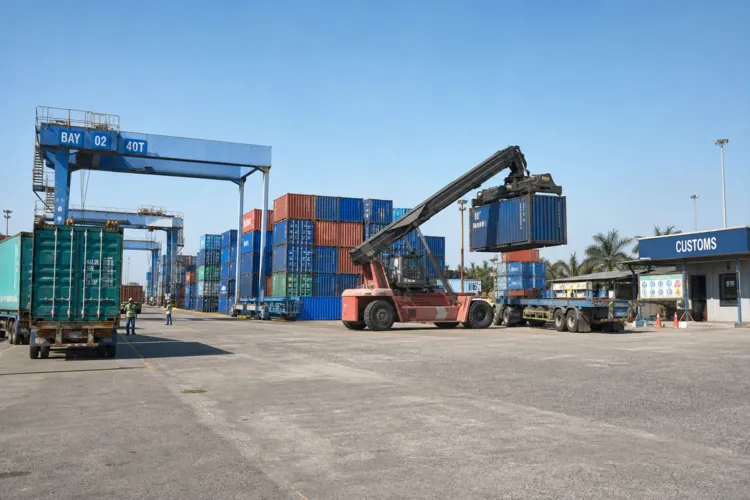
Trade and energy dynamics are a direct channel from macro stress into operating costs. EBC cited April trade data where the surplus narrowed to only $0.09 billion while imports rose 22.49% year on year, and oil and gas imports surged 85.52%. Smart Advisory Solutions also linked rupiah pressure to higher energy prices, noting Brent crude rising from around $68 per barrel in late February to above $110 at its peak in early May, before easing back toward $100 as ceasefire talks developed. It also reported foreign exchange reserves declining from $154.6 billion in January to $146.2 billion by April 2026. When energy imports and other inputs are priced in dollars, these moves reshape procurement budgets and working-capital needs.
How Currency Swings Rewrite Import-Reliant Business Models
At the company level, rupiah weakness creates a clear divide between firms that pay in dollars and those that earn them. Indonesia Business Post reported the rupiah weakening beyond Rp18,000 per US dollar and cited Bloomberg data showing Rp18,058 per US dollar in one session, while warning that companies reliant on imported raw materials, foreign-currency debt, or imported capital expenditure are expected to face higher operating costs and weaker profit margins. The same report said exporters with US dollar revenue and rupiah cost bases can see stronger earnings after conversion. For import-reliant businesses, this means profit protection depends less on volume and more on currency exposure, hedging behavior, and whether any revenue line can naturally offset dollar-linked costs.
Price discovery in 2026 has also been psychological, with Rp18,000 acting as a stress marker. The Southeast Asia Desk said the rupiah breached Rp18,000 per US dollar for the first time and hit an intraday low of 18,209/USD on June 9, 2026, citing Bloomberg and BI’s JISDOR. It added that back-to-back interest rate hikes pushed the BI benchmark rate to 5.75% on June 18 and that the rupiah later stabilized in the 17,700–17,800 range. Volfold observed the rupiah at 17,869.7 on June 1, 2026, with daily fluctuations between 17,807 and 17,890, and reported a steady 10% depreciation over the past year. For importers, these ranges can compress margins quickly if contracts, inventory cycles, and customer pricing move at different speeds.
Looking at the rupiah exchange rate outlook for 2026 through a market lens, volatility has remained two-sided, with episodic relief rallies. Trading Economics reported USD/IDR at 17,754.3000 on August 10, 2026, down 0.26% on the session, up 1.97% over the past month, but down 8.88% over 12 months, with an all-time high of 18,279 in July 2026. It also published expectations of 17,760.12 by the end of the quarter and 17,525.08 in 12 months. Even if the currency firms, the 2026 lesson for import-reliant models is structural: external deficits, energy import dollar demand, reserves, and capital flows can override headline growth and force continuous adjustments to purchasing, financing, and pricing policies.
Why did the rupiah weaken in 2026 even as GDP grew 5.61% in Q1?
Which import indicators signaled rising USD demand in 2026?
What happened when USD/IDR moved past Rp18,000 in June 2026?
How do currency swings affect import-reliant listed companies versus exporters?
What does the rupiah exchange rate outlook for 2026 imply for planning around volatility?