
Indonesia changed how foreign investors can enter the market through a PT PMA in late 2025. Under Minister of Investment Regulation (Permeninvest) No. 5 of 2025, effective 2 October 2025, the minimum paid-up capital for a foreign-owned company was reduced from IDR 10 billion to IDR 2.5 billion (also described as approximately USD 150,000). Government Regulation (PP) No. 28 of 2025 on Risk-Based Business Licensing came into force alongside it and supports the wider OSS-RBA framework. Together, these rules are presented as the legal foundation for PT PMA establishment in 2026, and they are widely framed as making Indonesia more accessible to mid-scale foreign investors, startups, and service providers.
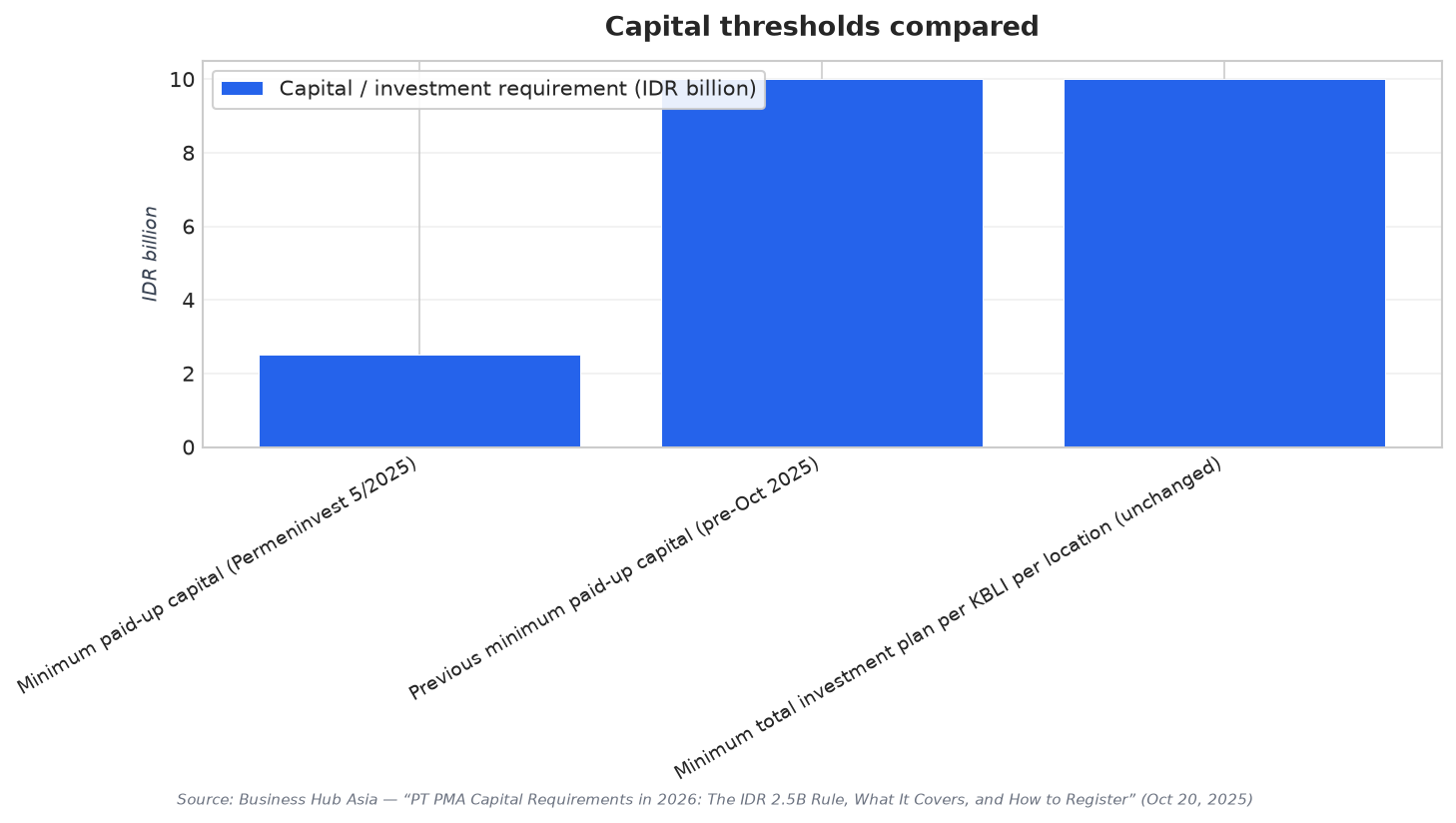
The key to using the lower entry bar is understanding what changed and what did not. Multiple guides warn that investors commonly confuse three separate figures: paid-up capital, authorised capital, and the total investment plan. The “IDR 10 billion” number many people cite is not the paid-up capital under the 2025 reform. It refers to a total investment plan obligation that still applies. Sources stress that confusing the investment plan with the cash deposit can lead either to over-capitalising unnecessarily or to under-planning and facing compliance issues during review.
What the IDR 2.5 Billion Rule Covers (and What Still Applies)
For 2026 planning, the revised framework separates the upfront paid-up capital from the broader investment commitment. The minimum paid-up capital is IDR 2,500,000,000 per company. Separately, the total investment plan must exceed IDR 10 billion per business activity (KBLI code), per project location, excluding land and building value. This per-KBLI approach can scale fast: one source gives an example where a PT PMA with two unrelated KBLI codes must plan for at least IDR 20 billion in total investment. Another warns that if a company spreads distinct KBLI codes across multiple locations, treating the plan as a single IDR 10 billion figure can stall licensing review because the numbers do not reconcile.
Mid-size investors also need to budget for cash timing and restrictions after incorporation. The same regulation that lowered the paid-up capital threshold includes a 12-month “capital lock-in.” Paid-up capital must remain in the company account for at least twelve months from the deposit date, except for permitted uses tied to the business, such as asset purchases, construction, payroll, rent, or equipment purchases supported by invoices or contracts. Sources describe this as a trade: a lower gate at entry, plus continuing scrutiny and a clearer obligation around keeping funds available for genuine operations. Some summaries also note that a shareholder capital statement letter (pernyataan modal) can be accepted during the process, but the overall theme is that the deposit and its retention matter in practice.
There are also structuring details that matter when you are trying to fit a real operating plan into the new framework. Paid-up capital can be contributed as non-cash assets such as machinery, equipment, or intellectual property, as long as an independent appraiser certifies the valuation and it is documented in the Deed of Establishment; land and buildings are excluded unless real estate is the primary business activity. Investors should also remember that immigration rules are presented as separate: one guide states that for an Investor KITAS, each individual investor must still hold a minimum share value of IDR 10 billion, regardless of the reduced paid-up capital threshold. For teams evaluating “Indonesia PT PMA minimum capital 2026” decisions, the practical takeaway is to map KBLI codes and locations early, then align capital injection, licensing, and operations to the 12-month retention rule.
What is the new minimum paid-up capital for a PT PMA in 2026 planning?
Is the IDR 10 billion requirement gone after the reform?
How does the per-KBLI rule affect the investment plan?
What does the 12-month capital lock-in mean for cash management?
When people ask about Indonesia’s PT PMA minimum capital for 2026, what number should they focus on?