Indonesia’s credit narrative in 2026 is split between headline growth and on-the-ground constraints. Bank Indonesia held the policy rate at 5.75% in July, after a cumulative 100 basis points of BI-Rate hikes between May and June to stabilise the rupiah. By June, system-wide credit was expanding 12.67% year on year, ahead of deposit growth of 10.21%. That gap matters because it pushes banks into tougher funding competition even when liquidity stays above regulatory minimums, raising the cost of keeping loan books growing at pace.
Later data still shows credit expanding, but with signals that funding and liquidity are becoming the binding constraint. Total bank credit growth accelerated to 13.3% year on year in August from 13.0% in July, based on Bank Indonesia data, while bank lending reached Rp 9,019.3 trillion. Broad money supply expanded 8.2% annually to Rp 10.45 quadrillion, and total bank customer deposits reached Rp 9,732.8 trillion, growing 7.7% year on year. When deposit growth runs behind credit growth, banks must pay more for funds or ration lending, which is where stalling momentum can start showing up for borrowers.
Liquidity Stress Is Reshaping Who Gets Credit—and at What Price
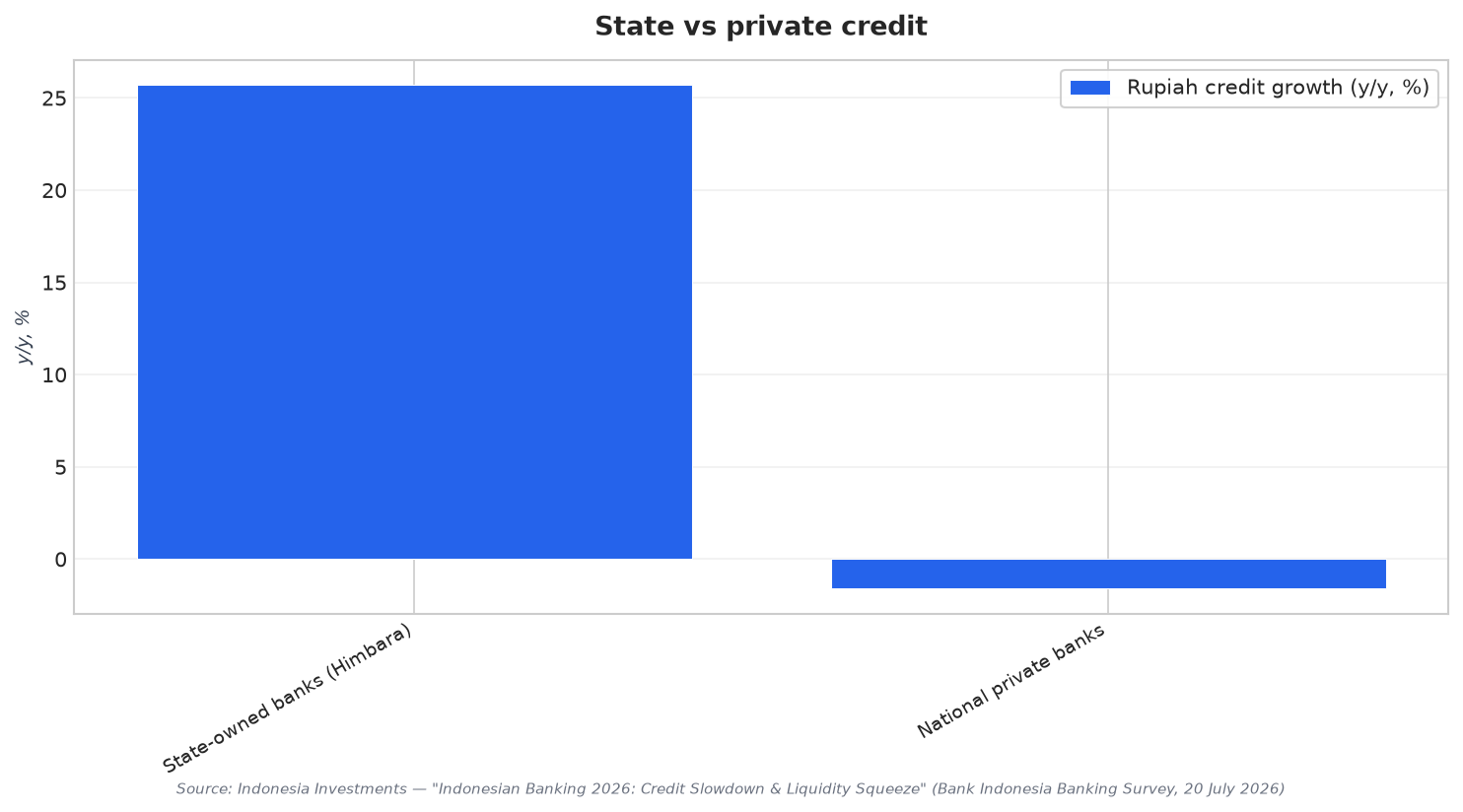
Several indicators point to credit supply being redirected rather than simply expanded. Bank Indonesia’s Banking Survey cited by Indonesia Investments projected third-party funds growth slowing to around 6.18% year on year by end-2026, while outstanding bank loans were forecast to decelerate to 7.51% year on year—below the lower bound of the central bank’s 8–12% credit growth estimation range. The same survey highlighted a sharp divergence: state-owned banks (Himbara) saw rupiah credit grow 25.7% year on year in May 2026, while national private banks contracted 1.6% year on year. This pattern implies that aggregate numbers can look “healthy on paper,” yet private credit transmission to non-state demand is weaker.
At the same time, corporate borrowing demand has been a key driver where lending is still flowing. In August, business borrowing expanded 21.6% year on year, and dedicated investment facilities grew 23.4%. Trading Economics also reported that investment loans led expansion at 23.2% (with working capital loans at 11.89% and consumer loans at 4.86%), and that undisbursed loan facilities stood at IDR 2,562.57 trillion, equivalent to 21.70% of total credit limits. For corporate treasurers, that combination can mean approvals exist, but drawdowns and pricing may become more sensitive to bank liquidity and internal limits.
Funding conditions can tighten abruptly, and that feeds straight into corporate funding costs. CreditSights noted a “funding shock” in Q3 that drove steep net interest margin compression, with Bank Mandiri’s NIM falling 25 basis points compared to Q2 and BNI seeing 30 bp compression. CreditSights also reported that the government’s surprise June–July deposit withdrawal triggered intense deposit competition and lifted funding costs, which later eased from an August peak but remained elevated. Even with supportive asset quality—gross banking-sector NPL was cited at 2.09% in June—CreditSights expected liquidity to stay tight and loan growth momentum to remain soft in Q4, shaping both availability and pricing for corporate bank funding.
Why is Indonesia’s bank credit growth at risk of stalling even when headline loan growth is positive?
What does the gap between state-owned and private banks mean for corporate borrowers?
Which loan segments are driving corporate funding demand in 2026?
How do liquidity shocks and deposit competition affect corporate loan pricing?