
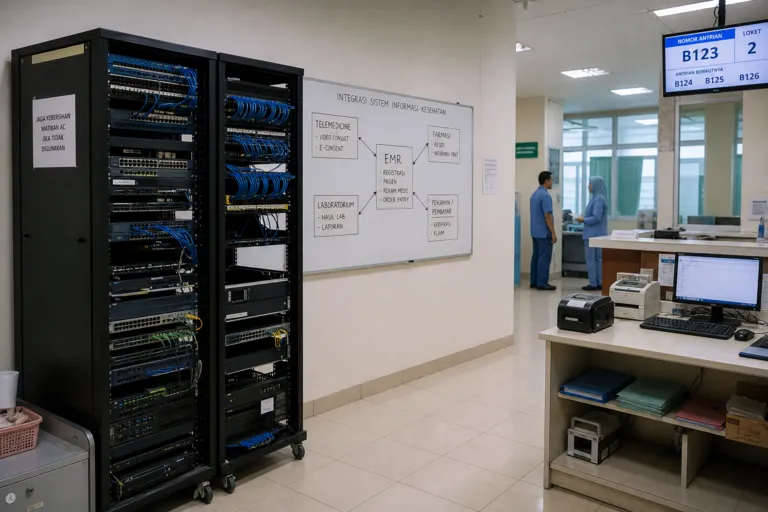
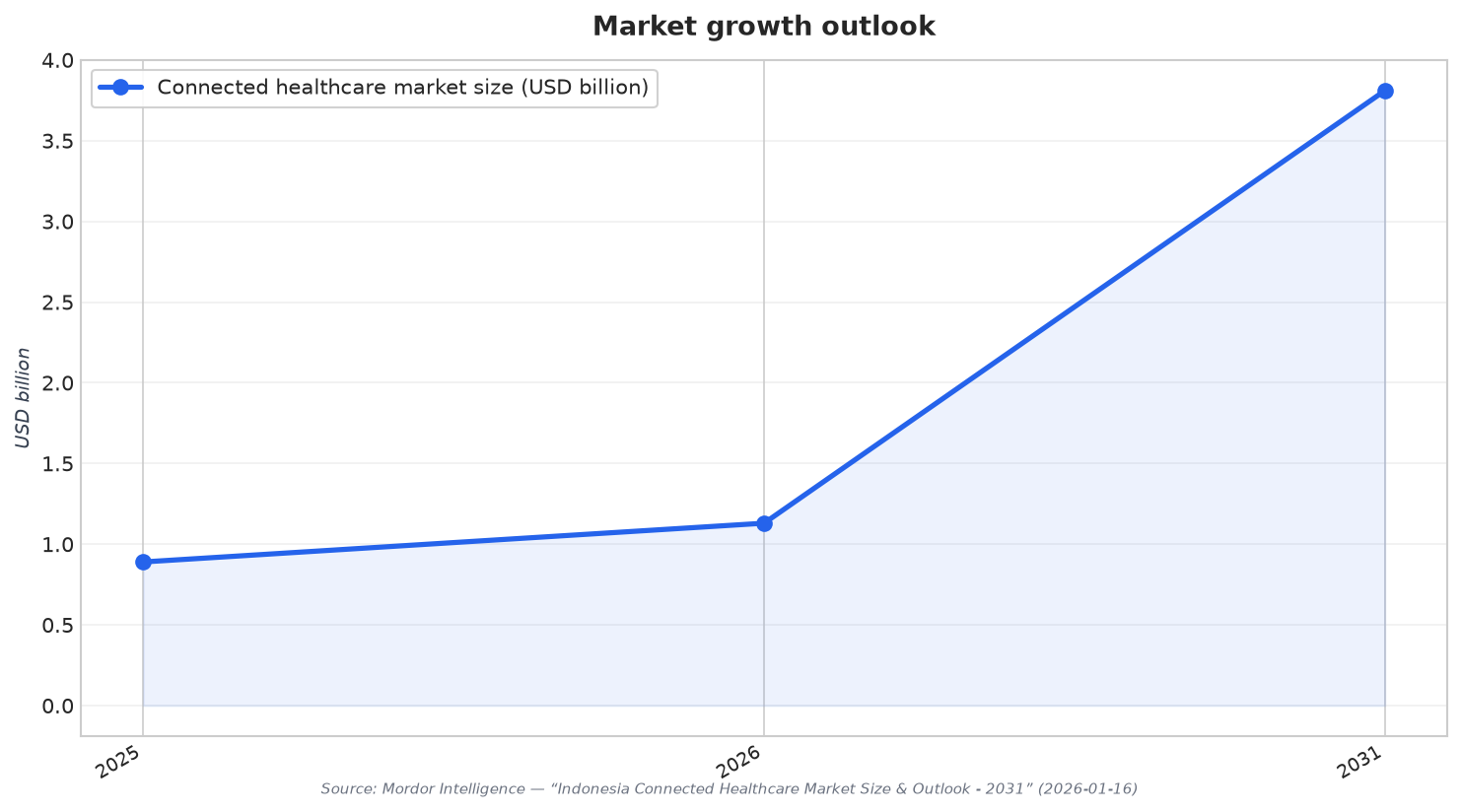
Indonesia’s connected-care ecosystem is moving from “apps” to infrastructure. Mordor Intelligence estimates the connected healthcare market at USD 0.89 billion in 2025 and USD 1.13 billion in 2026, with a projection of USD 3.81 billion by 2031 at a 27.4% CAGR for 2026–2031. The same analysis links momentum to government digitization mandates, expanding 5G coverage, and continuing venture-capital inflows, while interoperability rules centered on SATUSEHAT can lower integration risk for providers. That shift matters because the commercial center is still concentrated: Java held a 54.80% share of connected healthcare in 2025, and Java contained 55.65% of Indonesia’s population in 2025, reinforcing distribution and partnership density.
Telemedicine is the most visible adoption channel and a bridge into broader connected workflows. In the connected healthcare segmentation from Mordor Intelligence, telemedicine held a 37.10% share in 2025. In the healthcare providers context, Ken Research cites over 5 million telemedicine consultations in 2023, driven by government initiatives and private investment. Ken Research’s telemedicine overview also notes teleconsultation as the top-selling product and says Jakarta and the surrounding Java region dominate due to higher internet penetration, stronger healthcare infrastructure, and a larger population base. For investors, these usage patterns support monetization paths beyond one-off consults, especially when platforms extend into medication management and connected follow-ups.
EMR Mandates and SATUSEHAT Interoperability Change the “Moat”
Regulation is not only a constraint in Indonesia—it is also a demand engine. Mordor Intelligence highlights that Health Law 17/2023 made electronic records compulsory and aligned privacy rules, pushing providers toward compliant systems and integration. In parallel, Ken Research’s digital health market framing emphasizes that future value creation depends more on interoperability, clinical quality, and monetization depth than on user acquisition alone, explicitly calling out SATUSEHAT connectivity and enterprise health information systems as sources of larger recurring revenue pools. That helps explain why “solutions” already represented 62.20% of connected healthcare share in 2025, and why services are projected to expand at a 28.1% CAGR to 2031 as implementation, integration, and compliance needs rise.
Cloud-first delivery is becoming a practical go-to-market choice, not just a technical preference. Mordor Intelligence reports cloud-based platforms captured a 64.90% share of connected healthcare in 2025 and are poised for a 28.2% CAGR through 2031. This is aligned with the report’s view that cloud deployment can shorten time to value for small facilities outside Java, accelerating adoption. At the care-setting level, hospitals commanded a 45.20% share in 2025, but home care is advancing at a 28.7% CAGR through 2031, which creates incentives for remote patient monitoring, connected workflows, and more continuous data capture. Remote patient monitoring and wearables are forecast to grow at a 28.9% CAGR to 2031 in the same connected healthcare segmentation.
Investment angles are widening as connected care intersects with payments, pharmacy, providers, and payers. Mordor Intelligence notes venture funding rounds topping USD 100 million and cites 5G pilots with latency thresholds below 25 milliseconds, pointing to use cases such as remote surgery and real-time tele-ICU coordination. In the broader healthcare stack, Ken Research estimates 284.3 million JKN participants as of April 2026, while Mordor Intelligence’s insurance analysis reports 283 million participants—equal to 99.34% of the population—by October 2025, creating a baseline of coverage that can amplify digital claims connectivity and utilization management. On the insurer side, OJK is set to implement POJK Number 36 of 2025 in January 2026, which mandates medical governance, utilization review, and digital capabilities across health insurers, reinforcing demand for compliant, interoperable systems that can serve both clinical and administrative workflows.
How fast is Indonesia’s connected healthcare market expected to grow?
What role does telemedicine play in connected care adoption in Indonesia?
Why do EMR mandates matter for the connected health ecosystem?
Which deployment model is winning in Indonesia’s connected-care rollout?
What are emerging investment angles in the Indonesia connected healthcare market?