

Indonesia’s deal narrative in 2026 increasingly centers on consolidation rather than pure growth stories. Lyndon Advisory frames Indonesia as “the prize,” citing a population of 280 million and GDP growth consistently above 5%, alongside sharper M&A acceleration since 2023 driven by PE interest in consumer, fintech, healthcare, and logistics. In ASEAN overall, the same source cites USD 130B of M&A in 2025, up 18%, which sets a regional context for why buyers keep scanning Indonesia for scale platforms. Within Indonesia, the clearest consolidation pressure appears in regulated sectors where compliance demands and distribution modernization raise the cost of competing without size.
Insurance is a primary consolidation arena in 2026 because the rules and operating model are both moving at once. Mordor Intelligence values Indonesia’s life and non-life insurance market at USD 30.14 billion in 2026, forecasting growth at a 7.80% CAGR to USD 43.88 billion by 2031. The same report links consolidation discussions to OJK’s phased equity requirements through 2028 and the higher compliance costs tied to IFRS 17. It also notes that a digital regulatory framework enabling fully non-face-to-face journeys reduces distribution friction and supports embedded models across large platforms in 2026. A concrete example arrived in January 2026, when Hanwha General Insurance acquired a 61.5% stake in PT Lippo General Insurance Tbk.
Where Consolidation Becomes a Strategy, Not a Slogan
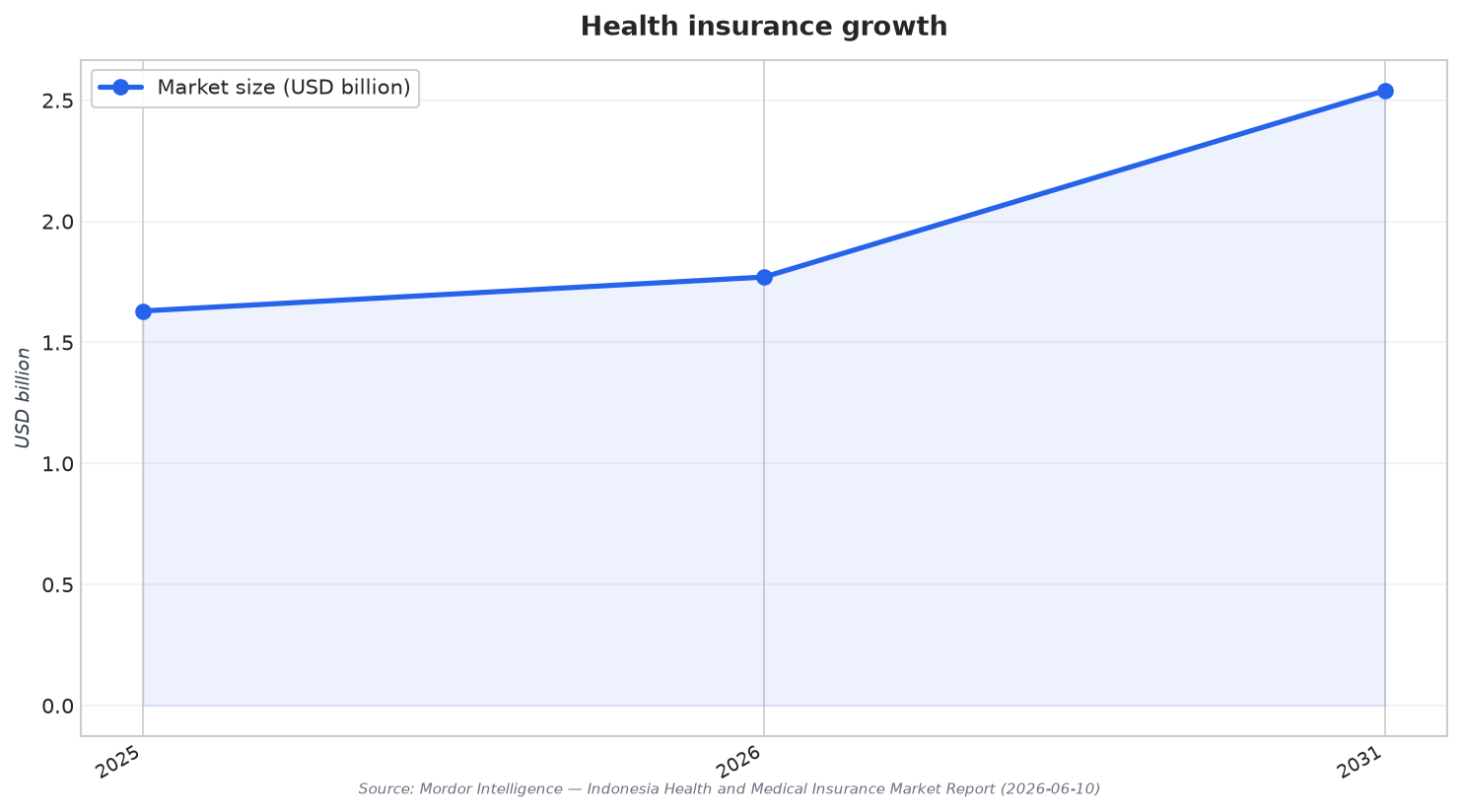
Health insurance and healthcare-adjacent services also show conditions that favor platform building and bolt-on acquisitions. Mordor Intelligence values Indonesia’s health and medical insurance market at USD 1.63 billion in 2025, estimating growth from USD 1.77 billion in 2026 to USD 2.54 billion by 2031 at a 7.48% CAGR. Demand dynamics are shaped by near-universal JKN coverage under BPJS Kesehatan, which reached 283 million participants, equal to 99.34% of the population by October 2025, pushing private demand toward supplementary benefits under coordination of benefits. OJK’s POJK Number 36 of 2025, implemented in January 2026, adds requirements around medical governance, utilization review, and digital capabilities—raising execution expectations for smaller insurers.
Operational infrastructure around claims and care coordination is becoming its own consolidation lane. NextMSC values Indonesia’s insurance TPA market at USD 1.66 billion in 2024 and projects it will reach USD 5.32 billion by 2030, growing at a CAGR of 20.6%. As TPAs handle claims processing, policy administration, and risk management, their role becomes more strategic as private healthcare costs rise and complexity increases. This creates a rationale for insurers, healthcare networks, or PE-backed platforms to acquire or partner with TPAs to tighten service levels, manage reimbursement workflows, and standardize utilization controls in line with tightening governance expectations.
Fintech consolidation is also part of the 2026 picture, especially where financial institutions want distribution and data advantages. Lyndon Advisory says fintech and digital payments have attracted significant buyer interest, adding that consolidation among second-tier players is accelerating as unit economics tighten, and that domestic banks are actively acquiring fintech capabilities. In parallel, the health insurance distribution stack is digitizing: Mordor Intelligence reports that OJK-licensed Financial Service Aggregators reached 20 registered providers with 1,172 institutional partnerships and served 13.10 million users in August 2025. Put together, the Indonesia M&A outlook 2026 looks less like isolated deals and more like a race to assemble compliant, digital-first ecosystems across insurance, fintech rails, and healthcare-linked administration.
What is shaping Indonesia’s M&A outlook for 2026 across key sectors?
Which insurance deal shows consolidation momentum in 2026?
How large is Indonesia’s life and non-life insurance market in 2026?
Why does health coverage structure matter for private insurance strategies?
What data suggests fast growth in healthcare-adjacent insurance administration?