Indonesia’s biodiesel policy sits at the center of a high-stakes tug-of-war between energy security, export earnings, and downstream supply chains that also serve food and industry. In 2026, the government continued the mandatory B40 program, meaning diesel blended with 40% palm-based biodiesel and 60% conventional diesel, and decided not to implement B50 nationwide. Reuters reported officials scrapped plans for a mandatory B50 grade “this year” and stuck with B40 due to technical and funding concerns. The same Reuters report noted the country had planned to launch B50 in the second half of the year, but held back as readiness and financing questions mounted.
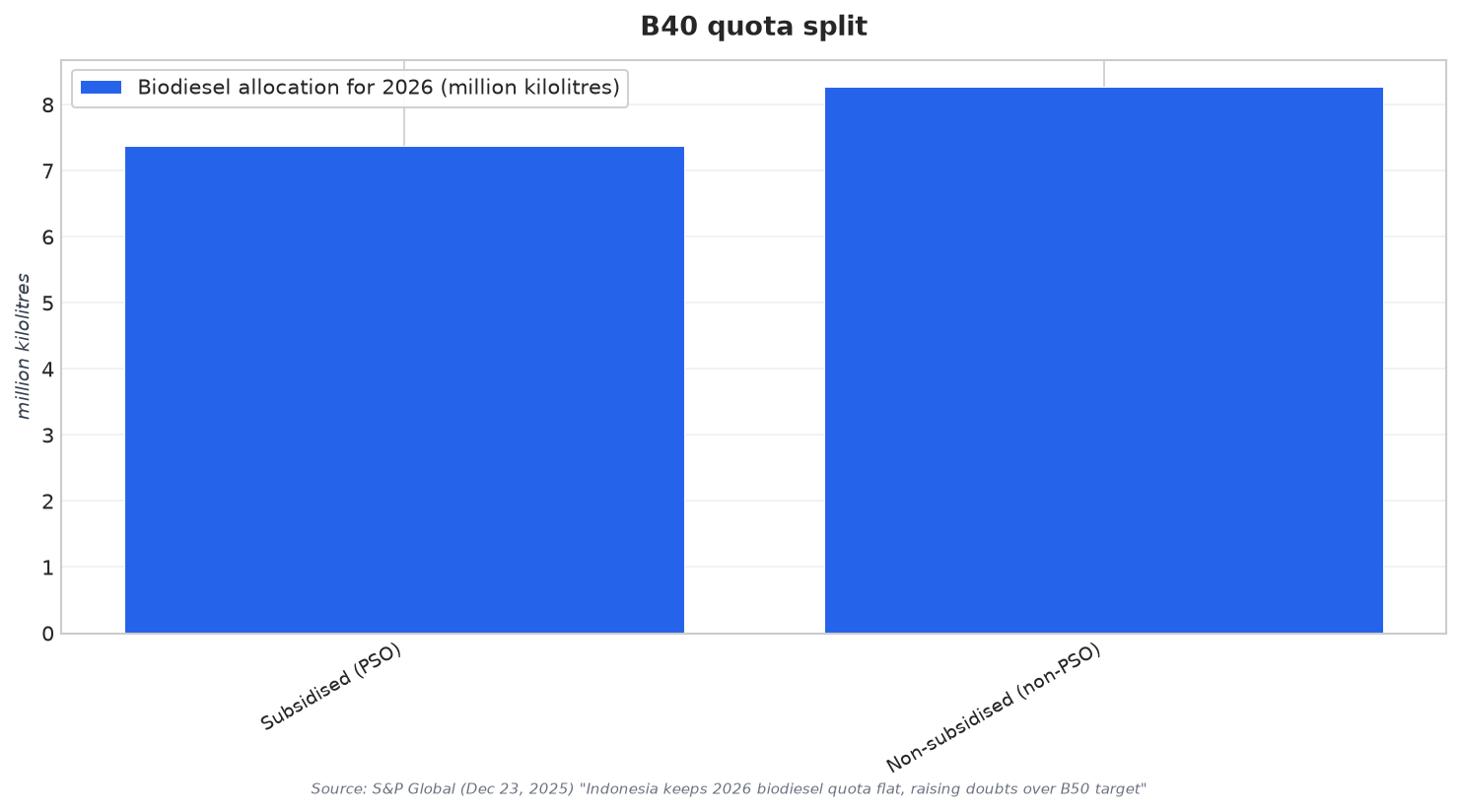
The decision is tightly linked to how Indonesia pays for blending. Reuters said Indonesia subsidizes its biodiesel program by plugging the price gap between crude oil-based diesel and palm oil-based fuel, using proceeds from palm oil export levies collected by the Indonesian Estate Crop Fund Agency (BPDP). For the mandate year cited by Reuters, the energy ministry allocated 15.65 million kilolitres of palm oil-based biodiesel, with 7.45 million kilolitres subsidized. S&P Global separately reported Indonesia set a 2026 biodiesel production quota of 15.646 million kiloliters, divided into 7.38 million kiloliters for subsidized Public Service Obligation (PSO) and 8.265 million kilolitres for non-PSO sectors, largely flat versus the 2025 target of 15.62 million kiloliters.
Why B50 Tightens Palm Oil Supply Chains
Moving beyond B40 increases the pull on palm oil feedstock and can ripple across global buyers. S&P Global said that if rolled out at full FAME content, B50 would require around 20 million mt of FAME, about 2 million mt more crude palm oil than current B40 levels. In the same report, S&P Global added that five large-scale biodiesel plants are needed to meet that demand, with three under construction. This matters for trade flows because Indonesia’s biodiesel mandate often affects global palm oil prices as increased domestic use reduces available exports, Reuters reported. POPSI warned that raising levies would affect Indonesian palm oil competitiveness and could drive buyers to other suppliers such as Malaysia.
Capacity and inputs also limit how quickly blending can rise without stressing supply chains. A USDA Jakarta report said that in early 2026 biodiesel production capacity reached 22 billion liters, up by 2 billion liters from last year, and that an additional 2–3 billion liters of capacity would be required to facilitate the next blending target of B50. The same USDA report stated B50 implementation is expected to require 20 billion liters of palm biodiesel each year, while B40 utilization in 2025 required 14.2 billion liters. It also noted methanol shipments halted due to the War in Middle East, threatening supplies for biodiesel production in Indonesia, highlighting that non-palm inputs can become bottlenecks too.
The broader economic trade-off is why “delay” does not necessarily mean “retreat” in the Indonesia B50 biodiesel 2026 debate. A qualitative review in the European Journal of Innovative Studies and Sustainability argued postponement reflects concerns such as incomplete automotive compatibility testing, infrastructure gaps, and fiscal sustainability constraints. Meanwhile, Palm Oil Magazine cited a University of Indonesia estimate that implementing B50 could reduce palm oil export value by approximately IDR190 trillion, exceeding projected IDR172 trillion in foreign exchange savings from lower diesel imports. The same Palm Oil Magazine piece also described the sector’s footprint, noting about 16 million hectares of oil palm plantations, with about 42% managed by smallholders, sharpening the stakes for both fuel demand and cooking oil supply expectations.
Why did Indonesia delay B50 and keep B40 in 2026?
How big is Indonesia’s 2026 biodiesel quota under B40?
What would B50 mean for palm oil and FAME demand versus B40?
How much biodiesel capacity does Indonesia have, and what more is needed for B50?
What does the Indonesia B50 biodiesel 2026 delay signal for energy and food supply chains?