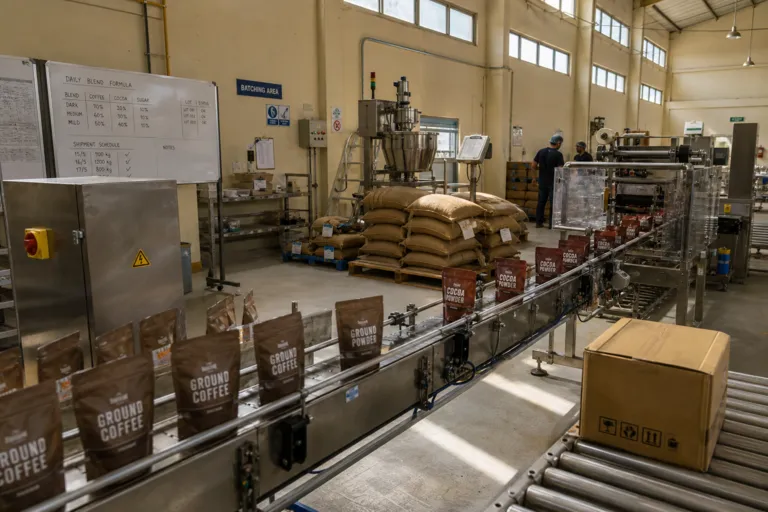
In the Indonesia cocoa coffee market 2026 discussion, the core theme is a squeeze: strong consumption and industrial demand growth meet supply constraints and input volatility. In cocoa, FACT.MR projects demand for cocoa in Indonesia to rise at a 4.4% CAGR through 2036, supported by national cocoa upstream processing investment under the Perkebunan Nusantara programme. That same source notes cocoa butter commands 47.5% of cocoa ingredient market share in 2026, reflecting how industrial demand can extend beyond chocolate cycles. In coffee, Indonesia Investments describes a “double squeeze” where domestic consumption rises faster than productivity gains, forcing exporters to compete for limited beans against global buyers with US dollars and expanding local roasters.
Powdered beverage demand amplifies this pressure because it is both mass-market and operationally intense. IndexBox’s Indonesia powdered beverages report describes a market spanning over 130 million households, with penetration exceeding 90% in core categories such as instant coffee, powdered chocolate drinks, and powdered white milk. It also states domestic production volume is sufficient to meet the majority of mass-market demand for coffee mixes, chocolate drinks, and powdered milk, with factories operating multi-shift schedules to manage seasonal demand spikes, particularly during Ramadan and the Lebaran festive period. But the same report highlights a structural vulnerability: domestic supply is “import intensive” for inputs, which can transmit external pricing and availability shocks into local manufacturing economics.
Where the Pressure Comes From—and Why It Creates White Space
On coffee, global concentration raises the odds of volatility that Indonesia then has to absorb. Indonesia Investments notes Brazil alone provides nearly 40 percent of the global coffee supply, while Vietnam accounts for around 17 percent of global production, primarily Robusta. The article argues that disruptions in these two origins—whether from weather events or logistics issues—can cause global coffee prices to soar, because the market is highly sensitive to circumstances in the top producers. When that volatility meets the local “double squeeze” on beans, Indonesian operators have a clearer incentive to move value capture downstream, rather than compete as price-takers in raw exports.
Downstream opportunity shows up in how Indonesia’s ingredient and packaged-goods ecosystems are already defined. IndexBox’s cocoa powder report frames the Indonesian market around HS 1805 cocoa powder (not sweetened) and maps it across types (natural, alkalized, low-fat, high-fat, instant, organic) and applications such as bakery and confectionery, dairy and ice cream, beverages, coatings, and flavoring. That segmentation matters because it points to differentiated pricing logic by specification rather than a single commodity benchmark. In parallel, IndexBox’s chocolate spreads report defines a packaged category built from cocoa solids, sugar, and fat, with formats from jars and tubs to single-serve sachets and bulk food-service packs, reinforcing that value can be captured through formulation, packaging, and channel execution.
For strategy teams, the practical playbook is to build around conversion, consistency, and channel fit. Indonesia Investments explicitly makes the case for fostering a robust downstream coffee industry by incentivizing exports of finished products rather than raw materials, so Indonesia can capture margins retained by international roasters. IndexBox’s vending ingredients report complements this logic by describing an ingredient market shaped by formulation economics, documentation, quality systems, and channel models. Put together, these sources point to a 2026 environment where tighter upstream conditions and input exposure raise risk, but also reward manufacturers and brand owners that can secure compliant specs, manage imported inputs, and scale finished goods across high-penetration household categories.
What is driving the squeeze in Indonesia’s cocoa and coffee value chains?
How large is the household reach of powdered coffee and chocolate drinks in Indonesia?
Why can global coffee volatility quickly affect Indonesia?
In the Indonesia cocoa coffee market for 2026, where are the downstream opportunities?