
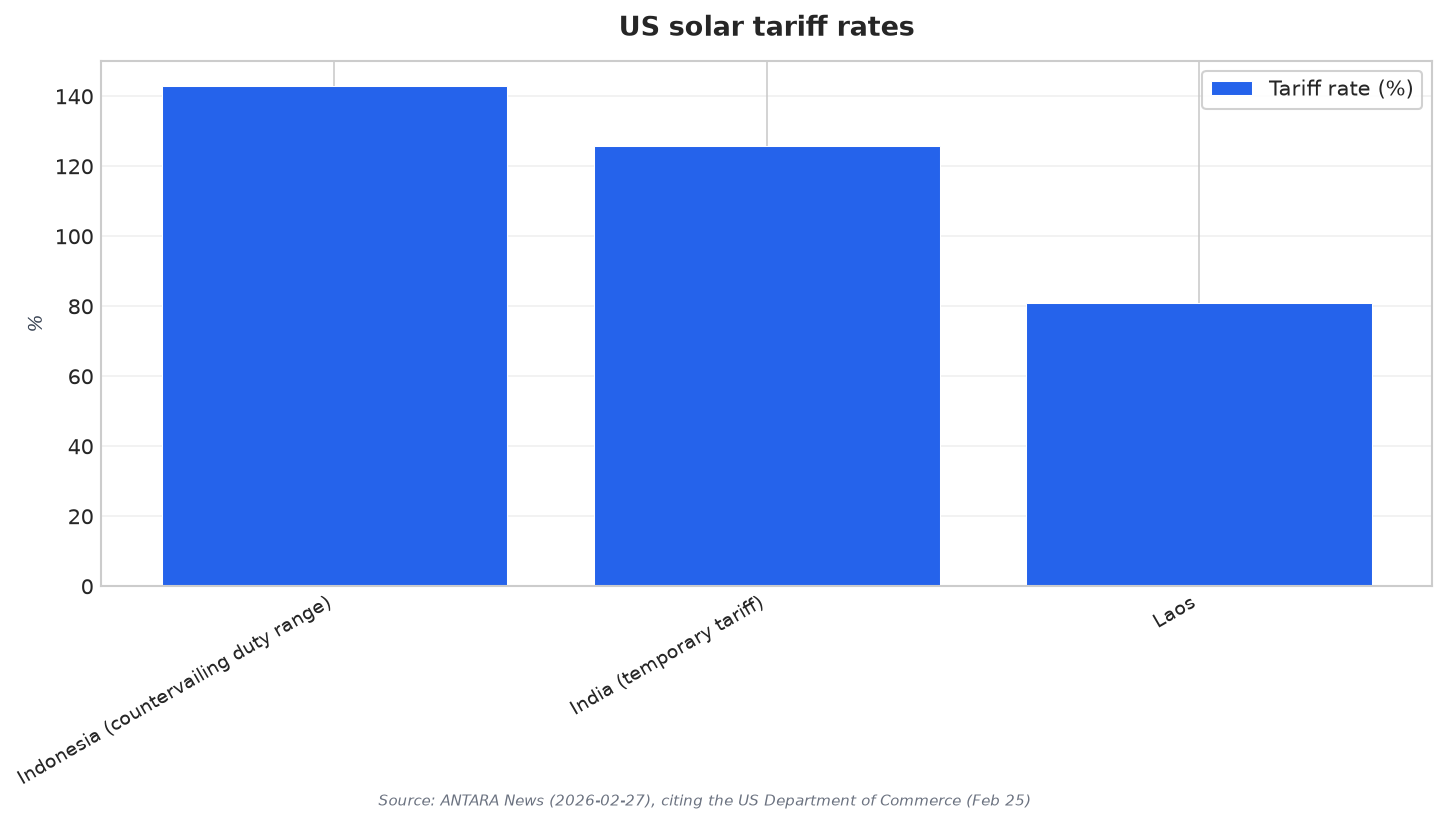
Indonesia’s solar module industry is being pulled in two directions at once. On one side, the United States has announced additional duties on solar panel products tied to Indonesia, including countervailing duties ranging from 86% to 143% (announced February 25 by the US Department of Commerce). On the other side, Indonesian officials say they want locally made products treated under the ART (Agreement on Reciprocal Trade) tariff level they cite as 15% “maximum,” not “hundreds of percent.” The dispute is not only about trade policy. It also hinges on how panels are classified, because Indonesia’s Energy and Mineral Resources Ministry said some items hit by steep US tariffs were not manufactured in Indonesia and only relabeled there through transshipment.
That distinction matters for the credibility of Indonesia’s manufacturing base. The ESDM deputy minister said his team reviewed panels facing tariffs “up to several hundred percent,” and asked the Director General for New, Renewable Energy and Energy Conservation to re-identify which panels are domestically produced and which are transshipped. The same US action also covered other countries, with a temporary tariff of 125.87% on Indian solar panel products and an 81% rate on those from Laos. In parallel, the import mix into the US provides context for why enforcement is escalating: India, Indonesia, and Laos together accounted for 57% of all solar panel imports to the US in the first half of 2025, and US imports from India reached US$792.6 million in 2024, a ninefold increase from 2022.
Local Capacity Exists, but the Supply Chain Is Still Imported
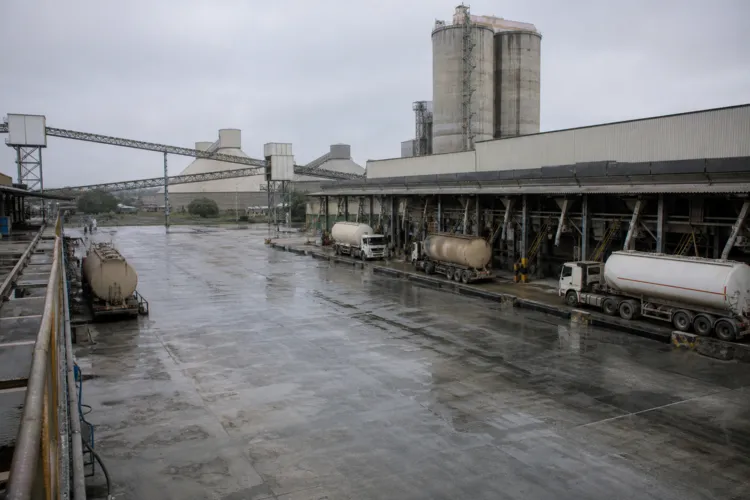
Domestic production capability is not zero. Indonesia’s Coordinating Ministry for Economic Affairs reported 34 domestic solar module manufacturers with combined annual capacity of 10,994 MWp. It also cited a maximum module production capacity of around 720 Wp per module and an average domestic component level (TKDN) of 40% to 55%. Yet the same policy environment that promotes local content can limit real scale-up. Legislative intelligence summarized by Energy Solutions International states Indonesia has local module assembly plants, but they rely 100% on imported Chinese cells, and argues it is mathematically impossible to reach a 60% TKDN threshold without a domestic cell factory. A separate supply-chain guide similarly concludes Indonesia imports over 95% of its solar cells, reinforcing why “local” often means assembly rather than a fully localized value chain.
Those constraints translate into pricing and project eligibility. Energy Solutions International says developers face cost premiums of 30% to 50% compared with imported Tier-1 modules, and that deviating from the local content threshold can trigger project rejection or loss of subsidies. It also states the lack of Tier-1 cell/wafer manufacturing has “completely stalled” large-scale solar deployment under the rule. At the same time, a module plant that relies solely on imported inputs has to manage landed costs beyond FOB pricing. The supply-chain guide notes import duties on solar components can range from 5% to 15%. This mix of TKDN compliance pressure and import dependence helps explain why Tempo reported national solar panel factories operate far below capacity and why domestic demand is described as limited.
US tariffs could still reshape strategy at home, even if they hurt exports. In a separate statement, the Indonesian government described US tariffs of up to 114% on Indonesian solar panel products as an opportunity to strengthen domestic demand and encourage local production. Officials said panels previously exported to the US could be redirected into the domestic market as additional duties rise. But winning against imports is not only a question of redirecting supply. It requires clearer enforcement against transshipment, plus investment partnerships that can move Indonesia beyond assembly into deeper manufacturing. Policymakers have also encouraged partnerships between local and global companies to attract investment, support technology transfer, and strengthen the national solar panel supply chain—steps that could decide whether local factories can compete under strict TKDN rules and shifting US tariff enforcement.
What US tariff rates have been cited for solar panels tied to Indonesia?
How large is Indonesia’s domestic solar module manufacturing base?
Why is meeting Indonesia’s 60% TKDN requirement difficult for many module makers?
What is transshipment and why does it matter for tariffs?
What is the key competitiveness question for Indonesia solar panel manufacturing right now?