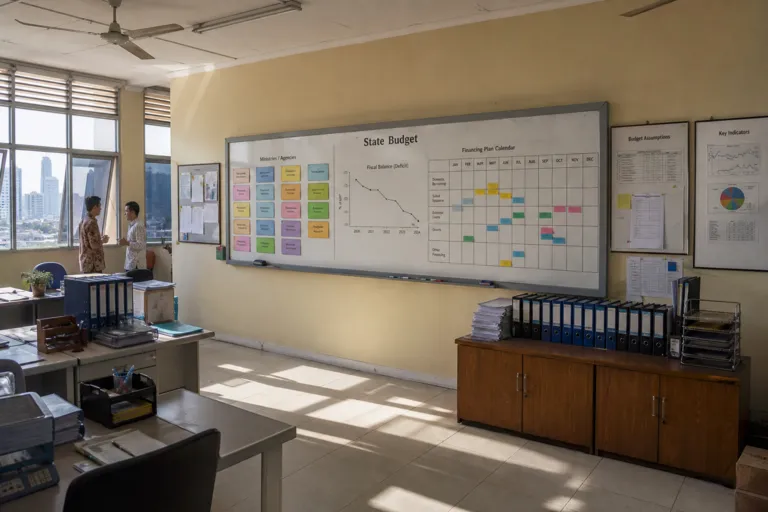
Indonesia’s parliament approved President Prabowo Subianto’s 2026 budget with spending of $231.5 billion and a fiscal deficit of 2.68% of GDP, according to Reuters. The budget assumes economic growth of 5.4% and targets revenue of 3,153.6 trillion rupiah ($189.29 billion), about 10% higher than in 2025. Spending for 2026 was expected to be 9% higher than estimated total spending for 2025, with Prabowo nearly doubling spending for free meals to 335 trillion rupiah and an estimated 30% increase in defence spending. Finance minister Purbaya Yudhi Sadewa framed the state budget as a “catalyst” to drive private-sector activity.
By mid-2026, official outlooks suggested the fiscal math was getting harder. Indonesia Investments reported the 2026 deficit could widen from the targeted 2.68% of GDP to 2.85% amid weaker-than-projected revenue and higher-than-projected spending, while still staying below the statutory 3% ceiling. The same source estimated tax revenue realization may reach IDR 2,310.8 trillion versus a target of IDR 2,357.7 trillion, implying a shortfall of IDR 46.9 trillion in the 2026 budget. Minister Purbaya said the government would need to chase at least 23% (year-on-year) per month growth for the remainder of the year to reach the target. Extra spending pressures were also linked to external shocks, including higher oil and fuel import costs over a three-month period tied to the Iran War.
Fiscal Space Narrows as Obligations Collide With Revenue Limits
Pressure is also visible in the interaction between fiscal policy and monetary conditions. East Asia Forum noted Bank Indonesia raised its benchmark interest rate three times in May and June 2026, yet the rupiah still weakened past Rp18,000 per US Dollar in July 2026, while year-on-year inflation reached 3.34% in June. It argued that when public debt is large, higher rates become fiscally costly because they raise debt servicing burdens and strain banks holding government bonds. East Asia Forum put public debt around 40% of GDP and projected interest payments of Rp 599 trillion (US$33.1 billion) in 2026, around 22% of projected tax revenues. In that context, markets may doubt how far tightening can go, shaping capital flows and financial conditions for both the state and businesses.
Budget priorities sharpen these trade-offs and create uneven spillovers for companies. The Diplomat said the government created a National Nutrition Agency to oversee the Free Nutritious Meal program, with a 2026 budget set at $16 billion. Civil-society group PWYP Indonesia cited IDR 223.5 trillion allocated to the National Nutrition Agency and argued it was recorded under the education budget, while also highlighting a projected IDR 236.6 trillion in non-tax state revenue (PNBP) from natural resources. PWYP Indonesia also cited a 34.3% reduction in infrastructure spending and warned that cuts to regional transfers could worsen service disparities, noting BPS figures showing Maluku–Papua growth at 1.44% versus 5.30% in Java. For contractors, logistics firms, and regional suppliers, these choices can reshape project pipelines and local demand.
For the private sector, the key implication is that financing conditions and government demand may become more sensitive to revenue outcomes and market confidence. Indonesia Investments explained that a larger-than-expected deficit requires more borrowing through government bonds (SBN), potentially pushing yields higher and making it more expensive for businesses to expand if they must compete for capital. Fulcrum warned that when revenues are tight, the consequences of spending choices become more visible, while also pointing to fiscal stress around transfers and service delivery. Together, these signals form an Indonesia 2026 state budget analysis focused less on headline ambition and more on execution risk, funding costs, and where public money is actually flowing.
What deficit and spending levels did Indonesia approve for the 2026 budget?
Why did some projections warn the 2026 deficit could widen to around 2.85%?
How could budget financing pressure affect private-sector borrowing costs?
What did East Asia Forum highlight about interest costs and fiscal constraints in 2026?
What should readers focus on in an Indonesia 2026 state budget analysis?