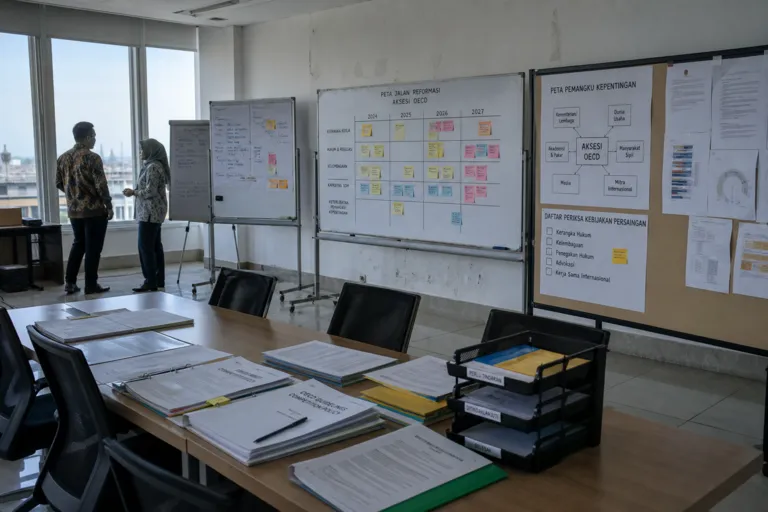
Indonesia launched its OECD accession bid in 2023 and received its accession roadmap in May 2024. According to the government, the process is intended to strengthen trade relations and global investment amid uncertainty, with discussions conducted on a sectoral basis. Officials argue that OECD membership could add value to Indonesia’s standing in international trade and investment and help signal alignment with developed-world policy standards. At the same time, commentary in The Jakarta Post cautions that joining an “elite club” is not a “magic lamp” and that diplomatic prestige is no substitute for domestic reform, especially in a fractured global order.
The accession work is already moving into detailed scrutiny. Airlangga Hartarto said Indonesia submitted its initial memorandum on June 3, 2025, containing a self-assessment of alignment between national regulations and OECD instruments, and that the technical review would take place in July. OECD Secretary-General Mathias Cormann described Indonesia’s accession as one of the most significant economic reform journeys of the decade. He said the process will involve a comprehensive review by 25 OECD technical committees across areas ranging from trade and investment to innovation, public governance, and education—an architecture that turns the bid into a structured regulatory and institutional audit rather than a purely political objective.
What Reform Pressure Could Look Like in Practice
Across sources, the anticipated reform agenda is broad. Cormann has framed accession as a catalyst for regulatory improvement, stronger market competition, and enhanced public integrity, and ANTARA describes the process as requiring structural adjustments in fiscal transparency, environmental protection, investment safeguards, and regulatory discipline. But The Jakarta Post argues these benchmarks—covering taxation, environmental rules, labor, governance, and human rights—remain well beyond Jakarta’s near-term reach. It also notes domestic resistance to sweeping liberalization across national and regional regulatory bodies. In this sense, the Indonesia OECD accession impact is less about a single policy change and more about whether Indonesia can sustain coordination and institutional overhaul at scale.
Investor confidence sits at the center of the debate. ANTARA writes that OECD alignment can act as a “trust mark” for long-term institutional investors who prioritize legal certainty and policy predictability. FTI Consulting similarly argues that meeting OECD requirements would signal a commitment to international standards and improve the climate for foreign investors, while still urging ongoing monitoring and strong due diligence after high-profile fraud cases exposed oversight failures. FTI reports that foreign direct investment inflows rose from $21 billion in 2023 to $24 billion in 2024, moving Indonesia to 14th place among global FDI recipients, up from 21st the prior year, despite a temporary dip in the third quarter of 2025.
However, sources also underline the practical friction foreign investors face today. An OECD report on infrastructure investment notes that navigating local regulations remains challenging and that partnering with local entities is often advisable. It says some local regulations still limit foreign ownership to 41% to prioritize Indonesian job creation, and identifies land ownership and procurement—especially at the local level—as key investor challenges. The same report adds that SOEs’ dominance in key sectors, prioritization of national resources, excessive bureaucracy, and lack of transparency have historically hindered private investment, and that past measures have not sufficiently boosted investor confidence. These constraints help explain why the accession process is being treated as an institutional transformation agenda, not just a market-access narrative.
What is driving Indonesia’s OECD accession process timeline?
How many OECD technical committees will review Indonesia during accession?
What does the Indonesia OECD accession impact mean for investor confidence?
What FDI figures are cited in relation to Indonesia’s investor positioning?
What regulatory barriers do sources highlight as ongoing investor challenges?