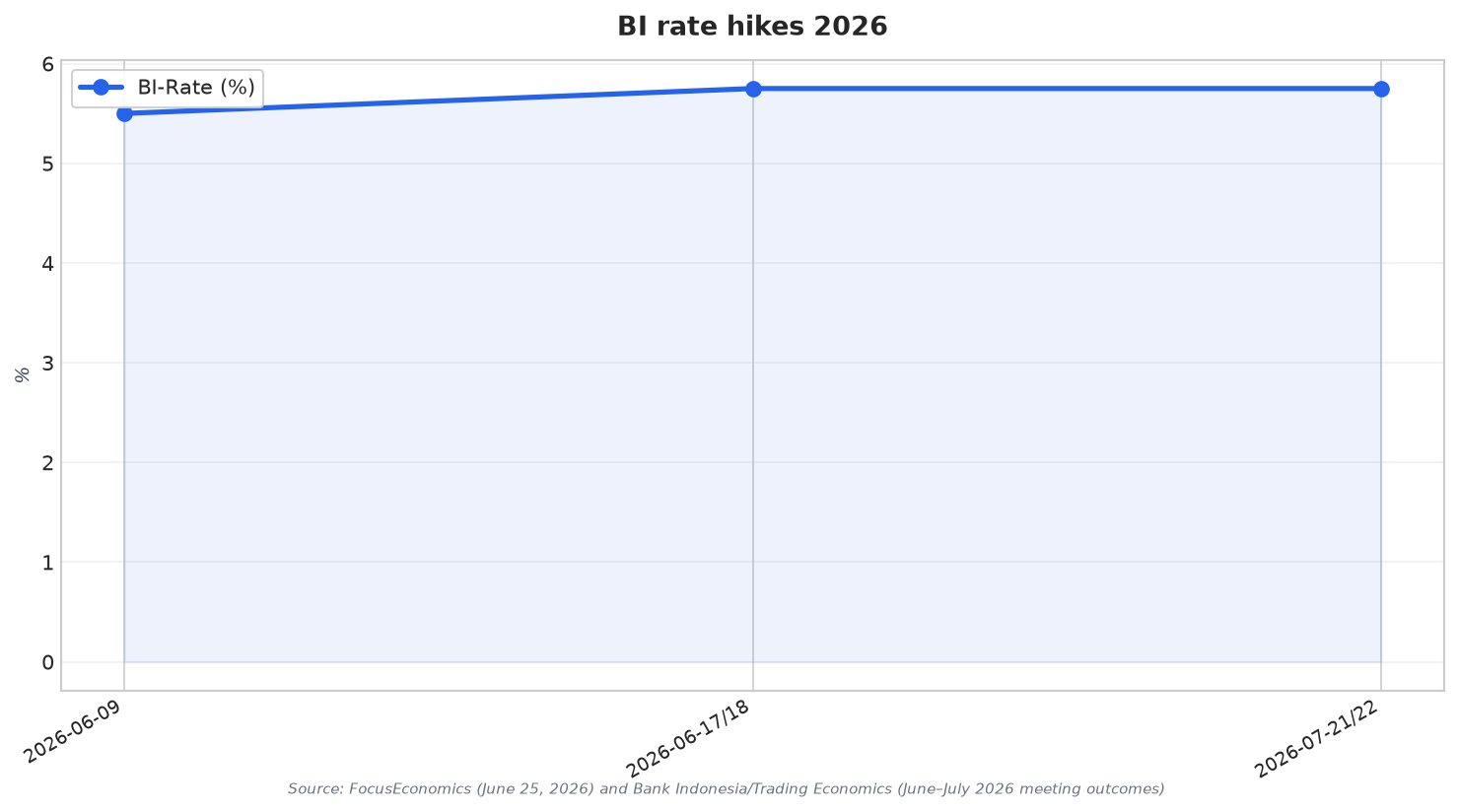
Bank Indonesia’s 2026 policy story has been shaped by currency pressure, volatile capital flows, and a need to keep domestic momentum intact. By the July 21–22, 2026 meeting, BI held the benchmark BI-Rate at 5.75% and kept the Deposit Facility at 4.75% and the Lending Facility at 6.50%. TradingEconomics noted the hold “defied market expectations of a 25-bps hike” after 25-bps increases at each of the previous two meetings. Since May, BI raised rates by a total of 100 bps to help attract foreign inflows and shore up the rupiah, which had come under pressure.
The rate path sits alongside inflation dynamics that have become less comfortable. Indonesia’s annual inflation accelerated to 3.34% in June from 3.08% in May, placing it near the upper end of Bank Indonesia’s 1.5%–3.5% target range. Even so, BI stated it expects inflation to remain within the government’s 2.5% ± 1% target range for 2026 and 2027. On growth, BI maintained its 2026 forecast at 4.9%–5.7%. That range underscores why policy was framed as a balancing act: tighten enough to defend stability, but keep conditions supportive for activity and lending.
Rupiah Defense: FX Intervention, SRBI Yields, and Inflow Incentives
External shocks were a constant backdrop. Bank Indonesia cited severe global turmoil linked to the war in the Middle East, while FXStreet described geopolitical tension and rising energy prices in the Middle East as factors that contributed to foreign capital outflows and added pressure on the rupiah. In the first quarter of 2026, BI reported net capital outflows of USD0.8 billion. BI also highlighted seasonal second-quarter foreign-exchange demand tied to dividend payments and external debt servicing. In response, BI intensified foreign-exchange intervention via offshore NDF markets and through spot and DNDF transactions domestically, while also working to maintain attractive yields on SRBI instruments to encourage foreign portfolio investment.
Market conditions show how hard that defense can be. FXStreet reported USD/IDR stabilizing around 18,100–18,200 at the time of writing after reaching 18,247 on June 8, described as the rupiah’s weakest level on record against the US Dollar. The same analysis tied pressure to a shrinking yield spread between US cash rates and Indonesian sovereign paper. BI’s reserve position also reflected the strain: FXStreet said foreign exchange reserves fell to $144.9 billion in May from $156.5 billion in December 2025, then rebounded modestly to $145.6 billion in June. Business-Indonesia also reported reserves at USD 145.6 billion at end-June and noted rising foreign ownership of BI’s Rupiah Securities (SRBI).
BI complemented the interest-rate stance with measures designed to keep growth channels open while reinforcing stability. OpenGov Asia reported BI reopened repo auction windows with tenors of three, six, nine, and twelve months, and said the central bank aimed to support liquidity expansion and keep base money growth above 10%. BI also raised the maximum Rasio Pendanaan Luar Negeri Bank (RPLN) from 35% to 40% of bank capital effective 1 July 2026, intended to broaden bank funding sources. Credit growth was reported at 11.51% year-on-year in May 2026, and BI projected credit growth of 8%–12% for the year. For the external balance, BI projected the 2026 current account deficit at 1.3% to 0.5% of GDP, reinforcing why policy synergy to support the capital and financial account was a recurring theme.
Where did the BI-Rate stand during the 2026 rate path?
Why did Bank Indonesia focus so much on rupiah stability in 2026?
What did BI do besides adjusting rates to support the rupiah?
How does the Bank Indonesia interest rate 2026 debate connect to inflation and growth targets?
What did BI report about reserves and market pressure on the rupiah in 2026?