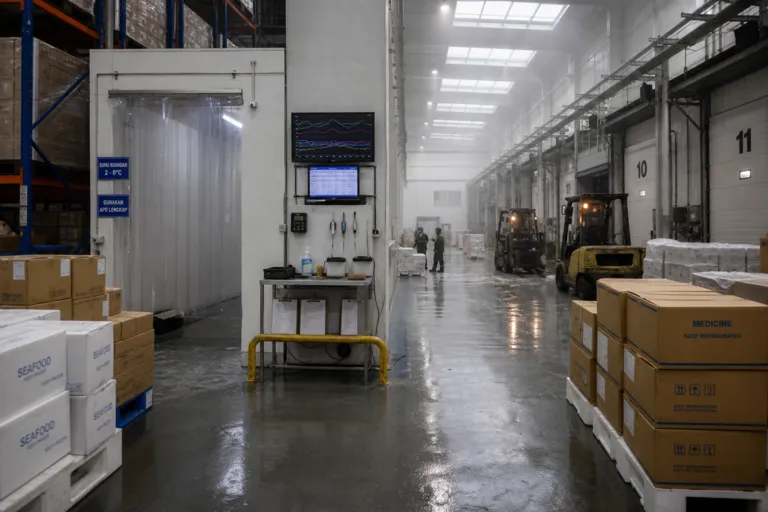
Indonesia’s cold chain is moving from optional to essential. The country spans more than 17,000 islands, so keeping products within temperature bands across trucks, ships, and air freight is complex and costly. This complexity helps explain why modern capacity is uneven, with more developed storage and operations concentrated in Java, especially Greater Jakarta, while remote areas face a deficit in modern facilities. That gap drives higher logistics costs and product spoilage, and it creates clear openings for investors that can build compliant networks beyond the main corridors. The opportunity is also reflected in market estimates: Verified Market Research valued the market at USD 5.08 billion in 2024 and projected USD 11.68 billion by 2032, while Expert Market Research cited USD 5.57 billion in 2025 and forecast USD 13.93 billion by 2035.
Food and beverage demand remains a primary pull. Sources describe frozen meat, seafood, dairy, and processed foods as key product categories, and note that food and beverage is the dominant user of cold chain services. Modern retail expansion and shifting consumption patterns toward “high quality, safe, and fresh” perishables reinforce the need for refrigerated warehouses and controlled transport. Ken Research also describes storage as the dominant segment due to more refrigerated warehouses in urban and semi-urban areas and heavy investment to handle products ranging from dairy to pharmaceuticals. At the same time, Indonesia’s geography pushes domestic delivery toward road transport for the majority of volume, while fragmentation in the last mile increases the value of integrated, multi-node networks that can deliver reliably in tier-two cities and outer islands.
Where the Biggest Gaps Turn Into Bankable Projects
Pharmaceutical cold chain requirements are tightening, and that changes the investment case. MarkWide Research notes that cold chain operations typically run between minus 25°C and plus 8°C depending on cargo class, and that real-time environmental monitoring is now part of the operational backbone. It also states BPOM requires end-to-end temperature logging for imported vaccines and biologics, pushing distributors toward certified warehousing and stronger documentation. Nexdigm adds that hospitals, clinics, and pharmaceutical distributors want visibility, data logging, and compliance records, not just a refrigerated box. This is why assets like FDA-equivalent compliant warehousing in Greater Jakarta matter, and why expansions into emerging tier-two cities can differentiate providers that can replicate compliant standards outside Java’s saturated corridor.
Food logistics offers a second lane of opportunity, especially where export standards and traceability increase the bar. MarkWide Research links Japan’s METI import standards for frozen tuna and shrimp to investment in minus 25°C blast freezing capacity at Surabaya and Makassar port zones. It also notes the Ministry of Agriculture mandates traceability protocols for livestock and fishery products moving across provincial borders, and that shippers are seeking granular traceability against BPOM food safety mandates. In practical terms, this supports port-adjacent cold storage, maritime temperature-controlled corridors, and integrated port-to-warehouse networks. It also raises the value of segregation practices, as stakeholders monitor evolving halal certification requirements for cold-chain segregation.
Technology is becoming the bridge between growth and reliability. Multiple sources highlight IoT sensors for real-time temperature and location monitoring and warehouse automation as key trends, with MarkWide Research noting that IoT monitoring is gaining fast traction as manual logs are replaced. This digital layer also supports e-commerce and online grocery, which require temperature-controlled last-mile delivery. Ken Research expects Indonesia’s e-commerce sector to surpass 50 million online buyers by the end of 2024, increasing demand for the distribution of perishables including frozen food and pharmaceuticals. On the policy side, Ken Research references the government’s $400 billion National Medium-Term Development Plan (RPJMN), and Expert Market Research notes the Ministry of Industry hosted the Indonesia Cold Chain Infrastructure Summit in August 2025 to coordinate fiscal incentives, standardize practices, and integrate the sector with the National Logistics Ecosystem. For investors in the Indonesia cold chain logistics market, the most defensible plays combine certified infrastructure, traceability tech, and expansion into underserved geographies.
What is driving growth in Indonesia’s cold chain sector?
How big is the Indonesia cold chain logistics market according to the sources?
Where are the most visible infrastructure gaps inside Indonesia?
Why are pharmaceuticals a high-priority cold chain investment area?
What technologies are being adopted to reduce temperature excursions?