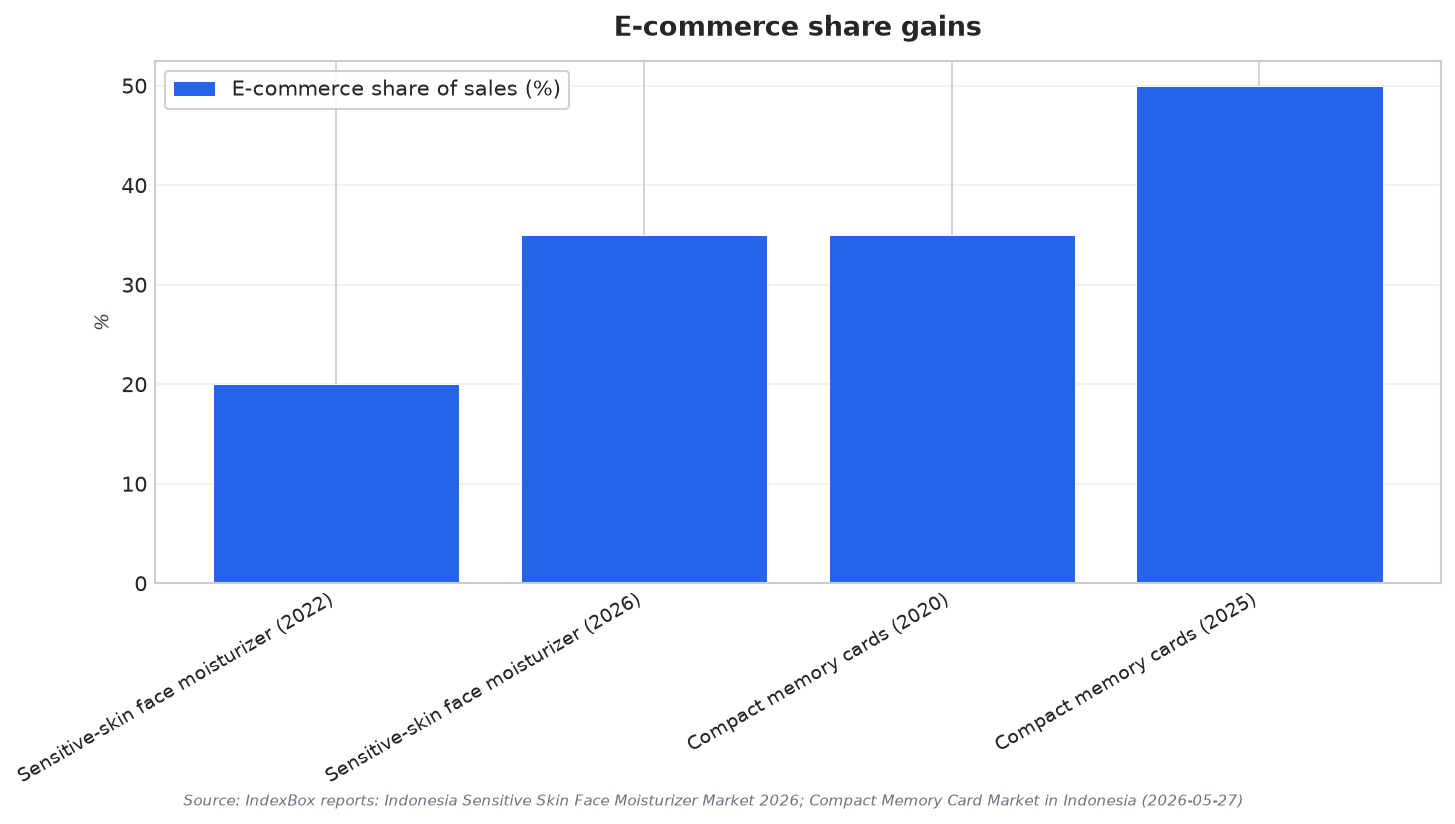
Pricing to Indonesia’s price-sensitive middle market is hardest when customers can compare offers instantly and switch channels without friction. Across categories, e-commerce has increased price transparency and intensified competition. In Indonesia’s compact memory card market, e-commerce captured roughly 50–55% of unit sales in 2025, up from about 35% in 2020, compressing offline retailer margins. In face and skin care, e-commerce and social commerce represent roughly 25–30% of sales, while in sensitive-skin moisturizers, e-commerce channels reached 35–40% of sales, up from 20% in 2022. An Indonesia pricing strategy for the middle market should start with a simple rule: design price architecture for a world where shoppers see comparisons fast, and where your profitability must survive that transparency.
Use a “good-better-best” ladder that is anchored to clear value signals, not only pack size. In Indonesia face and skin care, the mass market and masstige tiers together account for approximately 75–80% of retail volume. Yet prestige and medical-aesthetic hybrid segments are growing faster at an estimated 11–14% annually. In sensitive-skin moisturizers, domestic manufacturers have stronger share in mass-market creams and lotions priced below USD 15, while premium and dermocosmetic bands (USD 36–80 retail) are growing at 10–12% per year. This gives a practical ladder: protect the entry tier with disciplined specs and limited discount depth, then “trade up” shoppers with clinical claims, ingredient transparency, and dermatologist or influencer triggers, which rose above 55% in 2025–2026 for sensitive-skin moisturizer purchases.
Frameworks That Protect Margin Without Losing the Middle
Build a cost-to-serve and risk premium into price corridors, especially when imported inputs, taxes, and approvals can widen true landed cost. Sensitive-skin moisturizers are import-supplied at 65–75% of the market by value, and certain high-value cosmetics face import duties of 5–15% plus a 10% luxury-goods tax, which constrains accessibility beyond urban upper-middle consumers. In M-Bus gateways, 70–80% of units are sourced from overseas, and exchange rate volatility against the US dollar and euro raises landed costs and compresses distributor margins in a price-sensitive mid-tier. Add operational friction too: SDPPI radio approval and SNI compliance can extend procurement lead times by 8–16 weeks for gateways, while stricter BPOM substantiation can raise time-to-market and clinical testing costs by an estimated 15–25% for new cosmetic entrants. Pricing corridors should explicitly separate “base price” from “assurance price” that covers compliance, lead time, and service commitments.
Deploy “bundle and contract” pricing where the middle market prefers consolidation, and where services can defend margin against hardware-like commoditization. In Indonesia’s digital software solutions market, medium-sized firms favor suites that consolidate finance, inventory, and CRM under one contract, which accelerates cross-sell potential for vendors that prove early value. In the gateway market, local system integrators differentiate by offering cloud integration, custom dashboarding, and maintenance contracts, because pure hardware resale is vulnerable to price commoditization. The same logic applies in consumer categories where private-label pressure is real: in compact memory cards, private-label and white-label products in the value tier are typically priced 20–35% below equivalent branded entry-level SKUs. If you cannot win a straight unit-price fight, package guarantees, setup, monitoring, or replenishment into priced offers that are harder to compare line-by-line.
Finally, align price moves with customers’ financing constraints and the reality of margin pressure from caps and rates in adjacent spending categories. In Indonesia real estate, lending rates near 9–11% and construction-cost inflation push developers to rely on pre-sales, modular construction, and long-term rentals to protect margins, while capped price bands contribute to margin compression. That environment reinforces why middle-market pricing needs predictable steps and fewer surprise increases. Use planned, smaller adjustments tied to visible cost drivers, protect your entry SKU as the traffic magnet, and shift profit to “better” tiers and contracts. Where counterfeit risk is present, factor brand-trust investments into your price logic; industry estimates suggest 8–12% of face and skin care transactions on unverified digital storefronts involve products that do not meet BPOM registration or ingredient safety standards.
What makes pricing in Indonesia’s middle market especially challenging?
How should an Indonesia pricing strategy for the middle market protect margin without losing share?
Which cost and compliance factors should be reflected in price corridors?
How can vendors avoid pure price competition in a price-sensitive mid-tier?