Indonesia’s 2026 fiscal story is defined by a difficult trade-off: fund priority social programs while preserving the deficit signals investors rely on. In January, the government reported a budget deficit of 54.6 trillion rupiah, equal to 0.21% of GDP, after spending jumped 26% year over year, according to Reuters. The monthly deficit was larger than the 0.09% recorded in January last year, reinforcing the perception of front-loaded spending. Reuters linked the spending surge to the costs of President Prabowo Subianto’s free meals program, which alone cost 19.5 trillion rupiah in January, up from 45.2 billion rupiah in January 2025 when the program was starting.
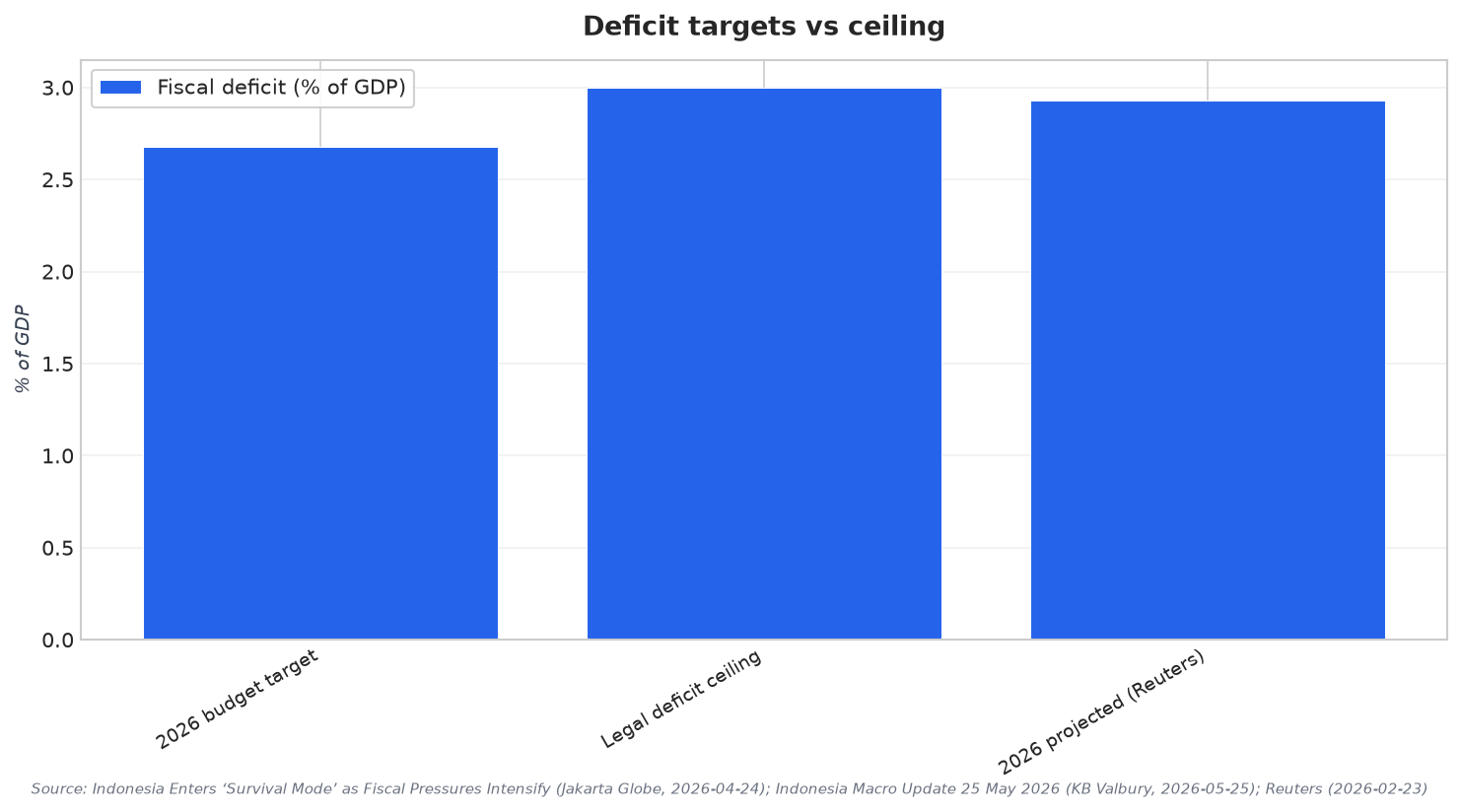
Targets in the 2026 budget aim to preserve credibility. Indonesia’s finance ministry publication shows 2026 revenue budgeted at IDR 3,153.6 trillion and spending at IDR 3,842.7 trillion, implying a planned deficit of IDR 689.1 trillion, or 2.68% of GDP, alongside messaging on “fiscal discipline & prudent financing.” Jakarta Globe also reported the government is targeting a 2.68% of GDP deficit for 2026 as part of a consolidation strategy. But early execution is challenging. In Q1, Jakarta Globe reported a deficit of Rp 240.1 trillion, equivalent to 0.93% of GDP, with revenues of Rp 574.9 trillion (18.2% of a Rp 3,153.6 trillion full-year target) and spending of Rp 815 trillion (21.2% of a Rp 3,842.7 trillion allocation).
Free Meals and Subsidies: Growth Supports, But Costs Lead the Narrative
Several sources describe 2026 fiscal policy as broadly supportive, but with rising cost pressure. The OECD projects fiscal policy will be supportive in 2026, as increased spending on fuel subsidies and the free meals program is only partly offset by tax increases and expenditure cuts elsewhere. Reuters estimated first-quarter spending on free meals could reach 62 trillion rupiah, and noted another 15 trillion rupiah would be used for food handouts and other fiscal stimulus measures. Jakarta Globe added that the free nutritious meals program has been allocated Rp 335 trillion this year, adding to pressure as the government tries to rein in the deficit. The OECD also argues that tighter cost control and better targeting could help contain fiscal costs, while still supporting public health outcomes.
Investor sensitivity is amplified by the legal framework. Under Law No. 17/2003 on State Finance, Indonesia caps its fiscal deficit at 3% of GDP, a rule Jakarta Globe called a cornerstone of macroeconomic credibility. Reuters reported the deputy finance minister predicted a deficit of around 2.93% of GDP for the year, with risk from sluggish revenue, close to the 3% limit. A May 2026 macro update noted investor concerns have centered on the sustainability and credibility of the statutory 3.0% of GDP deficit ceiling. It reported total expenditure through April reached IDR 1,082.8 trillion, up 34.3% year over year, and showed a fiscal deficit of IDR 164.4 trillion (0.64% of GDP) as of April, even as the primary balance returned to a surplus of IDR 28 trillion.
The market context helps explain why the Indonesia state budget 2026 is being interpreted not just as accounting, but as a confidence signal. A CRIF Asia note described a divergence between real economic growth and market pressure. It cited Q1 2026 GDP growth of 5.61% year over year, while also noting stress indicators such as the rupiah around IDR 17,950 per USD in June 2026 (after previously touching IDR 18,000) and foreign investor net outflows of approximately IDR 61.3–66.2 trillion year to date as of early June 2026. Against that backdrop, the fiscal narrative becomes central: sustaining priority programs like free meals, while convincing markets the deficit remains managed within the legal ceiling and aligned with the government’s stated targets.
What did Indonesia report for the January 2026 budget deficit and spending trend?
How much did the free meals program cost in January 2026, and how does it compare to early 2025?
What deficit does the 2026 budget target, and what is the legal ceiling?
What did Q1 2026 figures show for the budget balance and execution pace?
Why are investors focused on the 2026 fiscal stance behind Indonesia’s state budget?