Indonesia’s layoff story in 2026 is not a single shock. It is a stack of structural pressures that hit operations, cash flow, and orders at the same time. Government data from the Ministry of Manpower (Satu Data Kemnaker) recorded 15,425 layoffs between January and April 2026. By the first half of 2026, the same platform showed 32,389 layoffs. These counts are based on workers registered in the Job Loss Insurance (JKP) programme administered by BPJS Ketenagakerjaan. The data excludes resignations, retirements, permanent disability, or death under Government Regulation No. 6/2025 and Manpower Ministerial Regulation No. 2/2025, and officials and union leaders warned some layoffs may not be captured in the database.
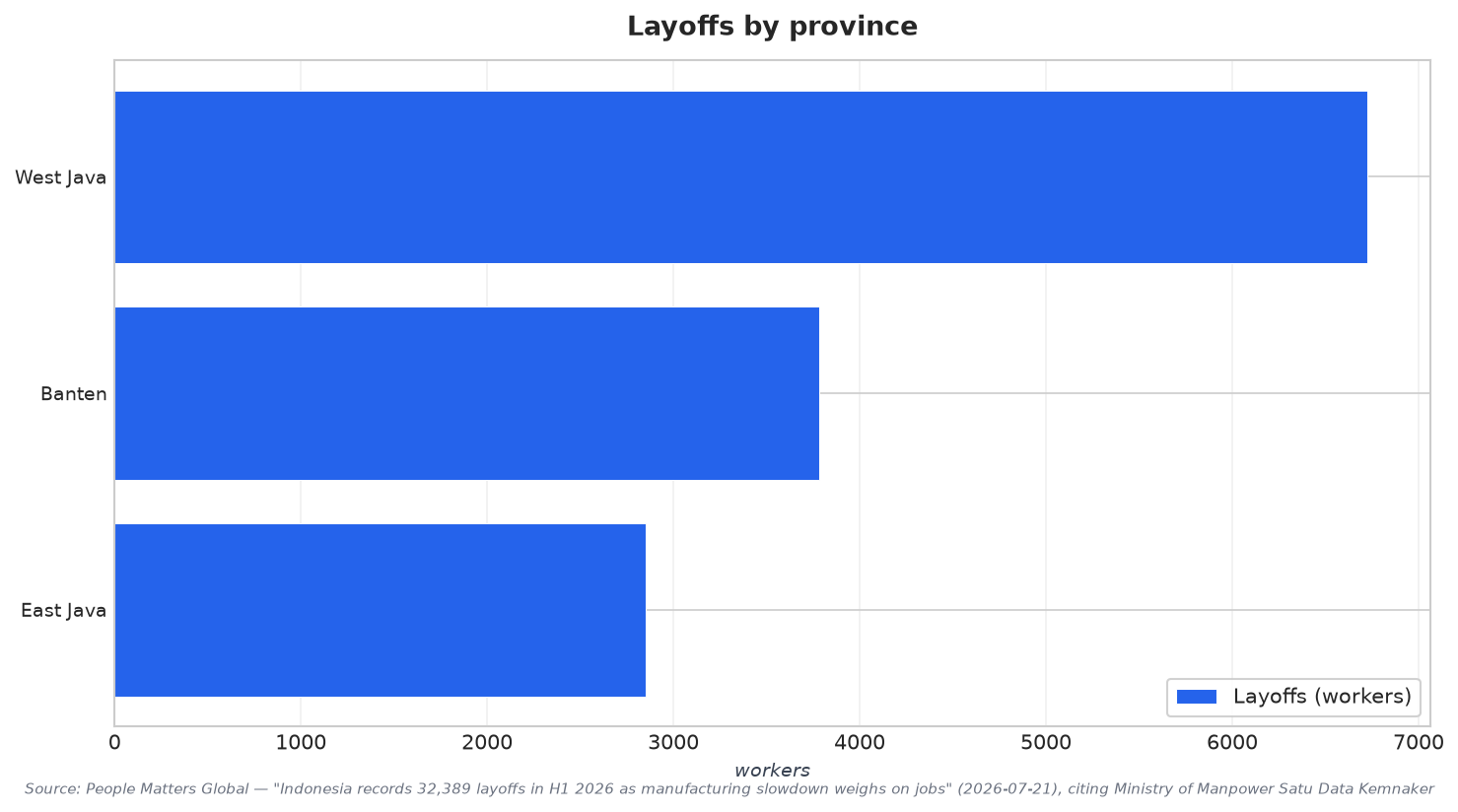
Where the layoffs concentrate also matters for workforce strategy. Between January and April 2026, West Java was the hardest-hit province with 3,339 affected workers, around 21.65% of the national total for that period. In the first half of 2026, West Java again led with 6,727 layoffs, or 20.77% of the national total, followed by Banten with 3,782 and East Java with 2,851. Earlier-month detail shows volatility: February 2026 recorded 6,610 layoffs, then 2,863 in March, with easing in April. Other provinces with significant January–April layoffs included South Kalimantan (1,581), Banten (1,536), East Java (1,367), East Kalimantan (1,237), and Jakarta (1,140), pointing to a mix of industrial and commodity-linked exposure.
What’s Driving the 2026 Layoff Wave: A Structural Stack
Multiple sources describe a business environment under severe, inter-related stress. Indonesia Investments cited weak demand from abroad, higher import prices for raw materials amid rupiah weakness, the impact of the Iran War disrupting logistics, and an unstable yet expensive supply of industrial gas. The same source reported that on 26 June 2026, the State Secretary and the Ministry of Manpower met the House of Representatives (DPR) and union leaders to form a Layoff Mitigation Task Force aimed at mapping industries in financial turmoil and identifying operational challenges to enable early mitigation. At that meeting, KSPSI president Andi Gani Nena Wa said his association’s data showed around 55,000 factory workers were at risk of being fired, underscoring how risk can extend beyond confirmed JKP-based reporting.
Company cases show how quickly demand and scheduling issues can translate into labor risk. Indonesia Investments reported that Feng Tay, an athletic footwear manufacturer in Bandung, West Java, almost had to lay off 4,000 workers out of around 15,000 after a temporary “gap order,” when a major production contract ended before the next global order cycle began. The report linked the decline in external demand to supply chain disruption and geopolitical tensions in the Middle East that delayed shipping and order timelines. After an urgent on-site inspection led by Special Advisor to the President on Labor Said Iqbal and the Ministry of Manpower, Feng Tay agreed to cancel planned layoffs and instead used a temporary cost-saving strategy, while the government reviewed tax relaxation measures to reduce immediate overhead. Separately, Pakerin in Mojokerto, East Java, reportedly mostly stopped operations across its cardboard packaging and caustic soda (NaOH) lines.
For workforce planners, the 2026 signal is also visible in macro and sentiment indicators. People Matters reported Bank Indonesia’s business survey showed employment continued to contract in Q2, with the labour utilisation index at 48.65 versus 48.76 in the prior quarter, and an expectation of 49.7 in Q3, still below the 50 threshold. S&P Global’s Indonesia Manufacturing PMI fell to 46.9 in June from 50 in May, reflecting deterioration tied to weaker new orders, softer domestic demand as price pressures eroded purchasing power, and the steepest export-order decline since August 2021. Indonesia Investments also listed Q2-2026 GDP growth at 5.29% (y/y), July 2026 inflation at 2.88% (y/y), and a BI Rate of 5.75% in August 2026. In response, Deputy Manpower Minister Afriansyah Noor said President Prabowo Subianto established a Layoff Task Force, and The Star reported the ministry was preparing reskilling with around 50,000 training slots available in 2026. For Indonesia layoffs 2026, the practical lesson is to build early-warning triggers tied to orders and logistics, use union collaboration to preserve flexibility, and treat reskilling as an operational continuity tool rather than a post-layoff benefit.
How many layoffs were recorded in Indonesia in the first half of 2026?
Which province was hit hardest by layoffs in early 2026?
What were key drivers behind the 2026 layoff wave in Indonesia?
What did the government set up to respond to Indonesia’s layoffs in 2026?
What does the Indonesia layoffs 2026 data miss?