Manufacturing cost planning in Indonesia starts with a simple constraint: there is no single nationwide wage floor. Minimum wages are set by province (UMP) and often by city or regency (UMK), and some provinces can set higher sectoral minimum wages (UMSP/UMSK) for specific industries. For 2026, published wage floors span roughly Rp 2.19 million to Rp 5.73 million per month, showing how different the baseline can be across locations. Because UMK must equal or exceed the provincial UMP, a plant’s exact address can change the legally required entry-level payroll assumptions. Underpayment is also described as a criminal offence, so cost planning and compliance planning are linked.
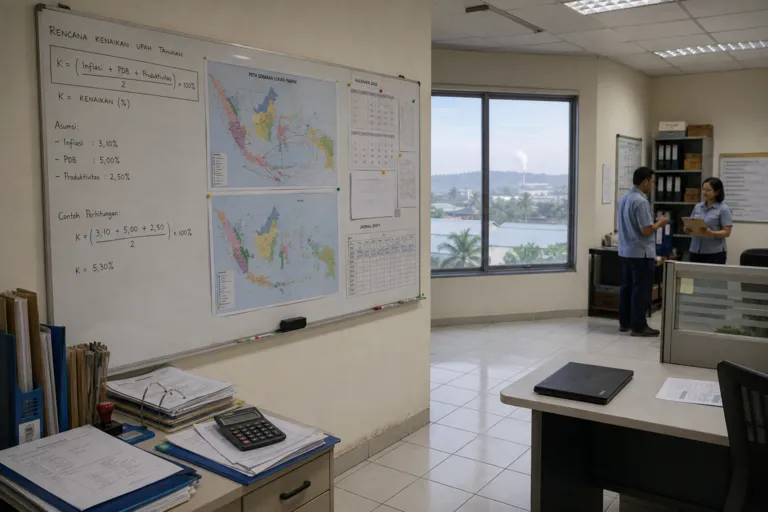
The 2026 adjustment mechanism adds another layer for forecasting. Under Government Regulation No. 49 of 2025, the annual increase is calculated as inflation plus economic growth multiplied by an alpha coefficient, with regional wage councils selecting an alpha within a stated range of 0.5 to 0.9. Multiple sources frame the practical outcome as roughly 5% to 7% increases for 2026, while another notes variation of approximately 5% to 8% depending on region. For manufacturers, that spread matters because it discourages using one Indonesia-wide escalation rate in multi-year cost models. Budget owners need province-by-province assumptions and should expect district-level differences where UMK applies.
What Regional Wage Gaps Mean for Plant Location and Headcount Models
Wage gaps can materially reshape location choice for labor-intensive manufacturing. Jakarta’s provincial minimum wage for 2026 is reported at IDR 5,729,876 per month, and one source describes this as approximately 130% to 150% higher than the wage floor in major manufacturing provinces that remain near the mid-IDR 2 million range. In a scenario with 500 entry-level workers, that differential alone is described as adding more than IDR 20–22 billion (US$1.3–1.4 million) to annual payroll before productivity or turnover is considered. Separate reporting also notes that Bekasi set Indonesia’s highest 2026 minimum wage at Rp 5.99 million, surpassing Jakarta and other major industrial regions, reinforcing that industrial corridors can carry premium wage floors.
Manufacturers also need to plan for how the minimum wage applies inside their workforce mix. One guide states the minimum wage applies only to employees with less than one year of service, while longer-tenured employees must be paid under a Structure and Scale of Wages (SUSU) that exceeds the minimum wage. If a factory budgets most roles at the minimum, it risks wage compression as tenure builds, making subsequent payroll adjustments more abrupt than expected. In practice, this means headcount plans should separate entry-level hiring from retained labor, and pay bands should be mapped to roles, seniority, and performance rather than anchored to the statutory floor alone.
Finally, cost planning should include enforcement-driven operational risk. One employer advisory notes the Ministry of Manpower has intensified enforcement across multiple regions and recommends updating payroll systems to reflect 2026 UMP and UMK rates. Another notes that new 2026 adjustments bring higher baselines, revised calculation formulas, and stricter enforcement expectations, particularly highlighted for Jakarta, Bali, and Lombok. Even in provinces described as more cost-competitive, changes still affect budgets: West Nusa Tenggara (NTB) is cited as having an approximately 2.73% provincial increase for 2026. For Indonesia minimum wage 2026 budgeting, the practical takeaway is to model labor costs by precise location, confirm whether UMK or sectoral rates apply, and build escalation sensitivity around the 0.5–0.9 alpha framework.
Does Indonesia have a national minimum wage for 2026?
What is Jakarta’s 2026 provincial minimum wage?
How does the 2026 wage formula affect manufacturing forecasts?
Why do UMK differences matter for factories hiring at scale?
How should manufacturers interpret the Indonesia minimum wage 2026 rules for tenure?